

The Rugby League World Cup is a great way to see the sport's best nations. But look at its history, and you'll see how it's changed, which countries have taken to the sport, and where it stands today. Here, we'll explore how the tournament started and how it came to be.
Key Takeaways
- France drove the creation of the Rugby League World Cup, with Paul Barrière playing a central role in turning the idea into the inaugural tournament.³
- The competition repeatedly changed its format, schedule and hosting model as international rugby league expanded beyond its original core nations.¹⁰
- Australia became the dominant force in the men’s tournament, but the modern era has brought stronger competition from nations including New Zealand, Tonga and Samoa.⁹
- Women’s and wheelchair World Cups were introduced in 2000 and 2008 respectively.⁷ The three competitions will again run concurrently at RLWC2026.⁸


How Did the Rugby League World Cup Begin?
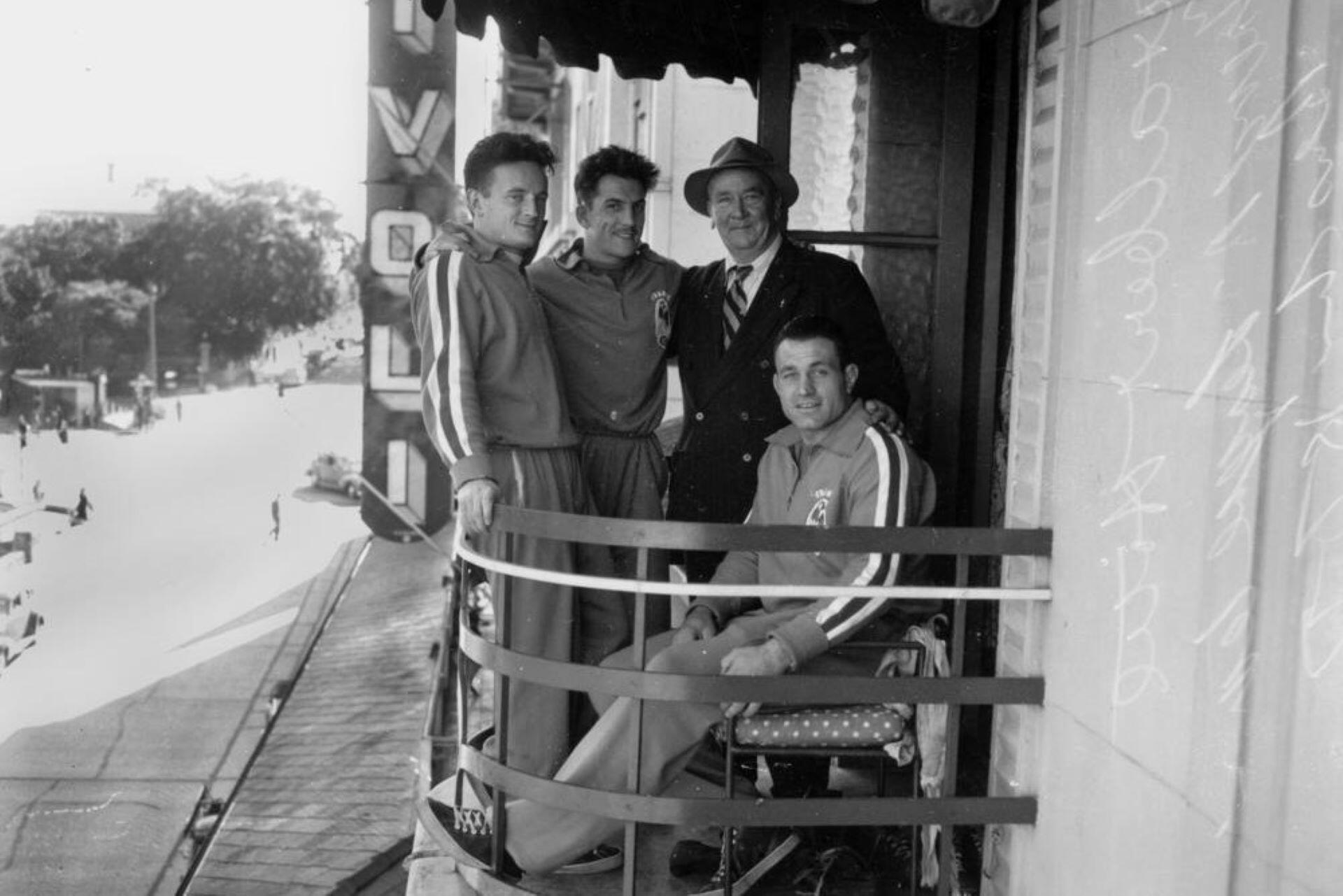
In France, rugby league had been suppressed under the Vichy regime.³After World War II, however, the sport came back, and France helped establish the Rugby League International Board in 1948.⁴ The team toured Australia in 1951, and it was clear that the team could compete at the top level.³ A World Cup was the country's way to turn momentum into international glory by crowning world champions.
The Rugby League World Cup began in France in 1954 with just four competing nations: Australia, New Zealand, France and Great Britain.¹⁰ Since then, the tournament has expanded in scale and scope, with men’s, women’s and wheelchair competitions now forming part of the international World Cup programme.⁷
Paul Barrière was a central figure in creating the Rugby League World Cup, campaigning for an international tournament while serving as president of the French rugby league federation.³ His contribution was later formally recognised when the World Cup trophy was renamed the Paul Barrière Trophy in 2016.²
The First Rugby League World Cup in 1954
While Test tours were the main way for rugby league nations to compete, the first Rugby League World Cup provided a decider. The event featured a compact structure and fewer teams than today's tournament.⁹ The crowds were enthusiastic and showed that there was public interest in the tournament.³
nations: Australia, New Zealand, France and Great Britain.¹⁰
The Early World Cups and Australia’s Growing Influence
Over the years, Australia rose to become the team other countries measured themselves against. Australia had a deep domestic game, and this was clear in the nation's international performances.⁹ By the 1970s, Australia was expected to do well in the Rugby League World Cup.
| Edition | Host arrangement | Format | Champion | What changed |
|---|---|---|---|---|
| 1954 | France | Four-team round robin followed by a final | Great Britain | The first World Cup established the original four-nation format and used a final to decide the champion. |
| 1957 | Australia | Four-team league, no final | Australia | The team finishing top of the standings became champion, with no separate final. |
| 1960 | United Kingdom | Four-team league, no final | Great Britain | The league-only format was retained for a second consecutive tournament. |
| 1968 | Australia and New Zealand | Four-team round robin followed by a final | Australia | A final returned, with Australia defeating France 20–2 in Sydney. |
| 1970 | United Kingdom | Four-team round robin followed by a final | Australia | The final remained, but the tournament returned to a single principal host region. |
| 1972 | France | Four-team round robin followed by a final | Great Britain | The final finished 10–10 after extra time, with Great Britain crowned champions because of their superior preliminary record. |
| 1975 | Matches played internationally | Five-team league, no final | Australia | England and Wales competed separately instead of Great Britain, and matches were spread across the year in several countries. |
| 1977 | Australia and New Zealand | Four-team competition followed by a final | Australia | The tournament returned to four nations and a shorter host-based format. |

Why Has the Rugby League World Cup Changed Format So Often?
The lack of a global calendar and a small pool of established national sides made it difficult to run a Rugby League World Cup for much of the 20th century. Organisers regularly shaped the World Cup around the teams, travel, and hosting opportunities rather than having a regular format.¹⁰ The sport was trying to balance meaningful international competition with the strength of its domestic leagues.
The Rugby League World Cup has never followed one permanent format, with different editions using round robins, finals, multi-country hosting and even competitions played over several years.¹⁰ The number of participating nations and the intervals between tournaments have also changed considerably as organisers adapted the competition over time.¹⁰
From Four Nations to a More Global Competition
Expansion came gradually. New entrants joined the World Cup as nations took to the sport and developed it. As Rugby League's map expanded, so did the tournament, even if it wasn't particularly continuous.¹⁰
1954
The first World Cup
France hosts the inaugural Rugby League World Cup after years of campaigning for an international tournament. Great Britain beat France 16–12 in the final in Paris.¹⁰
1975
A worldwide experiment
The competition expanded to five teams as England and Wales competed separately instead of as Great Britain. Matches are staged across several countries throughout the year, with Australia finishing as champions.¹⁰
1985–1988
A World Cup played over three years
Papua New Guinea joins a five-nation competition played on a home-and-away basis over three years. Australia defeat New Zealand 25–12 in the final at Eden Park.¹⁰
1995
The modern expansion begins
The World Cup grows to 10 teams, with Fiji, Tonga, Samoa and South Africa among the nations joining the main tournament. A parallel Emerging Nations World Cup also gives developing rugby league nations international competition.¹⁰
2000
Sixteen nations compete
The men's World Cup expands to 16 teams, then the largest field in the competition's history. Ireland, Scotland, Russia, Lebanon and the Cook Islands are among the newer participants.¹⁰
2008
Three World Cup pathways take shape
The men's tournament returns to Australia, while the first Wheelchair Rugby League World Cup is introduced.⁹ The women's competition, first staged in 2000, is also part of the increasingly broad international World Cup programme.⁷
2021–2022
The pandemic disrupts the cycle
RLWC2021 is postponed and eventually played in England in 2022, retaining its original name. The event brings the men's, women's and wheelchair competitions together concurrently.⁹
2026
A redesigned World Cup returns to the Southern Hemisphere
The next World Cup features 10 men's teams and eight teams in each of the women's and wheelchair competitions. Matches are staged across Australia, New Zealand and Papua New Guinea.⁸

The Modern Rugby League World Cup Era
From the 1990s onwards, the Rugby League World Cup tried to adopt a format in which teams progressed toward knockout matches.¹⁰ This was also an era where Australia's success was far less guaranteed. After all, New Zealand winning in 2008 and Tonga making the 2017 semi-finals showed that other nations were developing, too.¹⁰

The first Rugby League World Cup brought together only Australia, New Zealand, France and Great Britain in 1954.¹⁰ By the modern era, the competition had expanded to include nations from across Europe, the Pacific and beyond.¹⁰ Women’s and wheelchair tournaments also became part of the wider World Cup programme.⁷
Women’s and Wheelchair Rugby League Join the World Cup
Rugby League has also worked to bring the women's and wheelchair games more in line with the men's World Cup. The women's final was paired with the men's in 2017.⁹ In 2022, wheelchair rugby was put with the main World Cup event for the first time. Now, the three share a single platform.⁹

Women’s Rugby League World Cup
The women's competition began in 2000 and has since become a regular part of the international World Cup cycle. In 2026, eight women's teams will compete alongside the men's and wheelchair tournaments.⁷
Wheelchair Rugby League World Cup
The wheelchair competition followed in 2008, with England winning the inaugural tournament in Australia.⁹ The 2026 Wheelchair Rugby League World Cup will feature eight teams.⁷

RLWC2021, the Pandemic and the Move to 2026
Like many sporting events, COVID ultimately postponed RLWC2021. France later withdrew as host of the planned 2025 World Cup, prompting the IRL to rethink the international calendar.⁶ Australia was awarded the rescheduled 2026 tournament in July 2024, with Papua New Guinea included in the hosting plan.⁵ The 2026 event will now be staged across Australia, New Zealand and Papua New Guinea under a reduced format.⁸
Australia and New Zealand withdrew from the planned 2021 tournament over player welfare and safety concerns linked to COVID-19.¹ The World Cup was subsequently postponed by a year but retained the RLWC2021 name when it was played in England in 2022.⁹ The next World Cup was later shifted to 2026 as part of a wider international calendar reset.⁶
References
- ABC News. “Australia and New Zealand Pull Out of Rugby League World Cup in England Due to COVID-19 Concerns.” ABC News, 22 July 2021. https://www.abc.net.au/news/2021-07-22/australia-and-new-zealand-out-of-rugby-league-world-cup/100316074. Accessed 10 Sept. 2026.
- Fédération Française de Rugby à XIII. “Le Trophée de la Coupe du Monde portera le nom de Paul Barrière !” FFR XIII, 30 Mar. 2016. https://www.ffr13.fr/le-trophee-de-la-coupe-du-monde-portera-le-nom-de-paul-barriere/. Accessed 10 Sept. 2026.
- Fédération Française de Rugby à XIII. “Patrimoine.” FFR XIII. https://www.ffr13.fr/federation/patrimoine/. Accessed 10 Sept. 2026.
- International Rugby League. “About the IRL.” International Rugby League. https://www.internationalrugbyleague.com/about/about-the-irl. Accessed 10 Sept. 2026.
- International Rugby League. “Australia to Host Rugby League World Cup 2026.” International Rugby League, 24 July 2024. https://www.intrl.sport/article/202/australia-to-host-rugby-league-world-cup-2026-. Accessed 10 Sept. 2026.
- International Rugby League. “IRL Publishes 2023 Annual Report.” International Rugby League, 27 Feb. 2024. https://www.intrl.sport/article/134/irl-publishes-2023-annual-report. Accessed 10 Sept. 2026.
- International Rugby League. “Rugby League World Cup.” International Rugby League. https://www.internationalrugbyleague.com/competitions/rugby-league-world-cup. Accessed 10 Sept. 2026.
- International Rugby League. “IRL Rugby League World Cup 2026 Rules Confirmed.” International Rugby League, 29 Apr. 2026. https://www.internationalrugbyleague.com/article/711/. Accessed 10 Sept. 2026.
- Lenehan, Martin. “Story of the Cup: The Record Breakers and History Makers.” NRL.com, 15 Oct. 2022. https://www.nrl.com/news/2022/10/15/story-of-the-cup-the-record-breakers-and-history-makers/. Accessed 10 Sept. 2026.
- Rugby League World Cup. “Rugby League World Cup History.” Rugby League World Cup. https://www.rlwc2013.com/history/. Accessed 10 Sept. 2026.
Summarise with AI:
Did you like this article? Leave a rating!

 Loading...

