

Physicists seem to speak a language all their own, with just a few words of English thrown in. This makes the study of physics intimidating to the average student or physics enthusiast. But the language of physics is not that hard to grasp once you know the key terms. Here, we present the physics vocabulary you're likely to see in your physics textbooks1.


Absolute Zero
This temperature represents the total absence of heat; it is the lowest limit on the thermodynamic temperature scale. At this point, atoms stop moving, and molecular energy is virtually nil.
The Third Law of Thermodynamics states that it is impossible to lower a temperature to absolute zero through any physical process.
Acceleration
In physics, this term refers to the rate of change in velocity with respect to time. Acceleration has both magnitude and direction, making it a vector quantity. Acceleration is the cornerstone of Newton's Second Law of Motion. Every good online Physics course instils these laws as fundamental to the discipline.

Atom
We all know that atoms are the tiny building blocks of all matter. Crack an atom open, and we find electrons, protons, and neutrons. The study of atoms and their activity lies at the heart of physics study. Physicists identify atoms three different ways.
Classical Physics and Modern Physics
The study of the physical world stretches all the way back to Aristotle – and that’s just the recorded version. Who knows what phenomena sharp minds observed that has been lost to time? So, it comes as no surprise that physics study breaks into two main ‘eras’.
Classical physics
- physics theories developed before the early 20th century
- covers Newtonian mechanics, Maxwell's electromagnetism, and the laws of thermodynamics.
Modern physics
- emerged starting in the early 1900s
- addresses phenomena classical physics cannot explain
- grounded in the theory of relativity and quantum mechanics.
As long as your interest is piqued, why not discover other cool physics facts related to classical physics? You won’t believe how far back the study of our physical world goes.
Classical Mechanics
This term represents the study and analysis of objects visible to the naked eye, including planets, stars and galaxies. The 'modern' counterpart to classical mechanics is quantum mechanics, of course.
Energy
Typically, physics identifies energy as the ability to do work, but an actual definition of energy in physical terms remains out of reach. Energy can be changed into different forms: kinetic, potential, gravitational, thermal, sound, light, electromagnetic, and elastic.
According to this law, energy can never be created, nor can it be destroyed2.
Entanglement
Spooky action at a distance.
Albert Einstein to Max Born, 1947
This quantum theory phenomenon represents particles that interact with each other such that they become permanently dependent on one another’s properties and quantum states, even when far away from each other. Notably, Albert Einstein was very uncomfortable with the idea of measuring one particle, which could affect a different one, even though they weren’t close by.
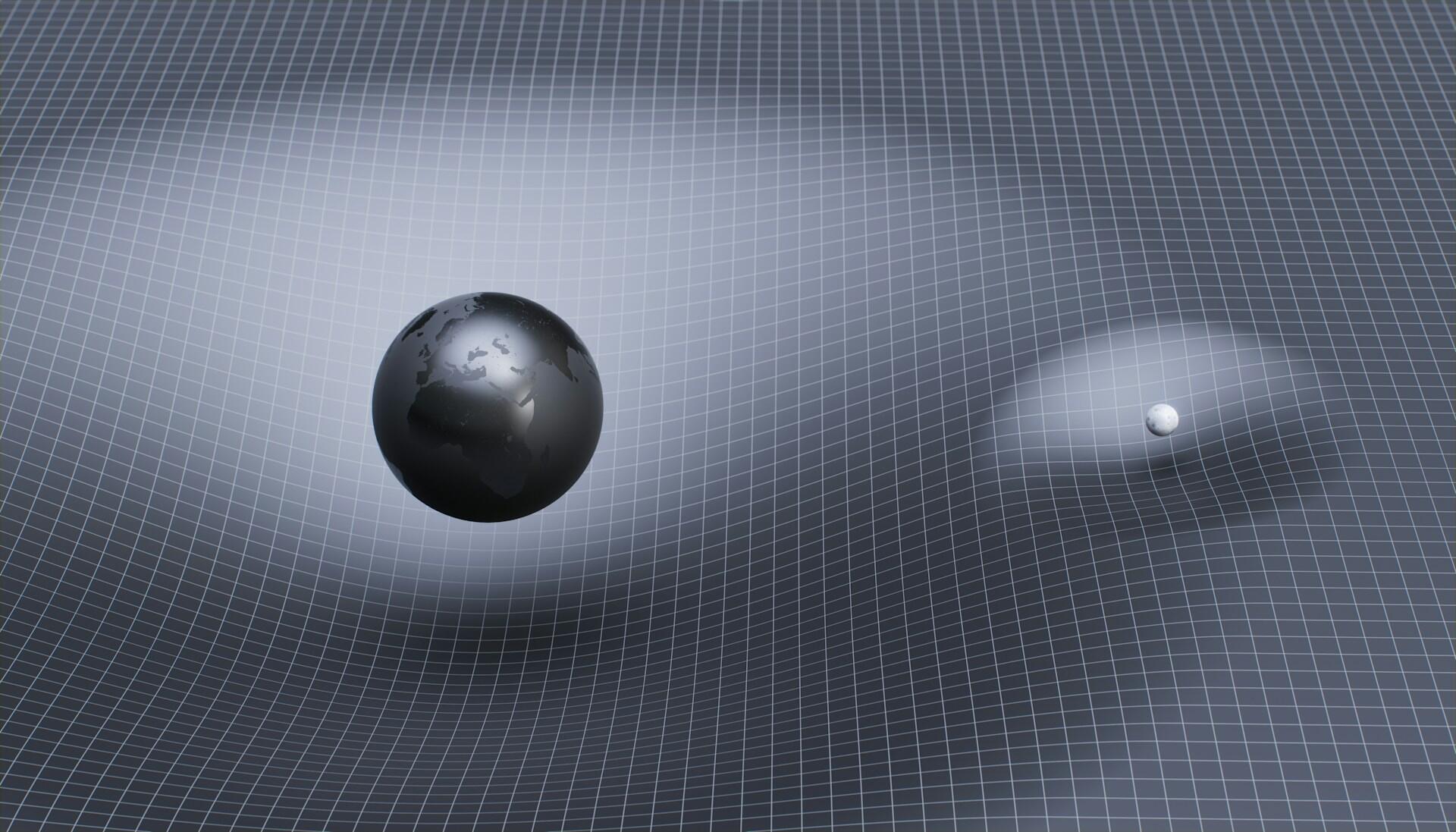
Einstein’s Relativity Theories
The average person might say ‘Einstein’s theory of relativity’, apparently unaware that Einstein gave us two foundational theories. Special relativity (1905) and general relativity (1915) form the cornerstone of all modern physics work.
Special relativity: physics laws are the same for all observers in uniform motion relative to one another. General relativity: expands special relativity to include accelerated motion and gravity.
Gravity
This term describes the attractive force between two masses. Gravity is one of the four fundamental forces, with the other three being:
electromagnetic force
strong nuclear force
weak nuclear force
Gravity exerts force on all bodies with mass, an essential factor in forming galaxies, planets, stars, and black holes. It's one of the key concepts in physics upon which the entire discipline rests.
Hawking Radiation
Sir Stephen Hawking proposed this theory in 1974. He based it on the idea that black holes lose matter through radiation over time, more than they gain matter through other means. The radiation of these featureless, random, and, so far merely postulated subatomic particles should cause a black hole to shrink and dissipate over time due to matter loss.

Inertia
A body at rest tends to stay at rest…
The First Law of Motion
Sir Isaac Newton’s First Law of Motion (1667) describes objects’ natural tendency to resist changes to their states of motion. When at rest, they want to continue resting, as the famous law points out. In physics, that is the definition of inertia. Conversely, when an object is in motion, it tends to stay in motion until another force acts on it to make it stop.
Isotope
An isotope is a possible form of an element. Two or more elements may have the same number of protons but vary in the number of neutrons in the nucleus.
Perhaps the most renowned of such elements is uranium-235. It's different from uranium-238 because it has 3 fewer neutrons, even though they are both uranium. You may engage the services of a Physics tutor Sydney to dive deeper into the physics behind isotopes if you live in NSW.
Mass
Physicists use this term to describe the amount of matter in a body. As a secondary usage, ‘mass’ expresses the degree of a body’s inertia or resistance to motion changes.
Mass describes the amount of matter in a body.
Weight describes the strength of gravity’s pull on the body.
That is why things weigh much less on the moon; it has hardly any gravitational pull!
Matter
This word describes anything that has mass and takes up space. Atoms, molecules, and everything in the known universe consists of matter. Matter exists in four states:
gaseous
liquid
solid
plasma
Within those four states, physicists find an astounding breadth and diversity of materials to study. The discipline has room for you, too, if you’re thinking about a career in physics.
Multiverse
Speculation rages in scientific communities and on enthusiast chatboards over the possibility of parallel universes. A persistent science fiction trope3, it presents the universe we inhabit as just one of a series. To date, the existence of a multiverse has not been conclusively proven. However, mathematics hints that a series of universes is a little more than possible.
Particle
Elementary particles have no substructure, meaning they are not made up of smaller particles. Particles are the building blocks of the universe; all other particles are made from elementary particles. The list of elementary particles includes:
- quarks
- electrons
- photons
- neutrinos
- muons
- gluons
Note that protons and neutrons are not elementary particles, despite being made of quarks. These are facts pioneering physicists and their discoveries established long ago.
Panspermia
Recent analysis of samples taken from the asteroid Bennu revealed it contained life’s building blocks: carbon, water, phosphates, and the building blocks for DNA and RNA. This explosive discovery reignited discussions of panspermia4, the hypothesis that all the ingredients for life are scattered throughout the universe.
Panspermia is a more limited theory of exogenesis, which states that life must have come from elsewhere in the universe.
Quantum
This word is used a lot in physics, from describing discrete fields of study (quantum chromodynamics) to delineating entire branches of physics, such as quantum field theory. Used by itself, quantum represents the smallest possible unit anything can be divided into: at the quantum level, e.g.
Quark
You might know this word as the name of a dairy product but, in physics, it represents an elementary particle. Physical quarks come in 6 'flavours': up, down, top, bottom, charm and strange. Quarks always feature in configurations of three: one up/two down; two top/one bottom and so on.
Any time you hear 'quark', 'hadron, 'boson' or 'fermion', you know those names represent classes of subatomic particles.
Quasar
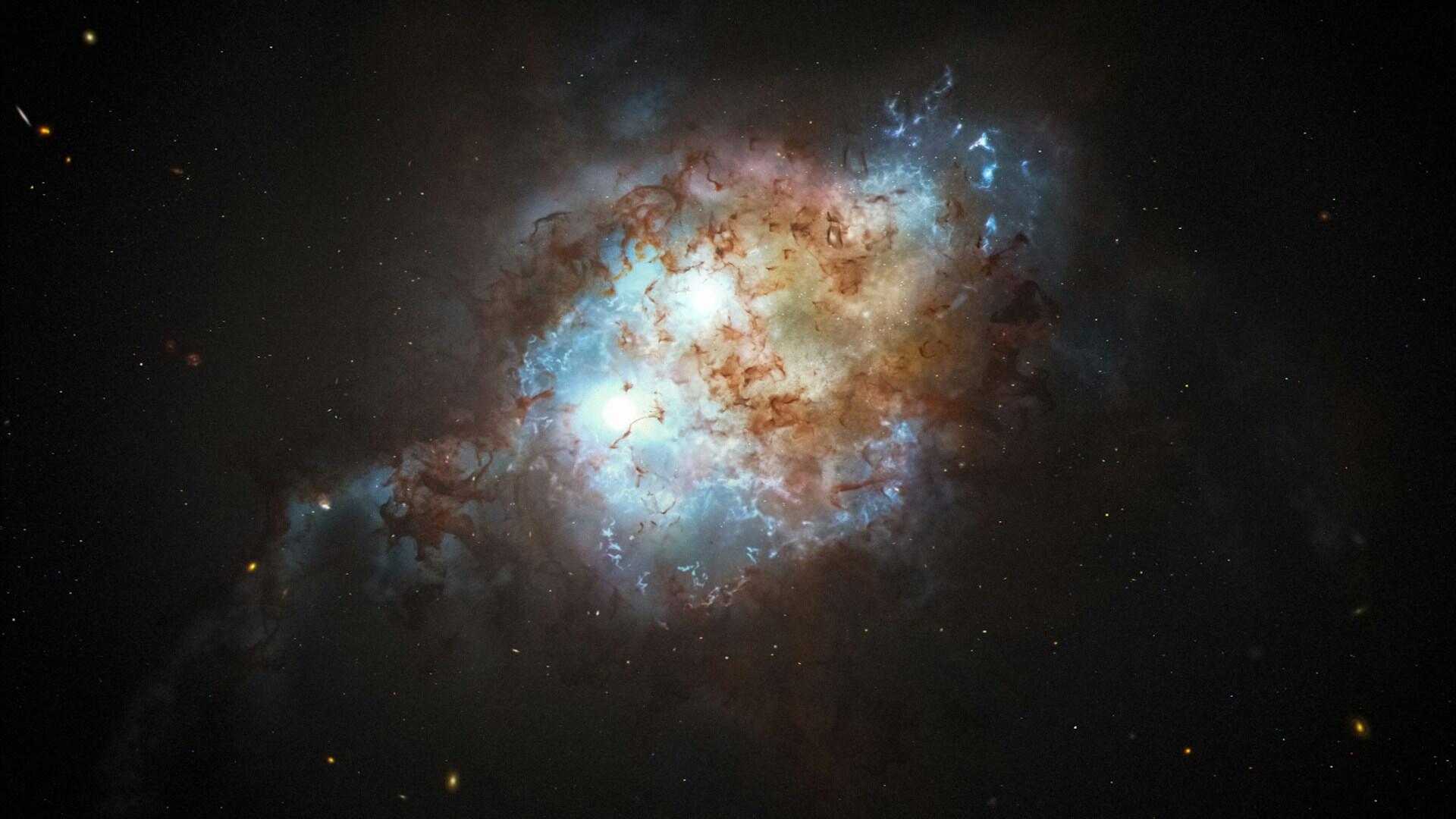
These bodies are very powerful galactic nuclei which get most of their energy from high-temperature matter that swirls into supermassive black holes.
Quasars are the most powerful objects in the known universe.
One quasar can generate as much light as 100 standard galaxies.
They are among the most distant things physicists have seen.
Thermodynamics
This is the branch of physics that deals with very general properties of energy and matter. It addresses temperature in relation to energy and work (work in the physical sense, not the type of work we do to earn our money.)
Waves
We tend to think of waves as something the ocean generates or something we do with our hands, but physicists associate waves with any disturbance that transfers energy through matter or space. Waves can be either a vibration or an oscillation, of a physical medium or of a field, around essentially fixed locations. The two main types of waves are mechanical or electromagnetic.
Careers in Physics
Choosing a career in physics will give you plenty of opportunity to use every bit of physics vocabulary you know and learn more, besides. These are the top physics branches students aspire to work in.
As our presenter said, physics is a maths-heavy discipline. If this is a subject you struggle in, you may need a maths physics tutors to help you understand the maths behind these physics terms.
You may then make your mark in these or another branch of physics. Perhaps someday, through your hard work, you may get to name a vital element or particle that future students will have to learn about5.
Beyond the Physics Dictionary
- Cliff Notes. “Tools & Resources: Physics Glossary | Test Prep | CliffsNotes.” Cliffsnotes.com, 2026, www.cliffsnotes.com/test-prep/high-school/tools-and-resources/physics-glossary. Accessed 25 Feb. 2026.
- Monash University. “Welcome to Zscaler Directory Authentication.” Monash.edu, 2025, www.monash.edu/student-academic-success/physics/relationships-between-force. Accessed 25 Feb. 2026.
- Spoors, Gavin . “Why Is the Multiverse so Popular in Sci-Fi at the Moment?” Space.com, 16 Mar. 2022, www.space.com/why-is-the-multiverse-so-popular-in-sci-fi. Accessed 25 Feb. 2026.
- Simms, Chris. “Asteroid Bennu Carries All the Ingredients for Life as We Know It.” New Scientist, 2 Dec. 2025, www.newscientist.com/article/2506650-asteroid-bennu-carries-all-the-ingredients-for-life-as-we-know-it/. Accessed 25 Feb. 2026.
- “Glossary of Terms - the Physics of the Universe.” Www.physicsoftheuniverse.com, www.physicsoftheuniverse.com/glossary.html. Accessed 25 Feb. 2026.
Summarise with AI:
Did you like this article? Leave a rating!

 Loading...