

A lot of learners dread studying physics; it's hard to understand why. Sure, this subject includes maths and some pretty weighty topics, but it's interesting, too. Perhaps you live in Brisbane and have a VCE Physics tutor who's introduced you to physics fun facts. Or maybe you're waiting for an article like this to show you how fascinating physics can be.
Interesting Physics Facts
- Light acts in two ways: as a wave and a particle.
- Time is different in space than it is on Earth.
- Water slows down the speed of light.
- Your smartphone screen activates when it senses the electrical charges your finger emits.


The Truth About Matter and Light
We take it for granted that light and matter are all around us. The smallest particles - the protons, electrons, and neutrons that make up the atoms - power, guide, and shape everything we have and do. We know all that thanks to centuries of dedicated physicists, but light and matter have a few more secrets to spill.
Atoms Are Mostly Empty Space
Just like everything else across the cosmos, we are all made up of atoms: protons, electrons and neutrons... and a whole bunch of empty space1. In fact, the space between particles is a key concepts in physics.

But if we were to somehow remove that space in every human body, the mass of humanity (~8.3 billion people) would be about as big as a cube of sugar. That cube would be incredibly heavy because it would be extremely dense.
Space exists in the same condition. What we can see comprises only about 5% of the whole universe. It’s not that we need better telescopes or equipment. It’s just that most of the universe is empty space. Astrophysicists believe it's filled with dark energy and dark matter. Not that anyone's ever seen it, but plenty of evidence exists to make this a valid theory.
And then, we have black holes. The general relativity theory predicts that a sufficiently compact mass, perhaps one with all of the space sucked out from its atoms as described above, can deform spacetime. That would cause such a gravitational pull that nothing, not even light, could escape it.
Light's Dual Nature
Light is light: formless, shapeless, and all around. Matter is also all around, but it's tangible. So, clearly, matter and light are two different constructs, right?
Matter
- has mass and occupies space.
- is made of atoms.
- Atoms are made of electrons, neutrons, and protons.
Light
- is made up of particles called photons.
- It has no mass, cannot be contained, and does not take up space.
Still, for all their fundamental differences, light and matter interact in several ways. For instance, matter can absorb light when it returns to lower-energy states. That's how light-emitting diodes (LED) work. You might also have heard about the photoelectric effect, wherein light ejects electrons from materials. That's how solar panels produce electricity.
Albert Einstein's equation expresses the principle of mass-energy equivalence.
That's a fancy way to say that mass and energy are interchangeable.
The world's most famous equation takes us to the concept of wave-particle duality. This is a quantum mechanics principle which states that fundamental entities existing in the universe may act like particles or waves, depending on the conditions.
Though the mass-energy equation is not directly related to the wave-particle duality, it lays the foundation for understanding this advanced concept. We have so much to thank physicists and their discoveries for, not the least of which is the deeper understanding of the quantum world.
Time And Relativity
Thanks to the remarkable mind that produced the elegant equation noted in the last chapter, everyone knows a bit about the theory of relativity. Those with more of a science history mindset also know about the long-running discussion Einstein had with the French philosopher Henri Bergson. As you might guess, it revolved around time and relativity2.
The Effects of Time Dilation
Those two thinkers' very public debate revolved around the concept of real time. Each approached the question, "What counts as real time?" from their respective positions. Bergson saw time in relation to the human experience; Einstein considered that position trivial, arguing that time is relative, based on the observers' frame of reference.
They were both right.
In fact, they both argued the same point, only from different perspectives.
Supporting Einstein's position, we find the concept of time dilation. This phenomenon describes time passing at different rates for observers in different states of motion. Going further, we can assert that time passes at different rates depending on the strength of the gravitational field it's in.
In a weak gravity environment such as space, time runs faster. The inverse is also true: in stronger gravity environments, time runs slower. Atomic clocks, positioned at different altitudes around the Earth - at different levels of gravitational pull, show measurable differences in time, thus proving the theory.
Your feet, being closer to Earth's gravitational pull, experience slower time than your head, which is further from Earth's gravity.
Practical Applications of Time Dilation
Do your feet care that they're behind your head's time? They probably don't even notice, because the difference in altitude (your height) is far too small to be significant.
But, as you might have learnt in your online Physics course, one common application we all rely on is all about that time difference.
In our high-tech world, global positioning satellites (GPS) monitor and direct everything from cargo ships and aircraft to where we drive our cars. Orbiting roughly 20,200 kilometres (km) above the Earth's surface, time is much faster for them than for the Earthbound mechanisms they direct.
To complicate matters, satellites travel very fast, around 3.8 miles per second, relative to Earth.
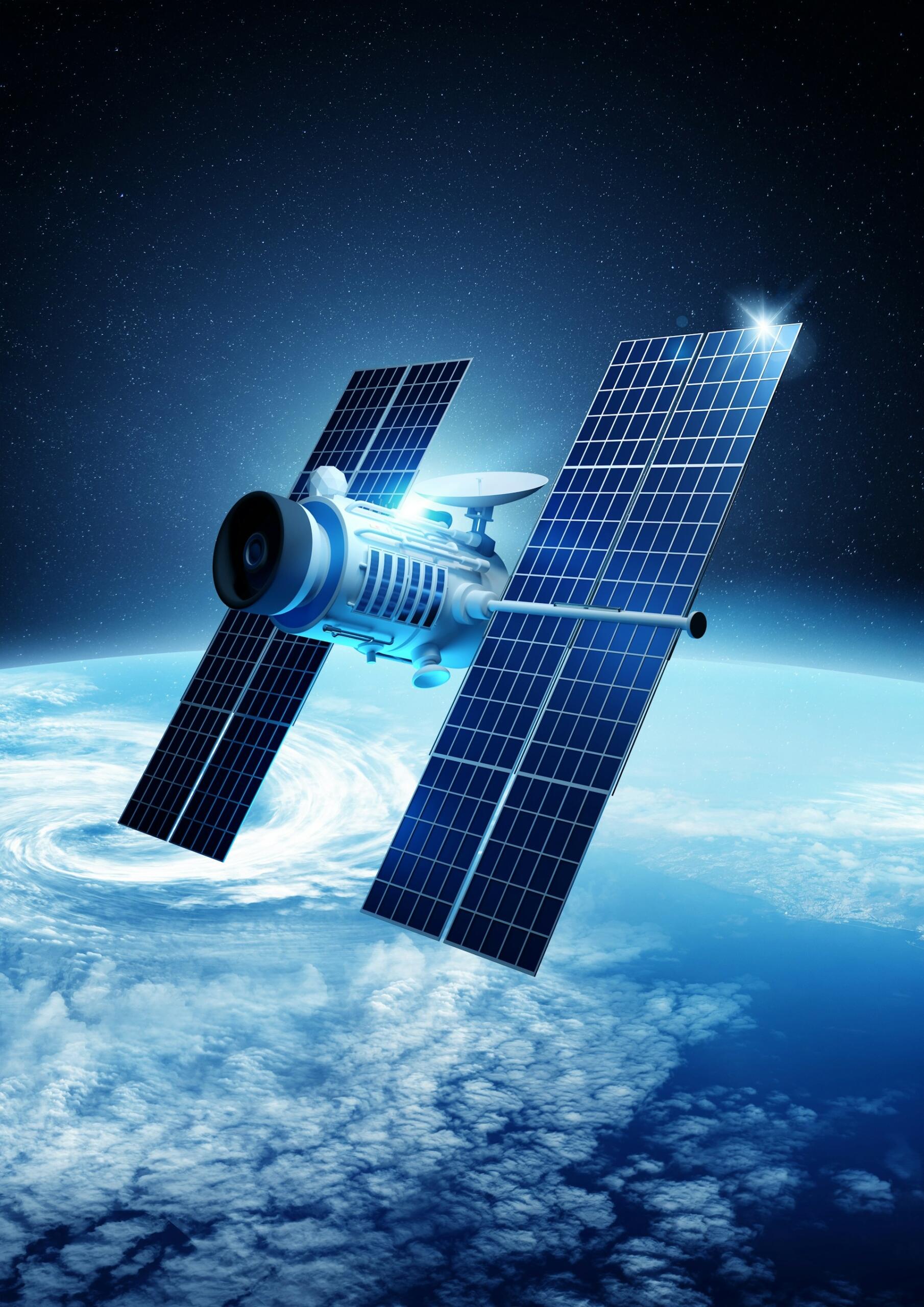
Recall above, where you read that time passes differently for observers in different states of motion? Satellites' motion has a slowing effect on their timekeeping processes.
Without time adjustments, satellites would lose roughly 10km of positioning per day, which would make the system obsolete in a matter of minutes.
That neatly explains all those news stories about people following GPS instructions into bodies of water, doesn't it? Still, the system is (mostly) reliable, thanks to their clocks being set to run slower before they're launched. Just don't take your eyes off the road or accept GPS directions as the gospel truth!
Physical Wonders We Use Every Day
GPS counts as such a wonder, of course, but we have a closer, more accessible device to marvel over. Our smartphones literally put a world of information at our fingertips. As you learn all about physics, that assertion becomes true in more ways than one.
: here. other for maths now
The Science Behind Touchscreens
Have you ever wondered how touching your phone’s screen makes your device do things?

Humans are electrical beings. Our bodies carry positive and negative charges that send messages along our nervous system, regulating our heartbeat and protecting individual cells. These charged ions manifest visibly when we touch something with an opposing electrical charge.
Our phones react to our bodies' ionic current, which repels the like-charged electrons in the phone’s screen. This causes the electrical circuit at the point of contact to open.
That, in turn, powers a programmed sensor to perform the action coded in the phone’s software.
Our phones' touchscreens are capacitive. The screens sense our electrical field through the changes our touch makes to the device's electrostatic field.
By the way, you can get a physical manifestation of your body's electrical powers. Simply walk across a carpet in stockinged feet. Doing so generates a buildup of electrons that discharge when you touch something with an opposite charge, such as a metal door handle. Note that the effect is stronger in colder temperatures, as any physics teacher would tell you.
What is Cherenkov Radiation and How Do We Generate It?
In 1934, Russian physicist Pavel Cherenkov noted an unusual phenomenon. He was preparing an experiment for his doctoral thesis that involved a radioactive preparation in water. He saw a faint, bluish light emitting from around the prepared material.
Now, we all know that light behaves differently as it travels through water. The phenomenon is called refraction; it's why things look distorted when you look at them through water3. But that's only incidental to the Cherenkov Radiation effect.
Light travels more slowly through water but charged particles from nuclear reactions move faster than the slowed-down light. When those particles move, they disturb the electromagnetic field they travel through. This causes molecular polarisation, and when those molecules return to their normal state, they emit particles of light.
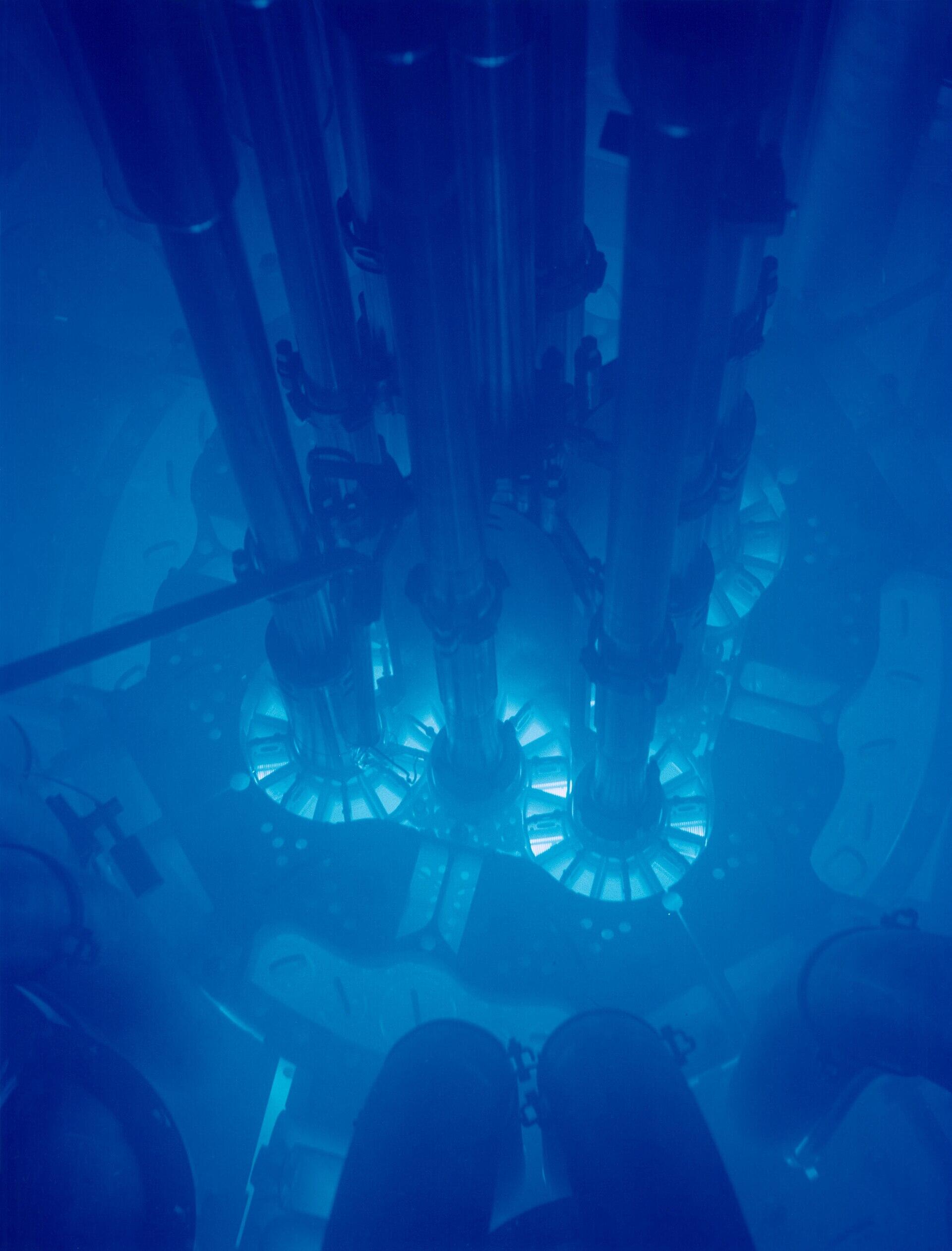
Cherenkov sprang on this discovery. He wrote his thesis on his findings, for which he won the Nobel Prize in 1958 (along with two other physicists). You may need to consult a physics glossary to understand some of the terms he used in his text but today's physicists have no problem building on his work.
In medicine: medical imaging, tumour detection and cancer treatment.
In particle physics, to detect and identify high-energy particles.
In astrophysics, to detect neutrinos and cosmic rays.
References
- Sundermier, Ali. “The Particle Physics of You.” Symmetry Magazine, 2015, www.symmetrymagazine.org/article/the-particle-physics-of-you. Accessed 23 Feb. 2026.
- Thompson, Evan. “Who Really Won When Bergson and Einstein Debated Time? | Aeon Essays.” Aeon, Aeon Magazine, 30 Sept. 2024, aeon.co/essays/who-really-won-when-bergson-and-einstein-debated-time. Accessed 23 Feb. 2026.
- Smith, Liam . “Refraction, the Magical Manipulator of Light. Why Objects Look Different When Looking through Water | IX Water.” Ixwater.com, 2023, ixwater.com/refraction/. Accessed 24 Feb. 2026.
Summarise with AI:
Did you like this article? Leave a rating!

 Loading...