


The National Rugby League ends the season with an exciting finals series. However, for those new to the sport, it can be quite confusing how this all works. Here, we'll explain how the NRL finals system works, how teams qualify, and how the finals format eventually produces the two teams that compete in the Grand Final.



How Teams Qualify for the NRL Finals
In Rugby league in Australia, before the teams get to the NRL Finals, they have to play the NRL Regular season. This determines which clubs qualify and where they'll be placed on the ladder. Teams play multiple regular-season matches.⁶
teams competing in the current NRL season.
A win is worth 2 points, a draw is worth 1, and a loss doesn't come with any points. Points are accumulated through the season, and teams are ranked on a ladder. Teams that finish on the same points are separated by points differential: how many points they have scored versus how many they have conceded.⁵
At the end of the regular season, the top 8 teams qualify for the NRL finals series. The teams outside the premiership contention are eliminated. These teams are effectively done for the season and will have to look forward to next season for another shot at the premiership. The higher a team finishes, the better their position for the finals.⁵
The team that finishes first on the NRL ladder at the end of the regular season is known as the Minor Premiers. This title recognises the club that performed best across the entire regular season by finishing at the top of the standings. While the Minor Premiership is an achievement in its own right, it does not decide the overall champion. The NRL premiership is only awarded after the finals series concludes with the Grand Final. In other words, the Minor Premiers were the best team during the regular season. However, they must still win through the finals to become NRL champions.
The NRL Top-8 Finals System Explained
The NRL Finals series is a four-week playoff tournament to decide the premiership winner. This is known as the NRL Top-8 system. The idea is that teams that perform well are rewarded while lower-ranked finalists still have a chance.²
teams qualify.
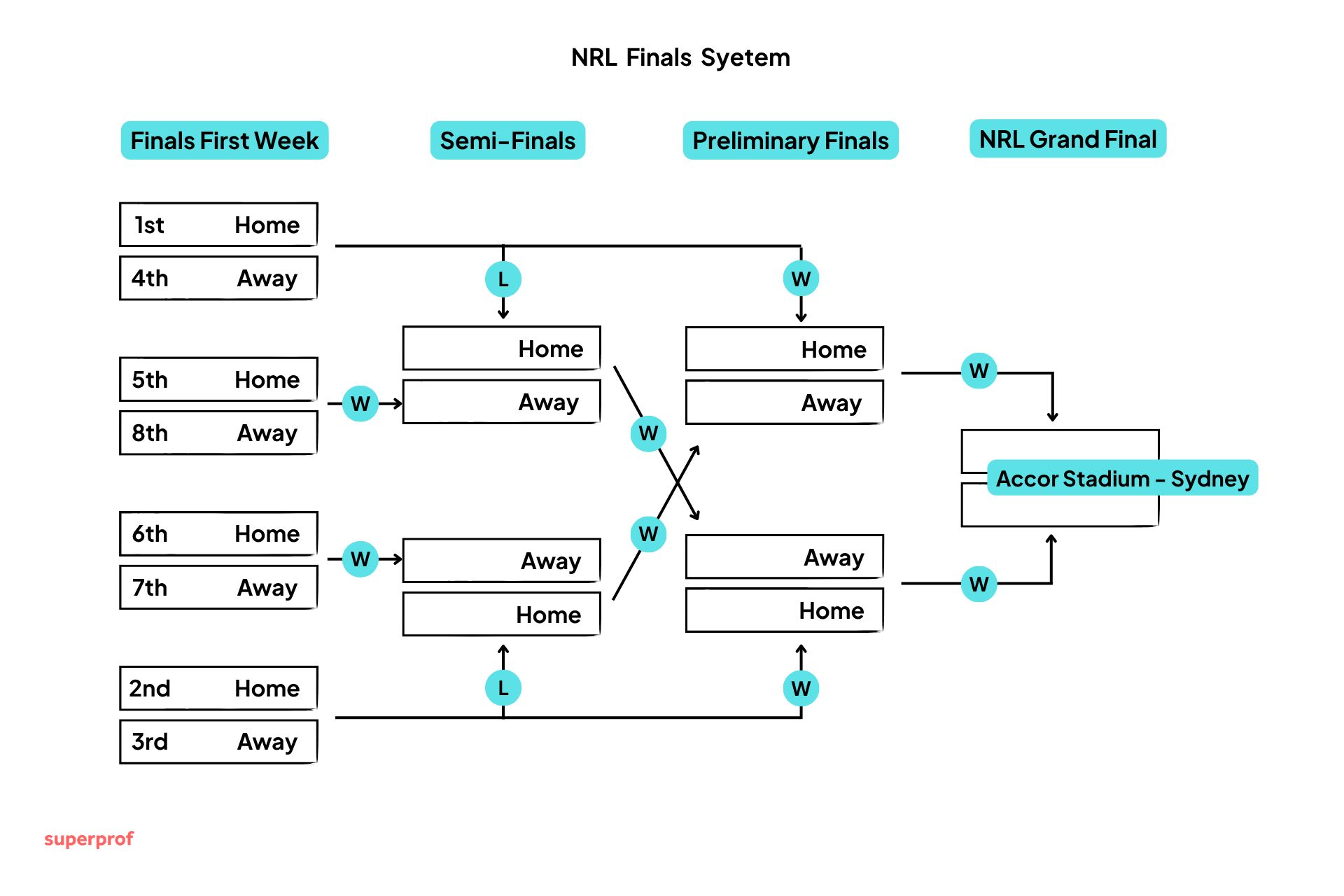
The NRL finals system uses a Top-8 playoff format. The eight highest-ranked teams at the end of the regular season enter a four-week finals series. Teams ranked 1st to 4th receive a “double chance”, meaning they can lose their first finals match and still remain in the competition. Teams ranked 5th to 8th play sudden-death matches from the start, so one loss eliminates them immediately.²

Week 1: Qualifying Finals and Elimination Finals
The first week of the NRL finals has two types of matches: qualifying finals and elimination finals. These games decide which teams move forward and which NRL teams are eliminated. This sets up the matchups for the following week.⁴

Qualifying Finals
Elimination Finals
Week 2: Semi-Finals
The second week of the NRL finals features the semi-finals. These teams are all vying for their spot in the Grand Final. The losers of the qualifying finals from Week 1 face the winners of the elimination finals. The qualifying final losers host the matches and are given another opportunity to remain in the finals due to their top-four finish in the regular season. At this point, the semi-finals are sudden-death matches. There are no second chances, and the losing teams are eliminated from the finals series.⁷
The naming of the NRL finals rounds can confuse new fans. In many sports, semi-finals are played when only four teams remain. In the NRL system, however, the semi-finals take place in Week 2 while six teams are still in the finals series. Only four of those teams actually play that week. The two teams that won their qualifying finals in Week 1 receive a bye and advance directly to the preliminary finals. Meanwhile, the two qualifying final losers play the winners of the elimination finals in the semi-finals. Because these matches decide which teams progress to the next stage before the preliminary finals, the NRL still refers to them as semi-finals, even though the tournament has not yet been reduced to four teams.
Week 3: Preliminary Finals
Here is where it gets confusing. The NRL calls the qualifying rounds the finals and the semi-finals, but here we're down to the last four teams. The two qualifying final winners from Week 1 skip Week 2 and face off against the semi-final winners. This is because the qualifying winners finished higher on the ladder. Preliminary finals are also sudden-death games, with the losing teams eliminated. The ultimate 2 winners will progress ot the NRL Grand Final, which decides the premiership winner.⁸

Week 4: The NRL Grand Final
The final week of the final series is called the NRL Grand Final. This match decides the premiership winner. It's the most important match of the NRL season. The winner is crowned the NRL premiers for that year. The team is given the Provan-Summons Trophy, the official premiership trophy, and will forever be remembered in the history of rugby league in Australia.¹
The NRL Grand Final is usually held at Accor Stadium in Sydney, Australia. The match takes place on the first Sunday in October and decides the NRL premiership winner for the season. It is one of the biggest sporting events in Australia. It attracts tens of thousands of spectators and millions of television viewers.

Why the NRL Finals Format Rewards Top Teams
The NRL finals format rewards teams that perform well during the regular season, giving players across all Rugby League positions a chance to shine. The teams that finish higher on the ladder gain advantages in the tournament, improving their chances of reaching the Grand Final.²
The top four teams have a double chance. If they lose their qualifying final in Week 1, they go to the semi-finals in Week 2. However, the teams ranked fifth to eighth play a sudden-death match in their first finals match.²
The higher-ranked teams are also given hosting rights during the final. This means they can play in front of their home crowds. For many teams, securing a top-four finish on the ladder is crucial if they want to win the premiership.²
References
- Bets.com.au. “How the NRL Finals System Works.” Bets.com.au, 28 Jan. 2026, https://www.bets.com.au/nrl/nrl-finals/nrl-finals-system-20260128-0012/. Accessed 13 Mar. 2026.
- Bet365 News. “How Do the NRL Finals Work? Qualification, Structure and Format Explained.” bet365 News, 10 Mar. 2025, https://news.bet365.com/en-gb/article/how-do-the-nrl-finals-work/2024081410174016878. Accessed 13 Mar. 2026.
- Ladbrokes Australia. “NRL Finals System and Schedule.” Ladbrokes Blog, https://www.ladbrokes.com.au/blog/betting-info/nrl/finals/. Accessed 13 Mar. 2026.
- Love Rugby League. “NRL Finals Format Explained: How Do the NRL Finals Work?” Love Rugby League, 22 June 2023, https://www.loverugbyleague.com/post/nrl-finals-format-explained-how-do-the-nrl-finals-work. Accessed 13 Mar. 2026.
- NRL Media. “How to Make the Finals.” NRL.com, 21 July 2016, https://www.nrl.com/news/2016/07/21/how-to-make-the-finals/. Accessed 13 Mar. 2026.
- Rugby League Rookie. “How the NRL Season Works.” Rugby League Rookie, https://rugbyleaguerookie.com/nrl-season-format/. Accessed 13 Mar. 2026.
- Sporting News. “NRL Finals 2025 Layout: How Does the Finals Format Work?” Sporting News, 5 Oct. 2025, https://www.sportingnews.com/au/rugby-league/news/nrl-finals-2025-layout-how-does-finals-format-work/063a42f42d3307fc71409df9. Accessed 13 Mar. 2026.
- The Roar. “NRL Finals Format Explained: How Do the NRL Finals Work?” The Roar, https://www.theroar.com.au/rugby-league/nrl/nrl-finals-format-explained-how-do-the-nrl-finals-work/. Accessed 13 Mar. 2026.
Summarise with AI:
Did you like this article? Leave a rating!

 Loading...
