
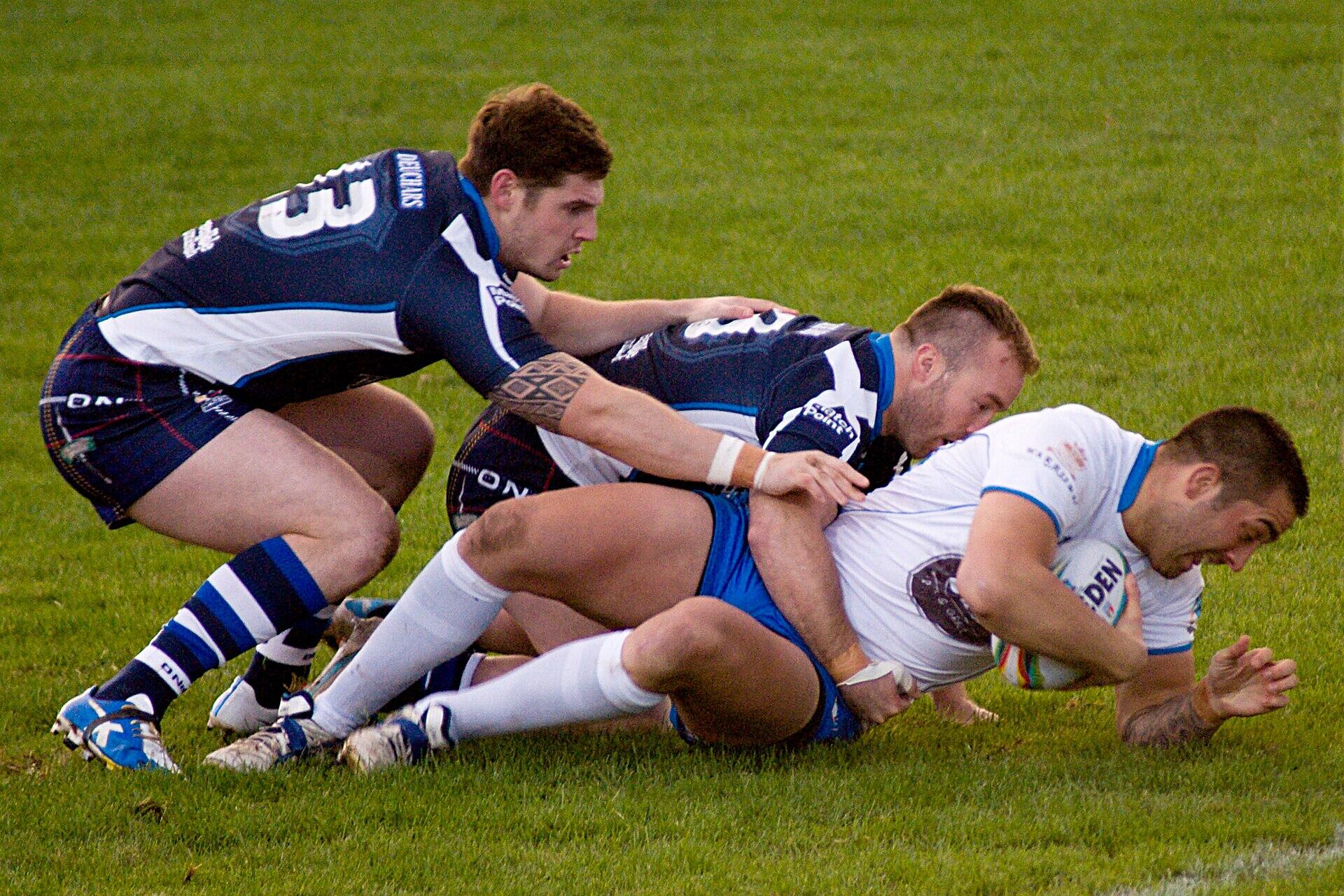

Rugby league teams in the National Rugby League (NRL) play with 13 players on the field.¹ Each has a specific role during attack and defence. These NRL positions are traditionally numbered from 1 to 13 and divided into backs and forwards.² If you're new to the sport, here's our guide to the various positions.
| Position | Typical Numbers | Category | Key Role |
|---|---|---|---|
| Fullback | 1 | Backs | Fields kicks, supports attack, last line of defense |
| Winger | 2, 5 | Backs | Finishes tries, speed on edges, sideline defense |
| Centre | 3, 4 | Backs | Breaks defensive lines, creates space, marks opposing centres |
| Five-Eighth | 6 | Halves | Creative playmaker, supports halfback, attacking structure |
| Halfback | 7 | Halves | Main organizer, kicking game, directs team strategy |
| Hooker | 9 | Spine | Distributes from dummy half, quick decisions, controls tempo |
| Prop | 8, 10 | Forwards | Powerful carries, gains meters, heavy defensive workload |
| Second Row | 11, 12 | Forwards | Strong runners on edges, tackle heavily, support attack |
| Lock | 13 | Forwards | Link between forwards & backs, ball distribution, defensive leader |



Rugby League Positions Diagram
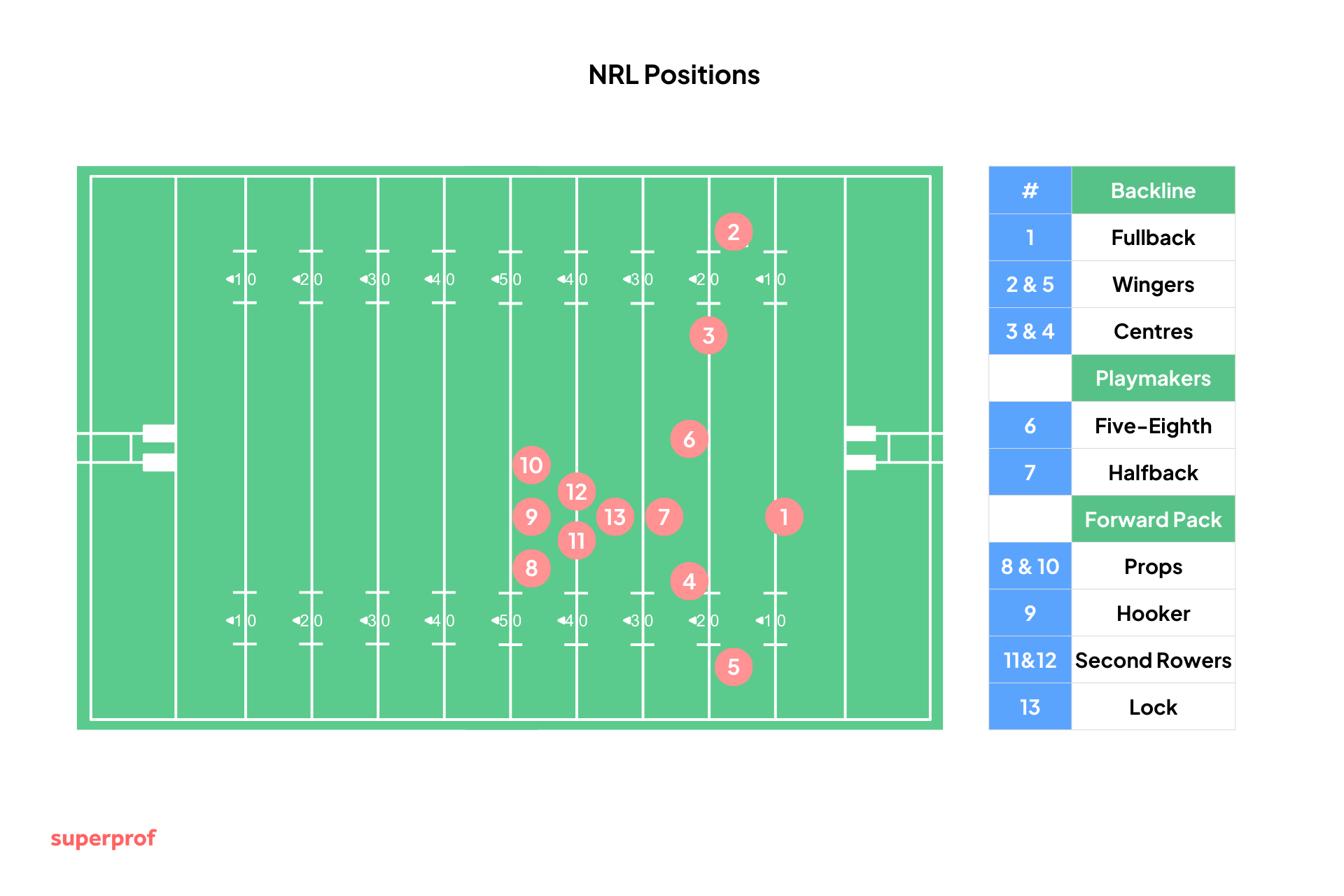
How to Read the Layout
Backline (Speed & Attack)
- Fullback (1): Positioned behind the main line, covering the entire field
- Wingers (2 & 5): Hug the sidelines on each edge
- Centres (3 & 4): Inside the wingers, key strike runners
Playmakers (The Spine Core)
- Five-Eighth (6): Slightly left or right of centre, attacking creator
- Halfback (7): Central organiser, often first receiver
Forward Pack (Middle & Edges)
- Props (8 & 10): Front and centre, driving the ball forward
- Hooker (9): Directly behind the play-the-ball (dummy half role)
- Second Rowers (11 & 12): On the edges of the forward pack
- Lock (13): Central link between forwards and backs
Backs vs Forwards in Rugby League
In rugby league, the 13 players are divided into backs and forwards.² Backs are usually responsible for speed, creativity, and finishing attacking plays, while forwards are all about strength, tackling and gaining territory with powerful runs.³ You'll see backs playing wider across the field. Together, the two groups work as a unit. To oversimplify, forwards create opportunities and backs use space and speed to turn chances into points.
Unlike rugby union, which uses 15 players, teams in the National Rugby League field 13 players at any time.¹
Differences Between Backs and Forwards
Jersey number
Backs usually wear 1–7, while forwards wear 8–13, reflecting their traditional NRL field positions.²
Scrum roles
Forwards usually pack into the scrum while backs line up outside it, ready for the next attacking play.⁴
Tactical roles
Backs focus on speed, passing, and finishing attacking moves, while forwards concentrate on tackling, ball carrying, and gaining territory through the middle.
Fullback (No. 1)
Throughout the history of rugby league in Australia, the fullback has typically stood behind the defensive line. Fullbacks watch the play develop across the field. When the opposition kicks the ball, it's often the fullback who catches it and starts the next attacking run.⁵ The fullback frequently joins the line to provide passing options and support to teammates.
Winger (No. 2 and 5)
Wingers play near the sidelines. These are often the fastest players on NRL teams. Their job is to attack and finish moves by scoring tries.⁵ In defence, they often attempt to stop opposing wingers.
Centre (Nos. 3 and 4)
Centres play between the wingers and the halves. They act as a link in attacking plays. They often receive the ball and try to beat defenders with strength and quick footwork.⁶ Centres also have to read the game well to stop attacking movements along the edges of the pitch.
Five-Eighth (No. 6)
The five-eighth is one of the main playmakers in the team. They work closely with the halfback to organise the team's attacking moves. This is the player who's often responsible for deciding whether to run, pass, or kick.⁶ This creative role requires strong vision and quick decision-making and can be crucial in big matches, especially the NRL Grand Finals.
Halfback (No. 7)
The halfback is the player who controls the team's attacking structure. They direct their teammates around the field, deciding which plays the team runs during each set of tackles.⁶ A good halfback will keep the team organised and use tactical kicking to gain territory and create scoring chances.
tackles to move the ball down the field before possession changes.¹
Prop (Nos. 8 and 10)
Props are some of the strongest players on the field. They play a key role in the middle of the team's forward-back. They often carry the ball into the defensive line to gain distance and build momentum for the attack.⁷ When defending, props make tackles to slow down their opponents in the middle of the field.
Rugby league players traditionally wear numbers that correspond to their position on the field. The numbering system begins with the fullback at number 1 and ends with the lock forward at number 13.² These numbers make it easier for fans and commentators to identify positions during a game.
Hooker (No. 9)
The hooker plays in the centre of the field. They're often involved in many phases of play. After each tackle, the hooker often collects the ball from the ruck, quickly passing it to start the next attack.³ As they're often close to the action, you'll see hookers make a large number of tackles during the game.
Rugby league and rugby union share similar position names, but the roles are often different. Rugby league teams use 13 players and emphasise speed, set plays, and quick restarts after tackles.¹ In contrast, Rugby Union uses 15 players and places greater importance on contests such as scrums and lineouts.
Second Row (No. 11 and 12)
Second-row forwards play wider than the props, helping the forwards and backs during attacks. They run powerful lines near the edges of the field, breaking through defensive gaps.⁸ In defence, they protect the outside channels, tackling opposing runners.
Lock (No. 13)
The lock forward plays in the middle of the field. They connect the forwards and backs. This player is frequently involved in attack and defence, so they need a high work rate.⁹ Modern locks often handle the ball more than other forwards, helping the team maintain possession and build attacking phases, and can be crucial for teams looking to make the NRL finals.
Key Takeaways
- NRL teams have 13 players on the field, divided into two groups: backs and forwards.
- Backs (positions 1–7) focus on speed, playmaking, and finishing attacking moves.
- Forwards (positions 8–13) provide strength, tackling, and territory through powerful runs.
- Each position has a traditional jersey number, making it easier for fans and commentators to identify roles during a match.
- Key playmakers include the halfback and five-eighth, who organise attacking plays and control the team’s strategy.
- Fullbacks and wingers often finish attacking moves, while forwards like props and second-rowers focus on physical contests in the middle and edges of the field.
- Rugby league teams have six tackles to advance the ball, making positional roles and teamwork essential for creating scoring opportunities.
References
- “Australian Rugby League Laws and Rules of the Game.” National Rugby League, https://www.nrl.com/siteassets/documents/Australian-Rugby-League-Laws-and-Rules-of-the-Game-2017.pdf. Accessed 13 Mar. 2026.
- “Player Position & Staff Guide.” Canberra Raiders Community Rugby League, https://www.raiders.com.au/crrl/coach-resources/staff--players/player-position--staff-guide/. Accessed 13 Mar. 2026.
- “Positional Roles and Responsibilities.” Dolphins NRL Development, https://www.dolphinsnrl.com.au/development/positional-roles-and-responsibilities/. Accessed 13 Mar. 2026.
- “Rugby League Playing Guide.” Gladiator Rugby, https://www.gladiatorrugby.co.uk/league-guide.html. Accessed 13 Mar. 2026.
- “Rugby League Position Guide.” Summit Sport, 8 Dec. 2025, https://summitsport.com.au/blogs/articles/rugby-league-position-guide. Accessed 13 Mar. 2026.
- St John, Mark. “NRL Positions: A Complete Guide.” Red Bull, 29 Oct. 2025, https://www.redbull.com/nz-en/nrl-positions-complete-guide. Accessed 13 Mar. 2026.
- St John, Mark. “NRL Rugby Positions Explained: Roles, Numbers and Formations.” Red Bull, 20 Nov. 2025, https://www.redbull.com/au-en/nrl-rugby-union-positions-guide. Accessed 13 Mar. 2026.
- “Understanding Rugby League Positions.” Shevington Sharks Rugby League Club, https://www.shevingtonsharks.co.uk/wp-content/uploads/2017/02/Understanding-Rugby-League-Positions.pdf. Accessed 13 Mar. 2026.
- Winter, John. “All Positions in Rugby League.” Rugby Dome, 24 Apr. 2023, https://rugbydome.com/all-positions-in-rugby-league/. Accessed 13 Mar. 2026.
Summarise with AI:
Did you like this article? Leave a rating!

 Loading...
