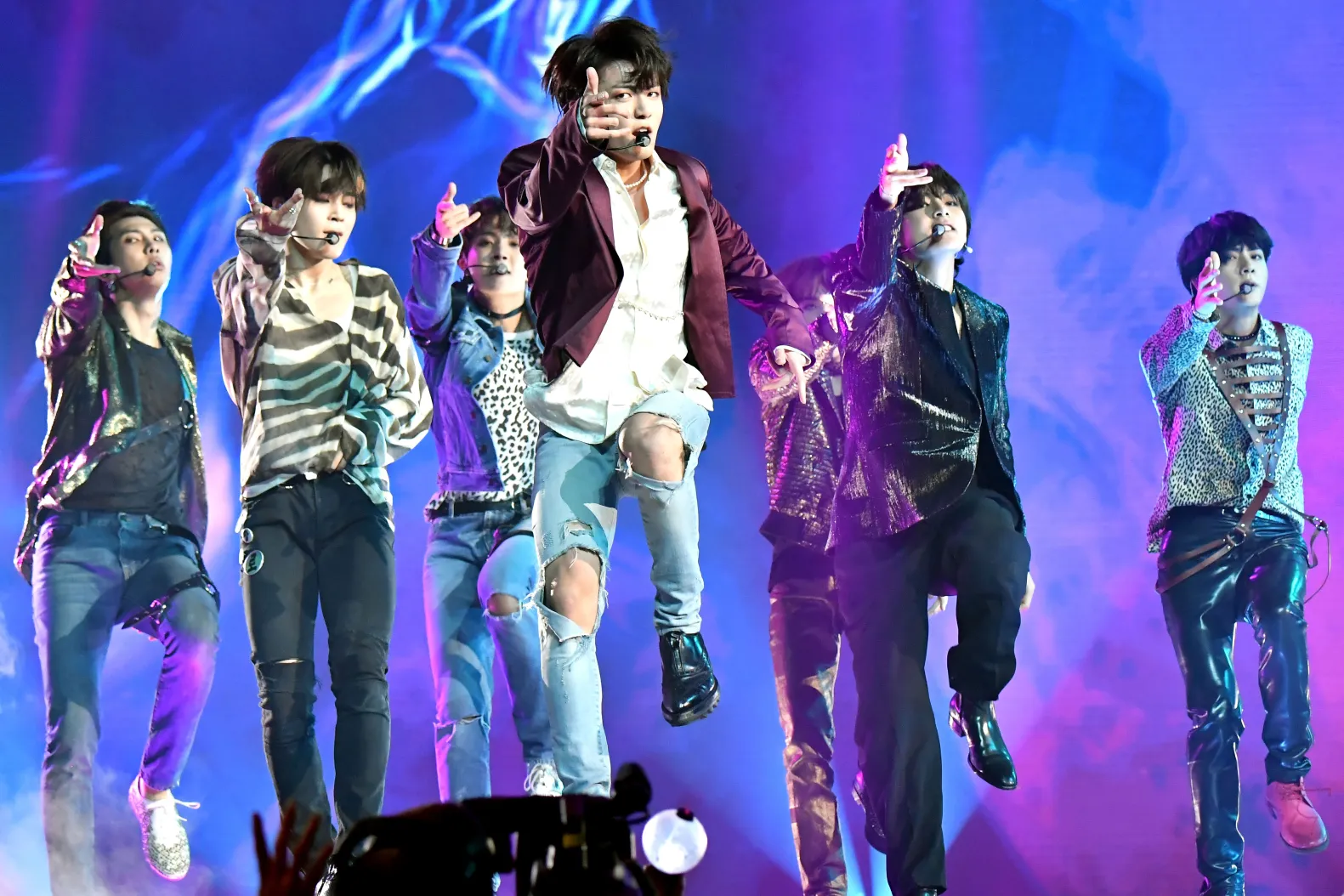

By all accounts, the Korean language and culture is enjoying a wave of popularity. This phenomenon, aptly called Hallyu (한류) - literally Wave (or Flow) of Korea, kicked into high gear during the pandemic lockdowns. You might remember the Korean boy band BTS releasing Dynamite around that time. It was their first song in English, gifted to make us all feel better during isolation.
However, the Hallyu Wave began long before the Bulletproof Boy Scouts (BTS) blew up our loneliness with their Dynamite. As far back as 2012, Korean artist Psy taught us a horse dance so we too could boogie, Gangnam Style. Before him, it was Winter Sonata, touted as one of the lushest productions in television history.
If we had to lay down our marker on when the Hallyu sensation built its current momentum, we'd place it on Squid Game. This 2021 dystopian thriller became the most watched series in 94 countries. Its streaming coincided with a global spike in searches for Korean lessons.
The Korean Wave is nowhere near cresting, and the demand for Korean lessons is not waning. While you search for the right Korean lessons for your needs and budget, Superprof helps you start your learning journey.
This article introduces you to aspects of Korean culture and Korean basic words every beginner learner should know. We'll present you with the best ways to master the Korean alphabet and how to count in Korean. You'll also learn the right ways to greet people in Korea and all the titles to describe a Korean family.


Korean Greetings 101: A Beginner’s Guide
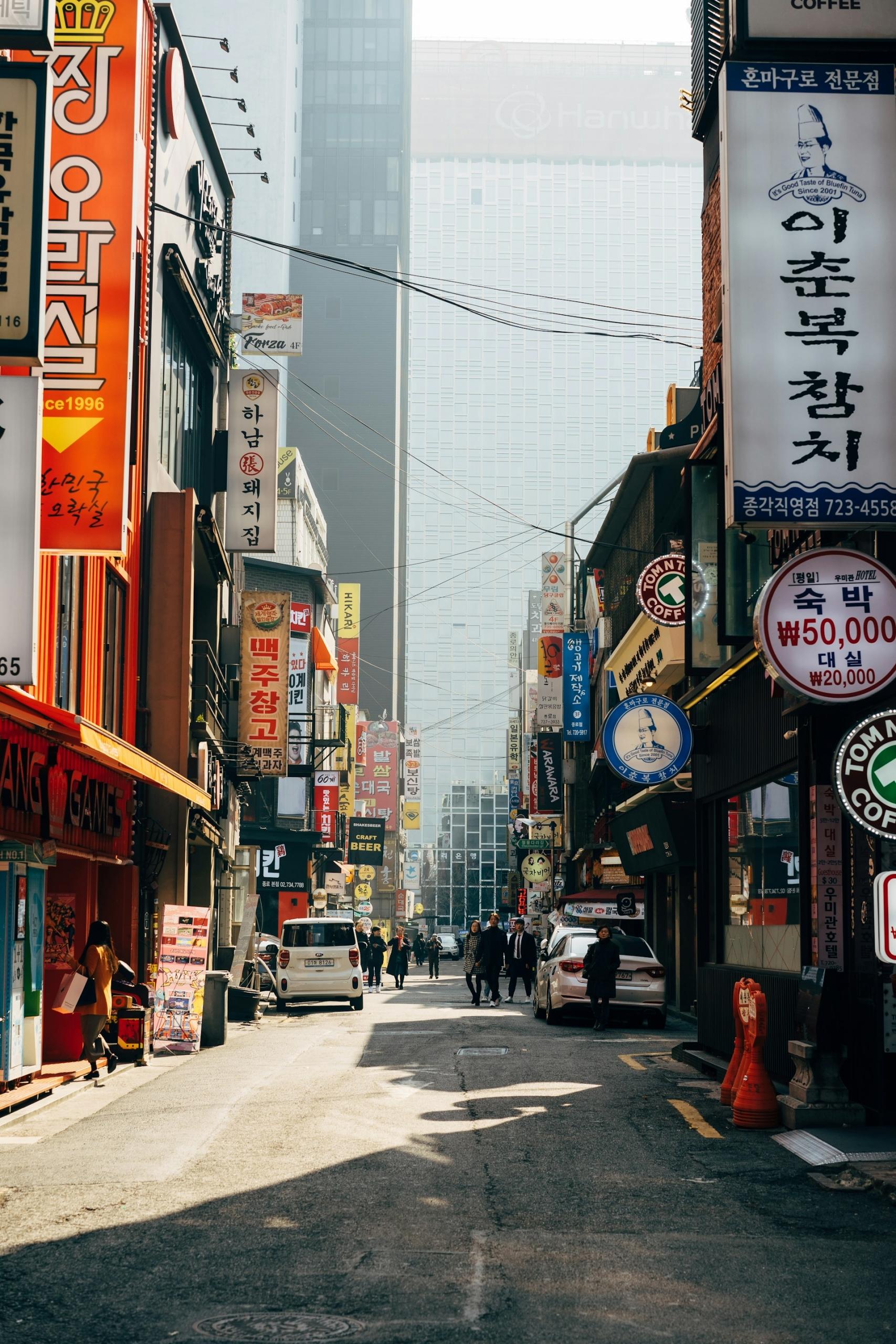
How would you greet the vendors as you walk down this street? That depends on whether it's your first time there. As a stranger, you should extend polite greetings.
However, if this is your neighbourhood and the vendors know you by sight, you may deliver a casual greeting, even to older shopkeepers. In Korea, how you greet someone depends on many factors. (Photo by Markus Winkler on Unsplash)
The best way to describe the Korean language and culture is 'hierarchical'. Elders and important persons sit at the top of this hierarchy, as they do in practically every other society. However, many variables decide who comes next.
These distinctions matter because they determine how people address one another. The Korean language includes formal, polite and casual expressions for just about everything. Addressing a senior staff member at work casually is a grave offence. Conversely, engaging with mates using polite speech could be insulting.
Many Korean language beginners discover this aspect early in their studies. They then make a critical social error. They conclude that, if they dole out the most formal greetings at every turn, they'll cover all the bases. After all, why learn three greetings when you only need one?
At best, your workmates will laugh at you. At worst, they will shun you, believing you want to keep them at arm's length with all your formality.
To avoid such situations, you must learn the full range of greetings in all three forms. The standard "Hello!" in Korean, an-nyeong-ha-se-yo (안녕하세요), is the perfect greeting for the first time you meet someone. Hierarchy will be established during that initial encounter, which will determine whether you may issue the more casual "Hi!" an-nyeong (안녕) next time you meet.
Note that an-nyeong also works as a casual goodbye. But don't leave yet! You haven't learned all the Korean greetings you need to know. This article details a fuller list of Korean greetings and how to use them.
Basic Words to Describe Family in Korean
"Have you eaten?" is a common greeting between friends and family. It recalls the times of scarcity in South Korea, when people had little to eat. Today, even though food security isn't a major issue in South Korea, that greeting persists.
If you watch Korean dramas, you might hear "Adeul-a, bab meog-eoss-eo?" (아들아, 밥 먹었어?). It means "Son, have you eaten?" Calling one's children adeul or ttal (딸 - daughter) is commonplace in Korea. (Photo by Markus Winkler on Unsplash)
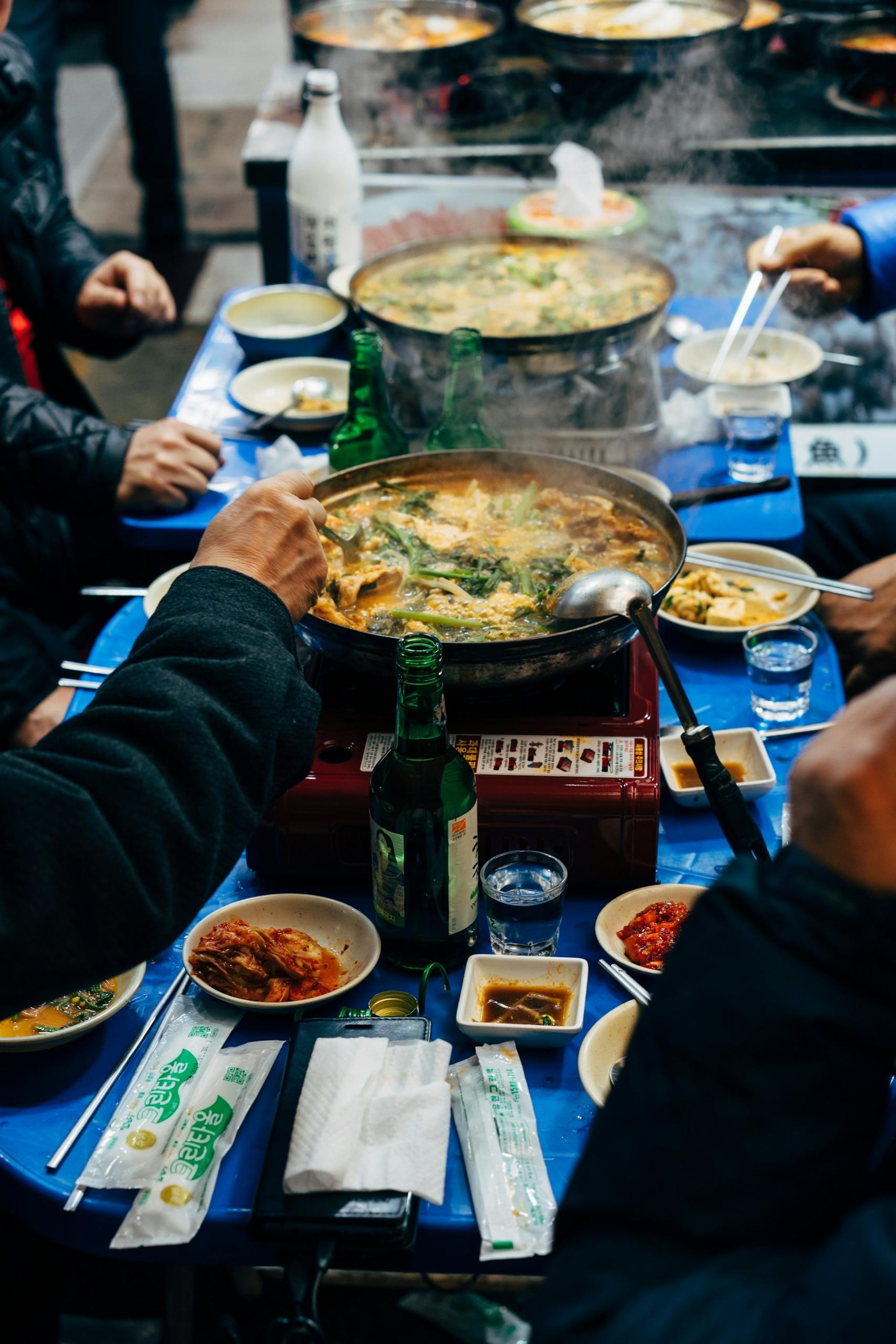
The Korean hierarchy persists within the family, too. Older brothers are hyeong (형) to their little brothers, and younger brothers are namdongsaeng (남동생). Sisters call their older brothers oppa (오빠).
Older sisters are nuna (누나) to their brothers, and eonni (언니) to their sisters. Younger sisters are yeodongsaeng (여동생).
As everywhere else in the world, each of those family members has a name. However, within the family unit, they are called by their title. This is a respectful way of acknowledging not just one's own place within the family, but everyone else's, too.
The word uli (우리) features prominently in addressing and talking about family members. It means 'our'. Korean families use it the same way we do: "Our Sally is a fine student", for example. As in English, the Korean uli folds the 'our' person into the family unit.
And, just as in English, the Korean speaker doesn't necessarily address the people they share the 'our person' with when using that phrase. For instance, a worker might beg for a day off because uli eomma (우리 엄마) 'our mother' is sick. Or maybe it's uli appa (우리 아빠) - our dad who needs our help.
Formal titles for mom and dad are eomeoni (어머니) and abeoji (아버지), respectively. Going through the generations adds a prefix to each title. Adding hal - (할) to abeoji gives you hal-abeoji (할아버지) - grandfather.
Before adding that prefix to form 'grandmother', you must first remove the placeholder consonant O. Thus, grandmother is halmeoni (할머니).
Beware that this brief summary of Korean family titles doesn't mislead you into believing that describing family ties is easy. Outside the nuclear family, family hierarchy can be confusing. Fortunately, you have an entire separate article that helps you figure them all out.
Your Guide to the Korean Alphabet
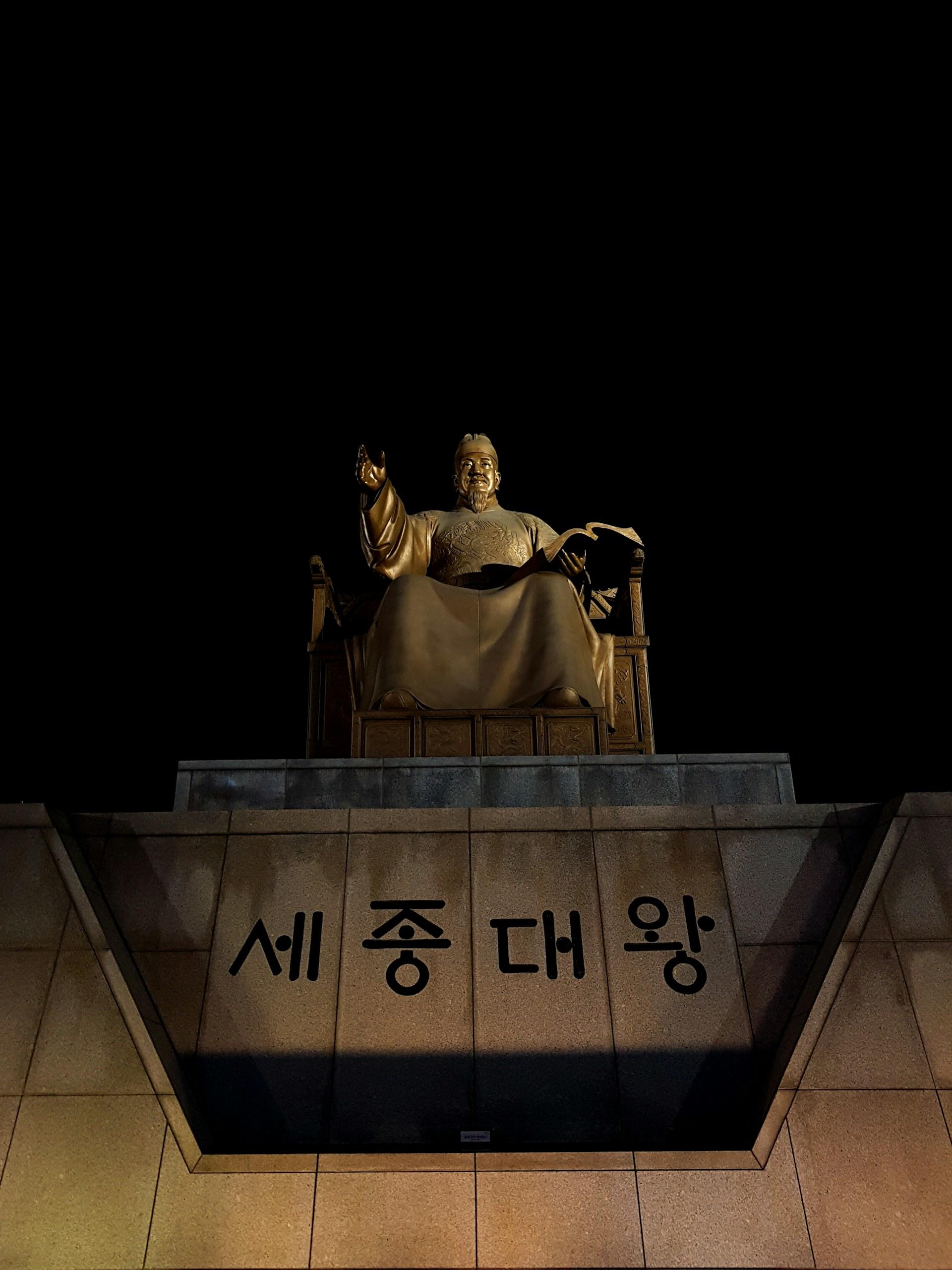
Gwanghwamun Square (화문광장) in Seoul is the historical seat of royal administration. Today, it is the city's centre point, an open plaza that serves as grounds for large public gatherings and backdrops for many K-dramas.
One end of the plaza features this six-metre high bronze statue of King Sejong the Great. He democratised reading and writing with the creation of Hangul (한글) - the Korean alphabet. (Photo by ASTERISK KWON on Unsplash)
For centuries, the Korean peninsula developed with heavy Chinese influence. A succession of Chinese envoys helped create Korea's historic civil service system and instil philosophical thought. Korean people benefited from Chinese art and culture standards, putting their distinctive signature on every import.
However, Chinese-influenced society had a major flaw. Education - specifically, reading and writing, was limited to the elite class. That changed in the 15th Century, when King Sejong created Hangul. Rather than banishing Chinese characters, he engineered a way for both writing systems to function together.
As a beginner Korean learner, you should first master Hangul, the Korean alphabet. However, you will have to study the Korean-adapted Chinese writing system called Hanja (한자). Each has specific functions in reading and writing in Korean.
This should not worry you. The Korean alphabet mirrors our alphabet in many ways, including the number of letters. Once you master Hangul's 14 consonants and 10 vowels, you can begin learning consonant and vowel pairs, and how to use them.
This enticing titbit will whet your appetite for study: that placeholder consonant we mentioned in the previous segment. Korean consonants change their sound, depending on where in the syllable they appear. We explain this and other features of the Korean alphabet in our companion article.
Counting With Korean Numbers
Like the Korean writing system, the numbering system retained Chinese numerals to complement their Hangul equivalents. To complicate matters, those Sino-Korean numbers appear in two scripts: Chinese and Korean. To be fair, Koreans mainly use Hangul characters, regardless of which numbering system. The Chinese characters feature mainly in artistic and historical contexts.
As you study Korean, you may delay learning Hanja for a while but you must learn both numbering systems at the same time. That's because each has specific uses. For instance, writing today's date demands Sino-Korean Hangul. To write historical dates, use Native Korean Hangul.
Besides being written in Hangul, everything about these numbering systems is different. Native Korean characters extend from one to 99; Sino-Korean numbers are infinite. Their names are different, too. Native Korean numbers hana, dul, set (하나, 둘, 셋) equal the Sino-Korean il, i, sam (일, 이, 삼) - one, two, three.
If you're filling out forms for your visa, use Sino-Korean numbers. For general counting, use Native Korean numbers. When you give out your phone number in Korea, use the Sino-Korean system. However, if someone asks you what time it is, tell them with Native Korean numerals.
Permanence is a good rule of thumb for how to use numbers in Korea. To make that point clear: you'll likely keep your (Sino-Korean) phone number but (Native Korean) time changes every second.
Learn with a qualified tutor! Find a Korean language course here on Superprof!
Summarise with AI:
Enjoyed this article? Leave a rating!

 Loading...