

Singing and vocal technique are very particular disciplines, and men and women don’t have the same vocal ranges. So what are the main types of female voice? In this article, we'll look at the four main female voice types, their subcategories, and why we classify them.
| Voice Type | Typical Range | Vocal Qualities | Famous Singers |
|---|---|---|---|
| Soprano | C4–C6 | Bright, agile, strong upper register, clear tone | Mariah Carey; Julie Andrews; Diana Ross; Delta Goodrem; Jessica Mauboy |
| Mezzo-Soprano | A3–A5 | Warm, rich, flexible; strong mid-range | Madonna; Rihanna; Janis Joplin; Barbra Streisand; Tina Arena; Natalie Imbruglia |
| Contralto | F3–F5 (can extend lower) | Deep, resonant, rarest female voice type | Cher; Annie Lennox; Missy Higgins; Amy Winehouse; Tracy Chapman; Sia |
| Coloratura Soprano | C4–F6+ | Extremely agile, capable of fast runs, trills, ornamentation | Maria Callas; Joan Sutherland; Diana Damrau ; Nellie Melba; Yvonne Kenny |
| Lyric Soprano | C4–D6 | Warm, expressive, less agile but powerful | Renée Fleming; Anna Netrebko; Nicole Car; Siobhan Stagg |
| Dramatic Soprano | A3–C6 | Powerful, dark, weighty sound; suited for intense roles | Maria Callas; Birgit Nilsson; Cheryl Barker |
| Lyric Mezzo-Soprano | A3–A5 | Smooth, lyrical, expressive mid-range | Alicia Keys; Adele; Kate Ceberano; Dami Im |
| Dramatic Mezzo-Soprano | G3–G5 | Strong, weighty tone; powerful projection | Florence Welch; Annie Lennox; Christine Anu |





The Three Primary Female Voice Types
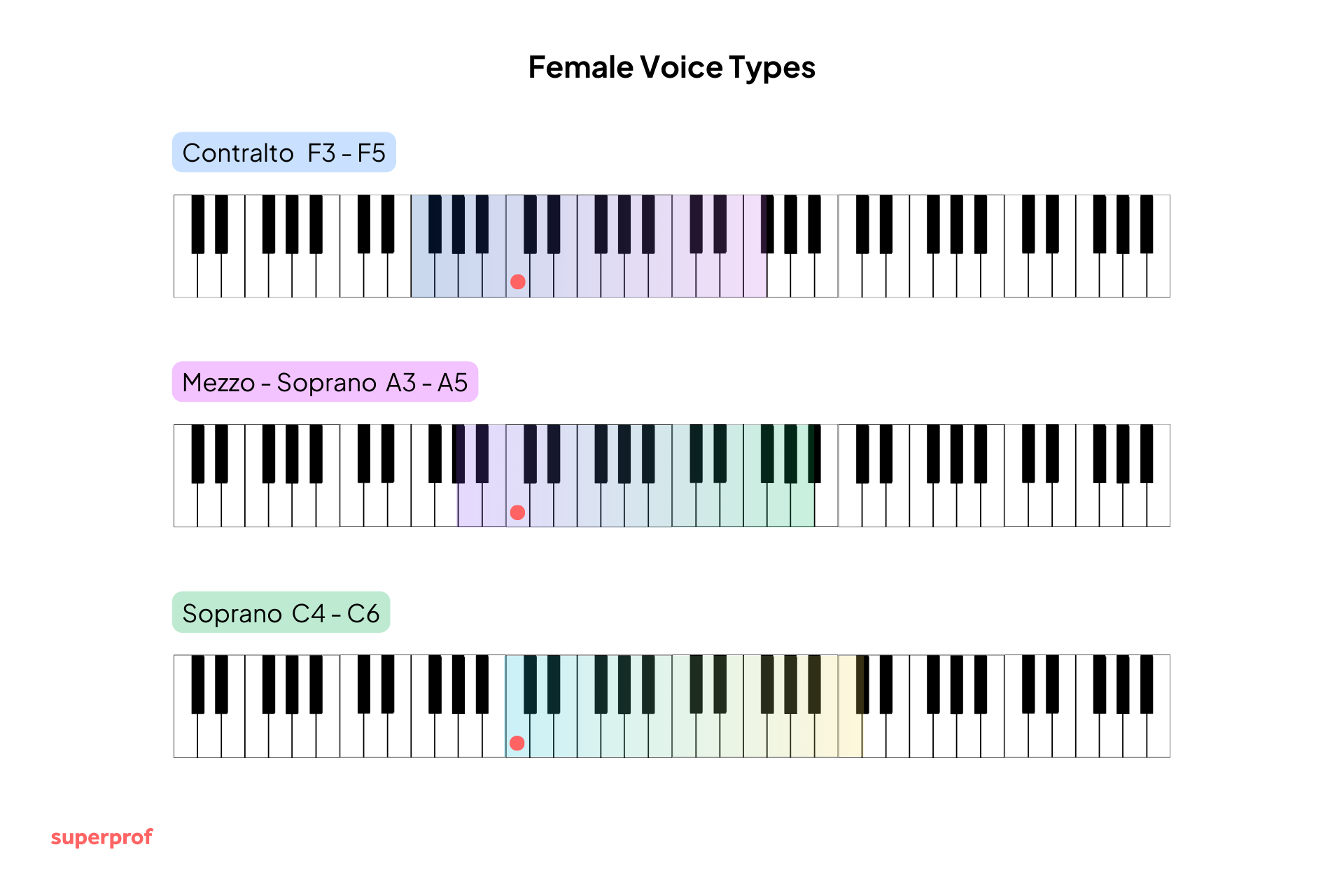
As we’ll see later, things aren’t quite that simple, but for this article, we’re going to look at four main female voice types. You'd likely cover these in singing lessons. Remember that voice types generally have a range and a tessitura, so before we explore these voice types, here's range and tessitura explained.
Vocal Range
All the notes you can physically sing, from your lowest to your highest.
- It includes your extremes (even the uncomfortable ones).
- It’s your full capability, not what you normally use.
- Example: A singer might reach C3 to E6, but only a few of those notes feel good.
Think of it as the whole map.
Tessitura
Where your voice is most comfortable, resonant, and healthy.
- It excludes the extremes.
- It’s the range you can sustain for long periods without strain.
- It’s your “home base” — where your voice sounds best.
Think of it as the neighbourhood you actually live in, not the whole city.
Finding your voice type takes more than singing a few high or low notes. Your range gives you a rough idea, but your tessitura (where your voice feels natural and effortless) is the real key.
Most singers discover their type by noticing where their voice resonates, how easily they transition between registers, and which notes cause strain or fatigue. Working with a teacher or coach helps you avoid guessing and ensures you don’t push your voice into areas that cause tension or long-term damage.
Soprano
The higher range is the soprano voice. This is very common among women and children. Famous sopranos include:
Mezzo-Soprano
The most harmonious and musical voices are often considered to be the higher ranges. When it comes to the female vocal ranges, there are two main types. The mezzo-soprano voice is the intermediate voice, which is both light and rich. A mezzo-soprano voice can sing a lot of contemporary music and integrate comfortably into a choir. This type of voice is quite common among women, and there are plenty of famous singers with it. Famous examples include:
Discover vocal lessons Melbourne here on Superprof.
Contralto
Additionally, we find contralto, which is quite an uncommon vocal range for females. There are even some children with this vocal range, but it’s on the lower end of the scale for them, too. This is a warm voice, and there are many famous female singers with this voice type. The most famous contraltos include:
This is just a way to classify voices by the range of notes they can perform, and male voice types are classified differently. There are also subcategories of female voices that help us classify voices more accurately.
A singer’s highest and lowest notes may sound impressive, but they don’t reveal how the voice truly functions. Tessitura tells you where your voice naturally sits, which is why it’s more useful than raw range when choosing repertoire.
Two singers with the same range can have completely different tessituras, leading one to fit soprano roles and another to suit mezzo or contralto parts. Understanding tessitura helps you select songs that highlight your strengths, protect your vocal health, and let your natural tone shine without strain.
Female Voice Ranges Subcategories and Extended Classifications
So while we can classify female voices into four broad groups, we sometimes need to be more precise in how we classify them by musical technique. There are so many factors that can affect a voice. There are three main sub-categories of voice: light voices, lyric voices, anddramatic voices. These group voices, in terms of their heaviness, can all be found within the main ranges we saw before. Make sure you’re singing songs within your range and heaviness. Light voices can chain together notes with ease and do better with their upper ranges than other voice types. Lyric voices excel in the middle ranges of their voice type, while the dramatic voices aren’t as agile but feel much more comfortable at the lower end of their range.
Coloratura Soprano
We tend to add an extra subcategory to light voices: the coloratura soprano, for example, is famous for its agile runs. In short, there’s a whole landscape when it comes to voice types.
Lyric and Dramatic Classifications
A lyric soprano tends to be referred to as just a “soprano”. They’re more powerful than light sopranos and are suited for expressive pieces. Giacomo Puccini’s Madame Butterfly, for example, is famous for this type of voice. Then there’s the dramatic soprano and the singer Maria Callas, who was this voice type incarnate. It’s also the most powerful subcategory of voice. The range also includes a few notes lower than that of a lyric soprano.
The Reason for Classifying Female Voices
The range of vocal ranges is impressive and they allow us to classify a performer’s abilities so that composers can write music for them or performers can audition for the right roles, which is why you should find out how to work out what your voice type is. Knowing your vocal range is important for your career choices. Each voice type is suited to a different type of music or a different piece. Imagine trying to sing heavy metal with a light soprano at the helm. It just wouldn’t work. It’s important to know what you can and can’t do in terms of your voice. The subcategories of female vocal ranges didn’t come into existence until the 19th century. During the 18th century, male and female voices were distinguished only by whether they were high or low.
Some say I have a beautiful voice, some say I have not. It is a matter of opinion. All I can say, those who don't like it shouldn't come to hear me.
Maria Callas, American-Greek soprano
Over time, the classifications were refined until we reached the different classifications we have today. They allow singers to perform to their strengths and enjoy pieces that work with their timbre and range. Whether it’s vibrato, a head voice, warming up, etc., there are so many techniques that singers need to master so they don’t want to be singing outside of their range or singing pieces that don’t match their voice. The more comfortable you are when singing, the better you’ll sing and the more progress you’ll make.
Discover singing lessons Brisbane here on Superprof.
What voice type are you?
Work with Your Voice Type with a Private Tutor
So, are you ready to work out your voice type? If you're trying to hit those high notes or want to take care of your vocal folds, consider getting help from a voice teacher who can help you discover your voice range, go through vocal exercises with you, and take care of your vocal health. You can also learn more about registers from a singing coach or tutor. They can even show you artists with the same tessitura as you, and suggest songs and activities that work best with your tessitura.
Summarise with AI:
Did you like this article? Leave a rating!


 Loading...