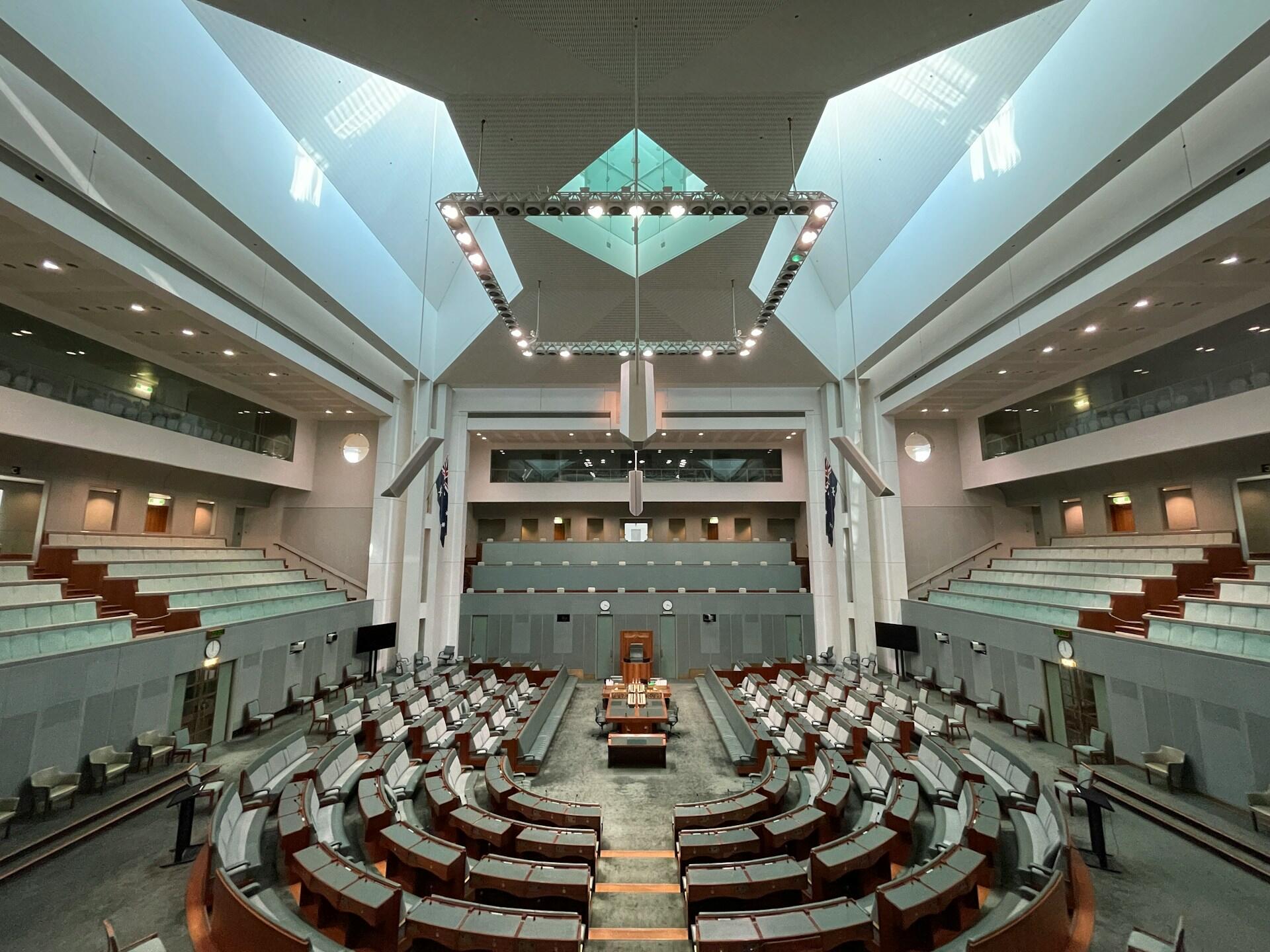

The Rule of Three is a powerful tool writers and speakers use to make their words memorable and appealing. In fact, across the human experience, we find the number three as a symbol of power: the Trinity, the triangle - the stablest geometrical shape, and political systems. The Australian system of government features two 'threes': within Federal leadership, and across levels of government.
Examining the Australian Political System:
- Three at the Federal level: the executive, legislative, and judicial branches
- Three across Australia: the local, state, and federal levels of government
- Each branch/level has corresponding duties and responsibilities
- Each branch and level works with the others





The Australian Political System
The country we call Australia is only 124 years old. Indigenous civilisations aside, regrettably, European settlers wanted to establish for themselves a system of government that would serve them.
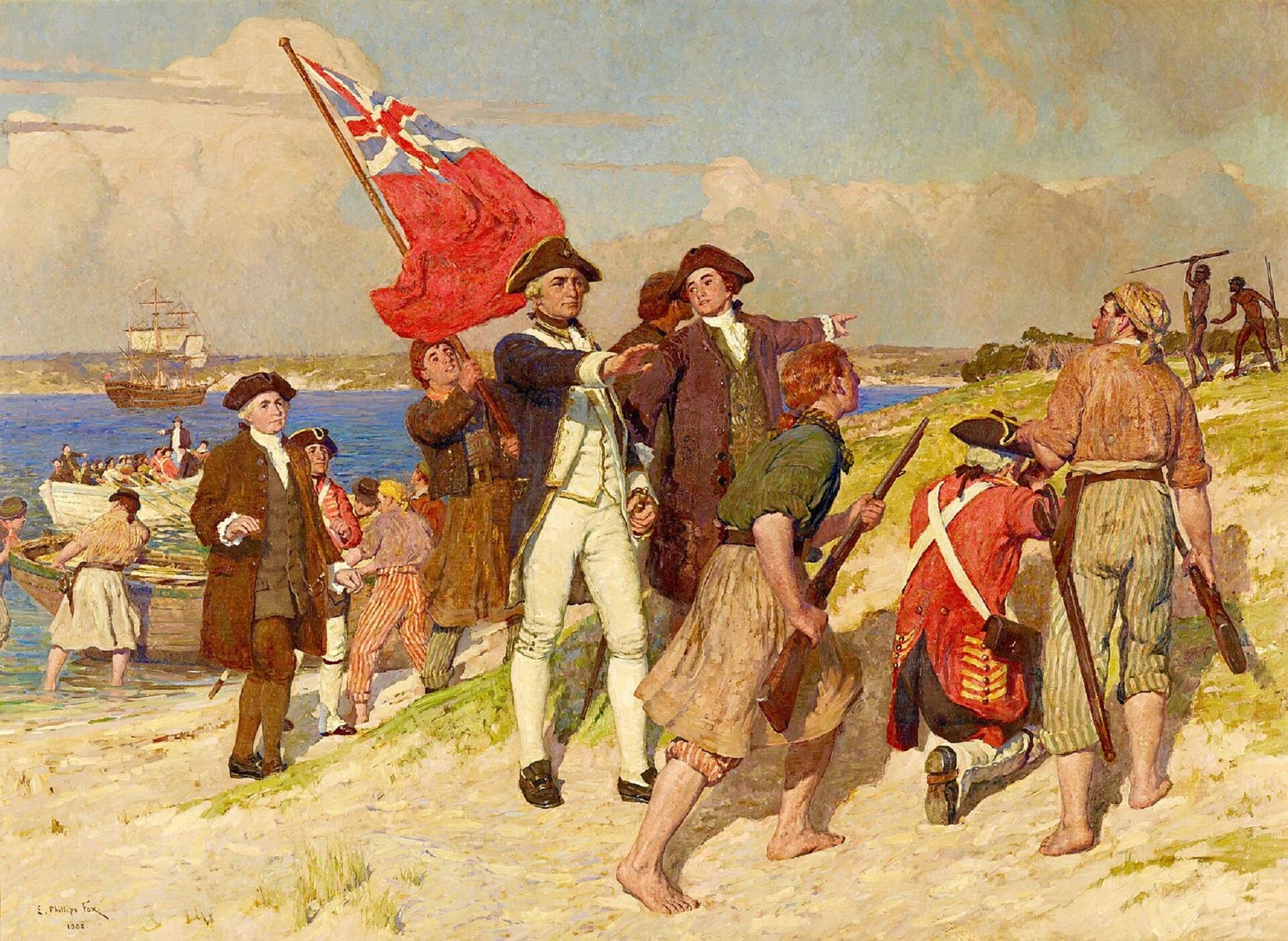
For the most part, their laws came from British rule. But, colonists resented the Crown's power over their lives. We see this in their partial rejection of the Westminster government system. They wanted no royally appointed Lords in their Parliament, and they wanted to write laws that suited their circumstances.
Today, the Australian Parliament works as a hybrid of 'borrowed' government systems. We took the Parliament concept from Britain's government, but added an elected senate, taken from the United States (US) system of government.
Australia is, first of all, a constitutional monarchy. It is also a federation of states, and a representative democracy, with elements of direct democracy.
Also, like the US, Australia is a federation of states, each of which has its own rights, privileges, and obligations within the federal system.
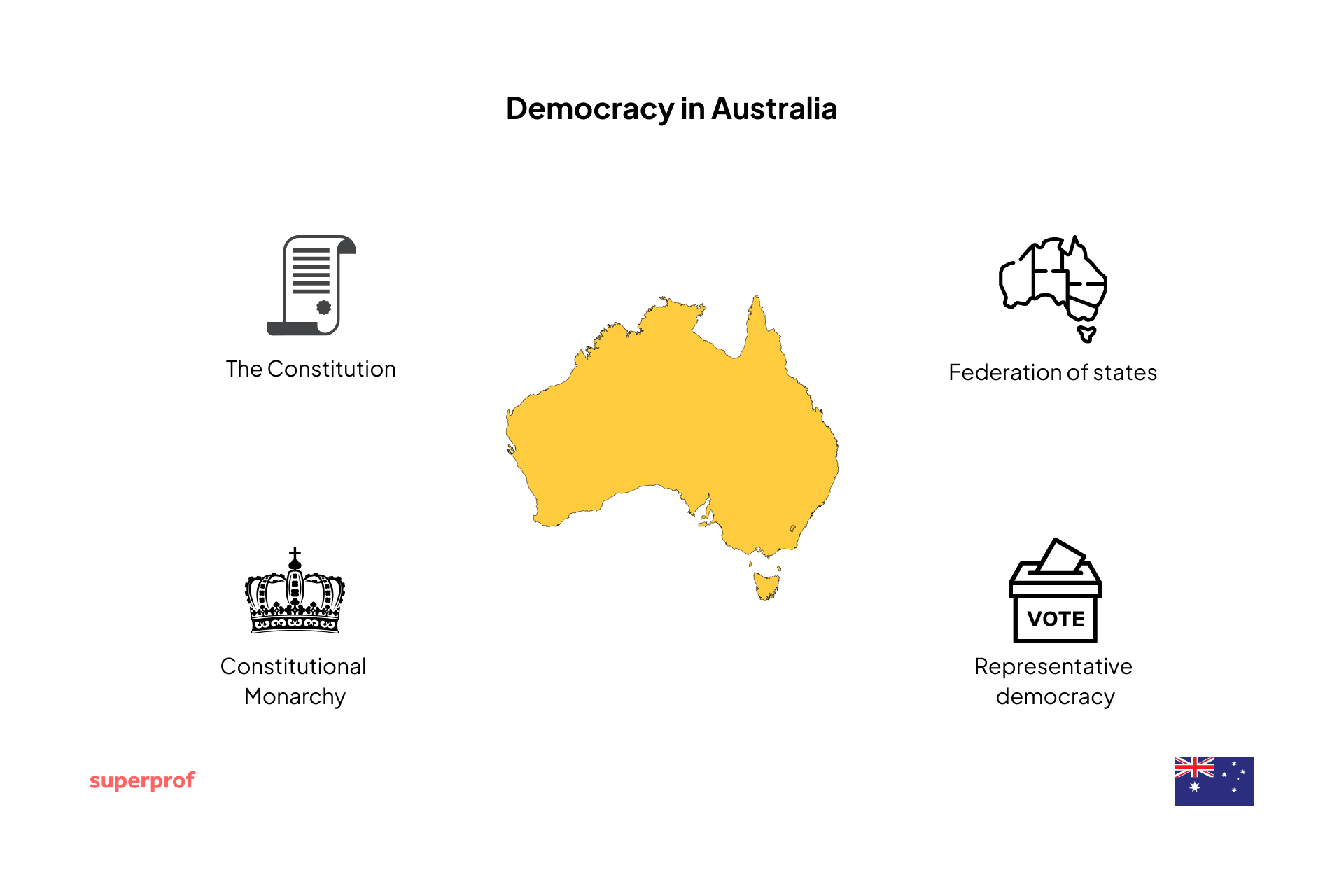
The Australian Constitution is the hub around which all these aspects revolve, with each process described in its own chapter.
| 📖Chapter | 📃What it addresses | 🔎Specifics |
|---|---|---|
| I | Parliament | Describes the roles and functions of: the monarchy, the Senate, and the House of Representatives. |
| II | The executive government | Describes the roles and functions of: the monarchy, the Governor-General, the Prime Minister, and various department Ministers |
| III | The Judiciary | Describes the makeup and function of: the High Court, and federal judicial power in the states. |
| IV | Finance and Trade | Outlines all commercial matters within the Federation. |
| V | The States | Defines states' roles, rights, privileges, and obligations within the federal system |
| VI | New States | Allows establishing new states, and accords them their rights. |
| VII | Miscellaneous | Lists provisions for the location of the Capital, voter exclusions, Governor-General provisions. |
| VIII | Alteration of the Constitution | Outlines procedures for referendums. |
You'll note that Australia's ties to the British monarchy are enshrined in our foundational document. We are, and will remain a constitutional monarchy, as stated in our Constitution. This document also enforces our nation's status as a representative democracy with elements of direct democracy.
We elect people to the state and federal governments to represent us.
democracy:
We vote in referendums to amend our state and Federal Constitutions.
Our Constitution is our guide to Australia's democratic systems. It lays out governing bodies' rights, responsibilities, privileges, and obligations under the law. But, constitutional provisions are flexible; we can change them through a referendum, if needed. This clip summarises our Constitution's importance, and what it represents.
The Federal Government
If we picture Australia's governing bodies as an onion sliced in half, our Constitution would be the outer layer, as it covers everything. The next layer is Parliament: the Senate and House of Representatives, and the Governor-General, who represents the monarch. Our Federal government represents the third layer: slightly thicker, and more flavourful, than the outer ones.
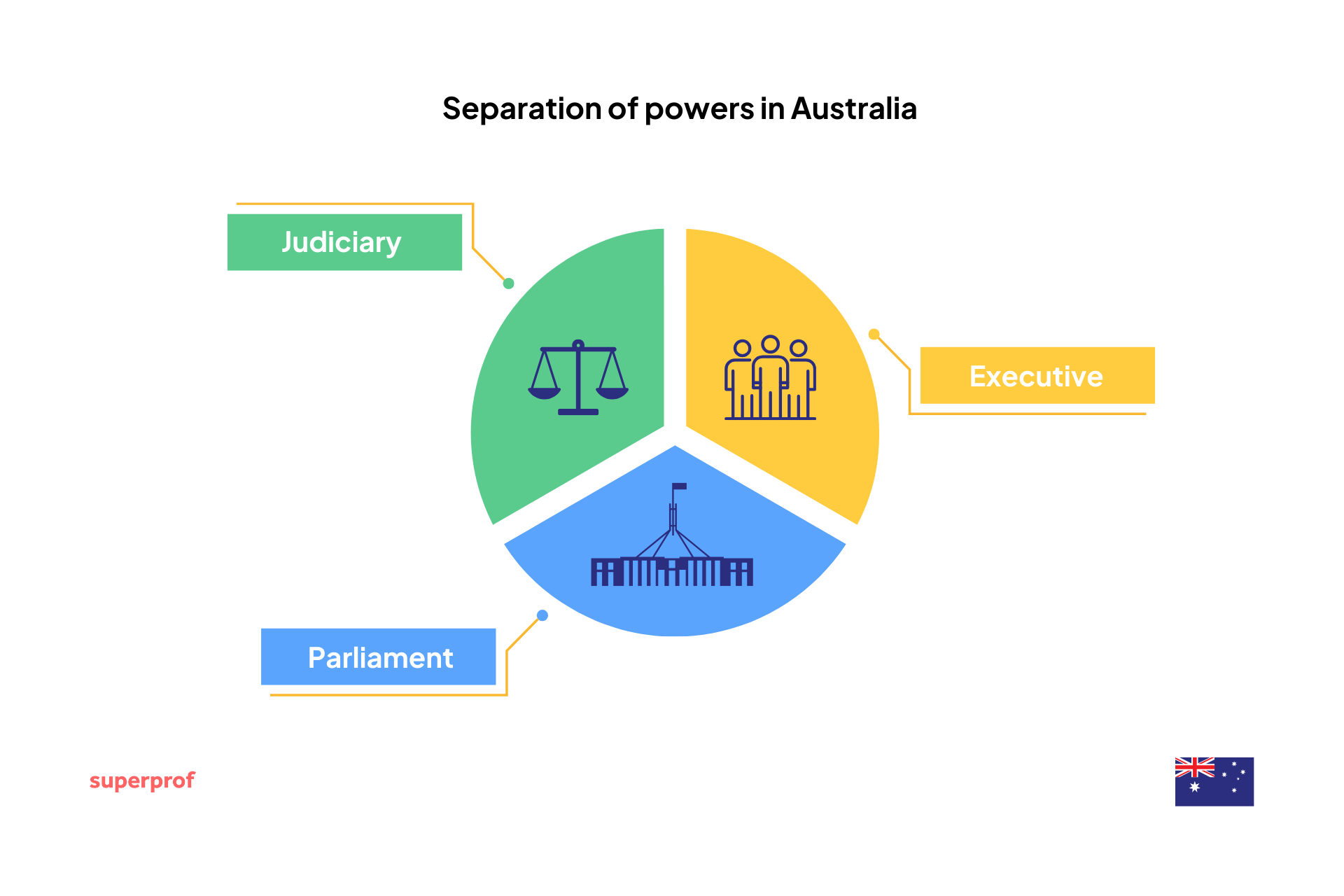
The Separation of Powers Australia: the Executive
Like many governments around the world, the Australian government distributes power across three branches: the executive, the parliament, and the judiciary. Of them, the Executive branch may be the hardest to understand.
The Prime Minister and their cabinet, called the Federal Cabinet.
Ministers staff this cabinet. Each minister is tasked to oversee an aspect of government, such as education, foreign affairs, trade and tourism, public service, and so on.
and description
The Constitution specifies that the Executive may have no more than 30 cabinet members. However, our most recent cabinet had 34 ministries. So, many cabinet members served as ministers of several government initiatives. For instance, Katy Gallagher served as Minister of Finance, Minister for Public Service, Minister for Women, and Minister for Government Services.
Parliament
Parliament is our country's law-making body. Representatives from all of Australia's political parties meet in this bicameral (two chamber) body to revise, debate, and write our laws. When they're not doing that, they examine the executive branch's doings, and form committees to review executive actions.
The Judiciary
The Judiciary is responsible for making sure our country's laws are upheld. More specifically, Australia's judges interpret and apply the law when deciding cases in court. At the federal level, justices examine the laws Parliament writes, to determine their viability under existing law, and the Constitution.
Federal Government Responsibilities
Our Constitution lays out each government branch's rights and responsibilities. Not in exact words, of course, because a lot has changed since our country was founded. But, it makes clear the separation of powers, and the obligations each branch has.
In the previous segment, you read a summary of each branch's duties, responsibilities, and obligations. They're much bigger and more varied than our summary lets on. This clip expands on what you just read.
The Three Levels of Government in Australia
Before Australia became a federation of states, it was a collection of colonies. They governed themselves, more or less, applying British laws to whatever situation arose. It didn't take long for prominent citizens to clamour for a firmer, more local, governing hand.
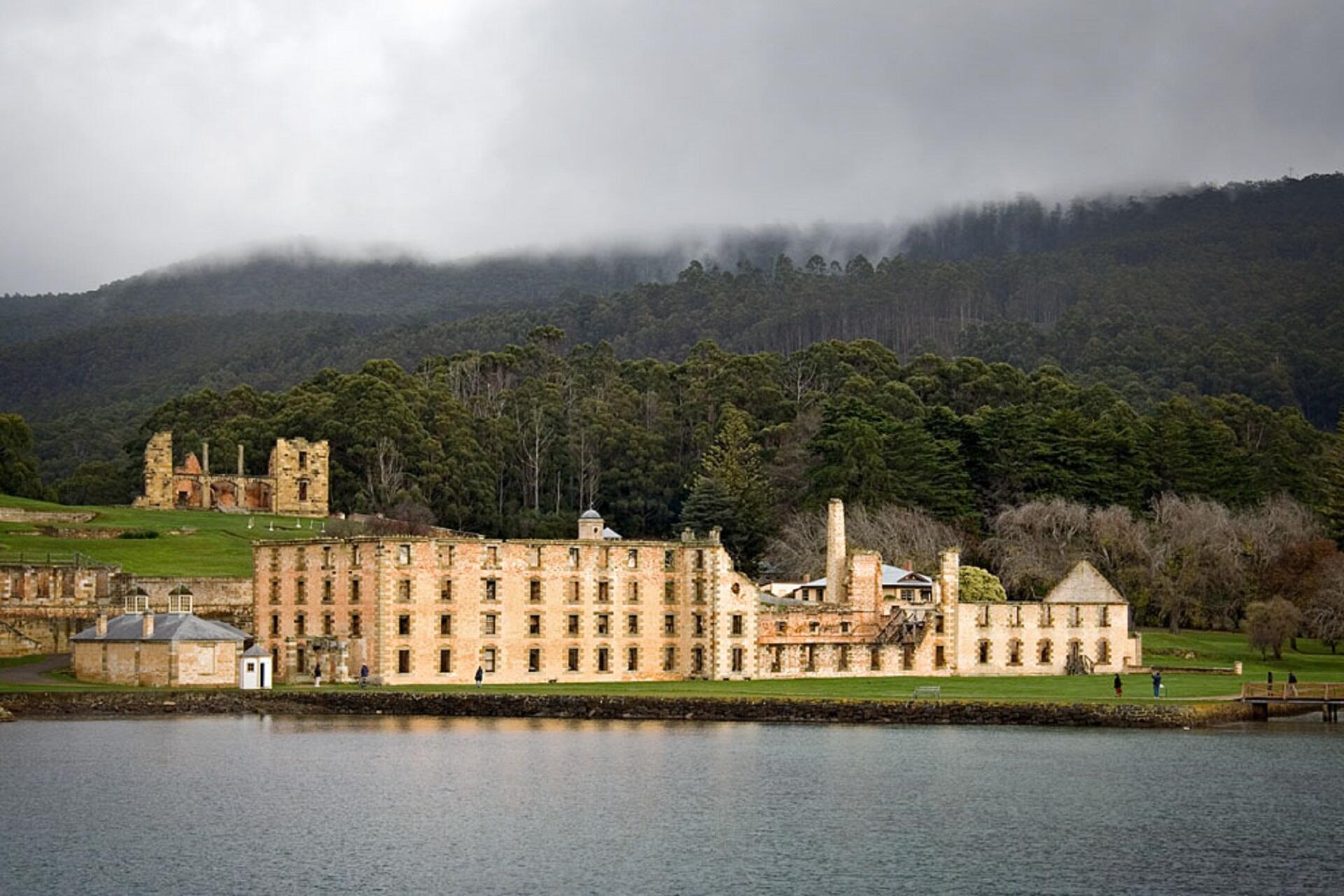
These local governments formed the bedrock of legislative activity. Eventually, local governments banded together to draw boundary lines, forming states. Then, a higher level of government was needed: the state government.
Local government leaders came together, to decide their state's capital and constitution.
These were often raucous meetings, with much disagreement and a certain level of violence. In the end, settlers hammered out a system that mirrored England's government structures. With only a little more work, they had the formula to govern states:
Local government:
- run by councils
- represent local government areas (LGAs)
- include cities, shires, boroughs, and regions
- administers schools, zoning, and local laws
State government:
- follows the Westminster system
- includes executive, parliamentary, and judicial
- governor is the head of state
- House majority leader is Premier
From the local councils to the Federal government, each level has a measure of power, and supports the level above. Local governments are the core that 'feed' and support state governments. In turn, state governments dictate, regulate, and fund local governments.
State governments receive direction and funding from the Federal government. In turn, the states send representatives and senators to Canberra, to ensure the state's interests get the Federal-level consideration they deserve.

The Division of Powers Australia: Who Does What?
No branch or level of government will work without the politically engaged citizenry. We have to know how our government levels work, and the issues they manage, to make informed choices when we vote. We must also know how Australian elections work, and the weight our votes hold.
So, starting with us, the voters, this is how power sustains itself across the country, even at the lowest levels.
graphic
The Australian Government Structure
It's tempting to think that our Federal government is the only government body that matters.
Foreign and Defence Ministers engage with world powers. Our children receive education, thanks to the minister that oversees our schools' curricula, and allocates funding.
In fact, our Federal government couldn't do the work it does without input from the states and territories.

Parliamentary Senators and Representatives learn how government works at the local and state level, before their stint in those Canberra chambers.
Support and cooperation run both ways, at all levels of government.
We see examples of such in real-time, and in the law. For instance, let's say a Federal senator - we'll call him Bob Uncle, needs to step down. A senator from Mr Uncle's home state will take his place. Depending on how close the next election is, the state may then hold a 'snap' election, to fill the seat. The most likely candidates will come from local government offices.
Federal-level Structures
We see the same cooperation and coordination at this government level. The Prime Minister is Parliament's lower-house majority party leader. He draws into his cabinet knowledgeable, often politically savvy leaders, to head various ministries.

Tony Burke: Minister for Home Affairs, also Leader of the House
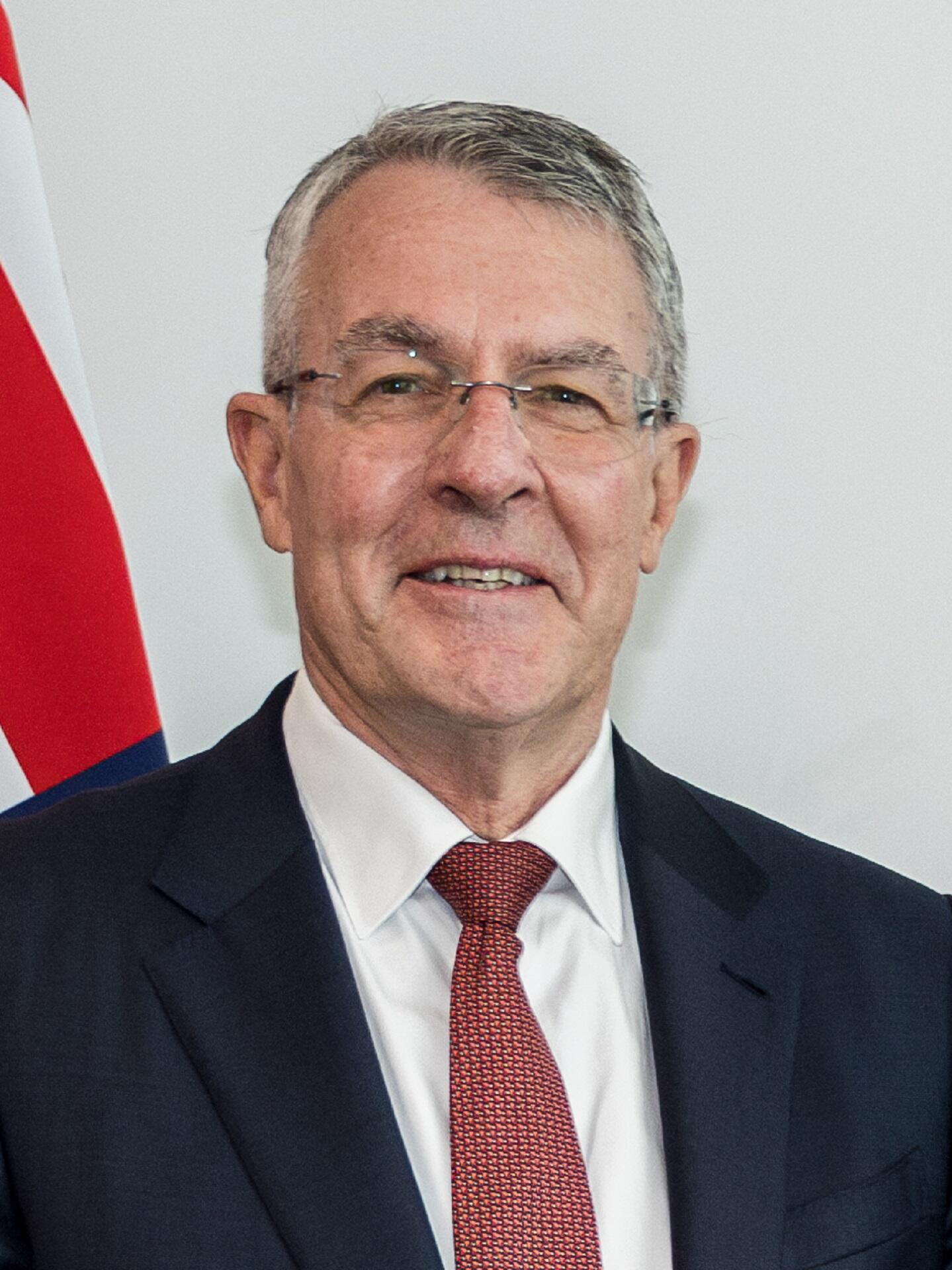
Marc Dreyfus: cabinet secretary, also attorney general.
At the federal level, the executive branch must consider the co-equal branches of government: the judiciary, and Parliament. Anthony Albanese, our current Prime Minster, has made sure both of those branches play a role in his cabinet, through the two members, mentioned above. Cabinets of past Prime Ministers reflect the same courtesy and power-sharing.
Summarise with AI:
Did you like this article? Leave a rating!

 Loading...