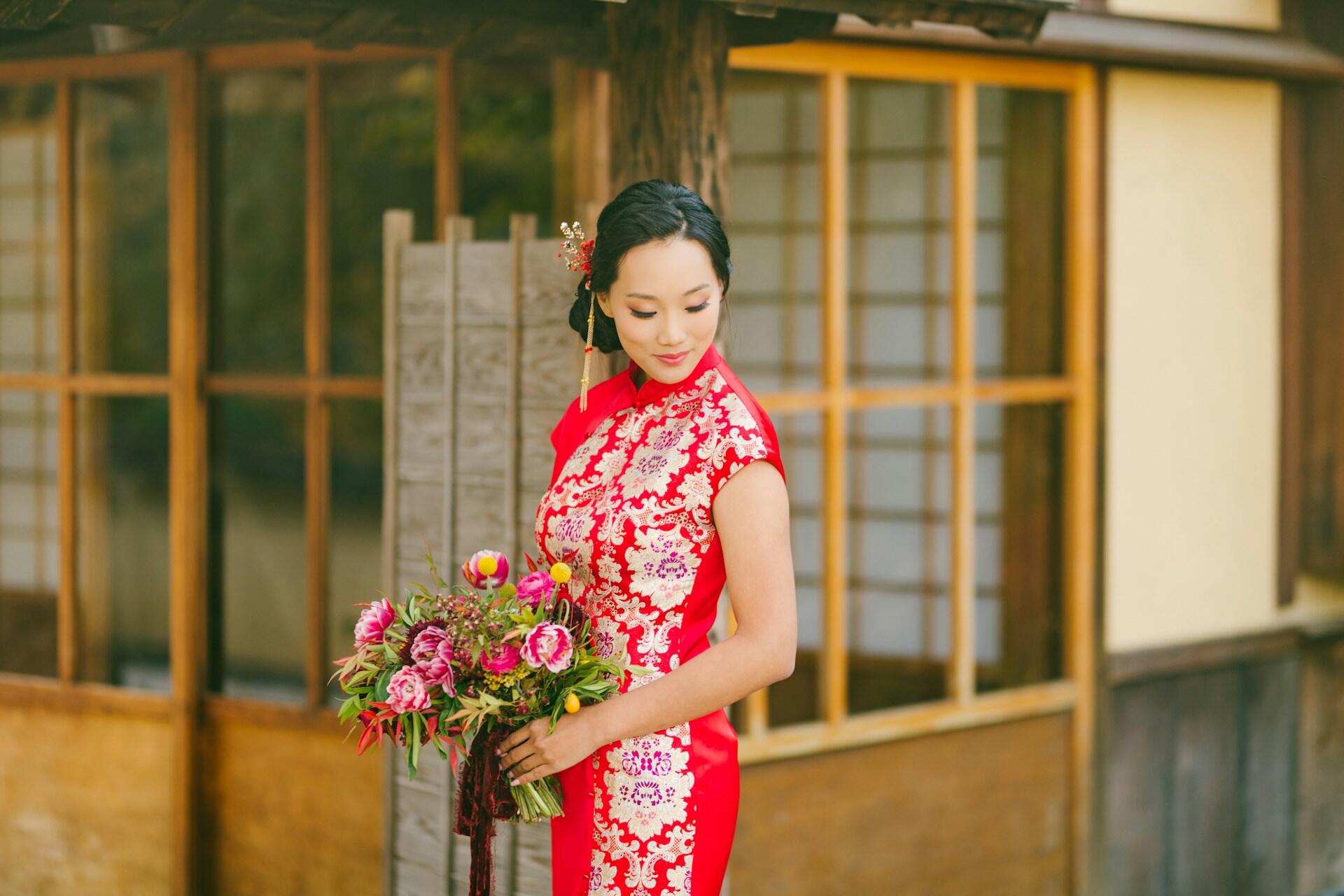

Traditional Chinese wedding ceremonies are steeped in centuries of history and symbolism, and the wedding attire is no exception. While modern brides often blend traditional elements with contemporary designs, the roots of these garments trace back to four influential dynasties that shaped what Chinese couples wear on their wedding day. This chart explores these dynasties and the distinctive attire that defined their marriage celebrations.
| Dynasty | When | Grooms' attire | Brides' attire |
|---|---|---|---|
| Zhou | 1046 - 256 BCE | miǎn fú: yellow inner garment vermillion skirt black robe white silk belt red shoes headdress (jué biàn) | chún yī xun póu: light red undergarments black robe withred and gold trim red and black belt black shoes hair in long bands set with long, decorative pins. |
| Han | 202 BCE - 9 CE; 25 - 220 CE | More colourful top-and-bottom outfits rather than one long outer robe. | Debut of the ruqun look, with long, flowing drapes over their top-and-bottom outfit. |
| Tang | 618 - 907 CE | liáng guān lǐ fú: red outer garments with black and white trim jacket with very wide sleeves skirt features pleats headdress: lián huā guān | chāi diàn lǐ yī: dark green jacket over lighter green skirt wide, squared sleeves gold embroidered cuffs and collar headdress: gold phoenix |
| Qing | 1644 - 1912 CE | Manfu: relatively short tunics with horse-hoof, 3/4 sleeves. Skirts, often with trousers underneath. Typically decorated with mang embroidery. Mang is a dragon-like creature with 4 short legs. | Fengguan xiapei (fèng guān xiá pèi - 凤冠霞帔) Qungua, also called lóng fèng guà (龙凤褂) xiù hé fú - 秀禾服 for a more tailored look Qí páo - 旗袍 - everyday dress more decorated for weddings. |


The Evolution of Chinese Wedding Attire Through the Centuries
Until recently, marriage was more a matter of political and economic concern*. That's not to say that people never married for love, of course. However, the matches that mattered were among power players: royalty and the aristocracy.
Throughout history, upper social classes set wedding traditions, both the rituals and what to wear. To wit, the standard white wedding dress wasn't a thing until Queen Victoria married her Prince. As it turns out, humans have been mad for celebrity culture throughout history!
The land we call China was no different in this regard. Recall that this country was not unified until the early 20th century; various 'tribes' fought for leadership throughout millennia. Women were peace offerings in their bridal roles. As such, they had to appear as tantalising and rich as possible. So, they often brought their clans' wedding traditions and materials with them.
*Sometimes, that's still the case today, particularly in power circles. Chinese dramas present examples of such; The Substitute Princess's Love and Destined are binge-worthy titles.
Zhou Dynasty Wedding Garb
The Zhou Dynasty spanned 790 years, from 1046 to 256 Before the Current Era (BCE). During that time, 32 monarchs and 37 kings held thrones. So elaborate was the clothing system that the court had officials to manage the imperial wardrobe.
Zhou weddings were typically held at dusk, and they were solemn affairs. The wedding clothing set the tone.
The Zhou Dynasty saw several strategic marriages. Among them, we count King Hui of Zhou (676-652 BCE) marrying a Red Di princess and King Xiang of Zhou (651-619 BCE) marrying a Di princess. Their marriages produced the Six Etiquettes - steps that underpin Chinese weddings today.
Proposal
birthday matching
betrothal gifts
wedding gifts
selecting a wedding date
the wedding ceremony
Wedding Dresses During the Han Dynasty
The Han Dynasty ruled from 202 BCE to 9 of the Current Era (CE), and again from 25 to 220 CE. Records from that time are incomplete; they estimate between 24 and 27 emperors. This is the period Hanfu came to be; a clothing style that endured for centuries.
Initially, the Han kept the Zhou black-red motif for weddings but gradually moved into more colourful ensembles.
Also, rather than a long outer robe, the clothing styles evolved into top-and-bottom outfits.
Over time, decorations became more elaborate and the materials richer, featuring more silk, more vibrant colours, and fine embroidery.
Tang Dynasty Wedding Attire
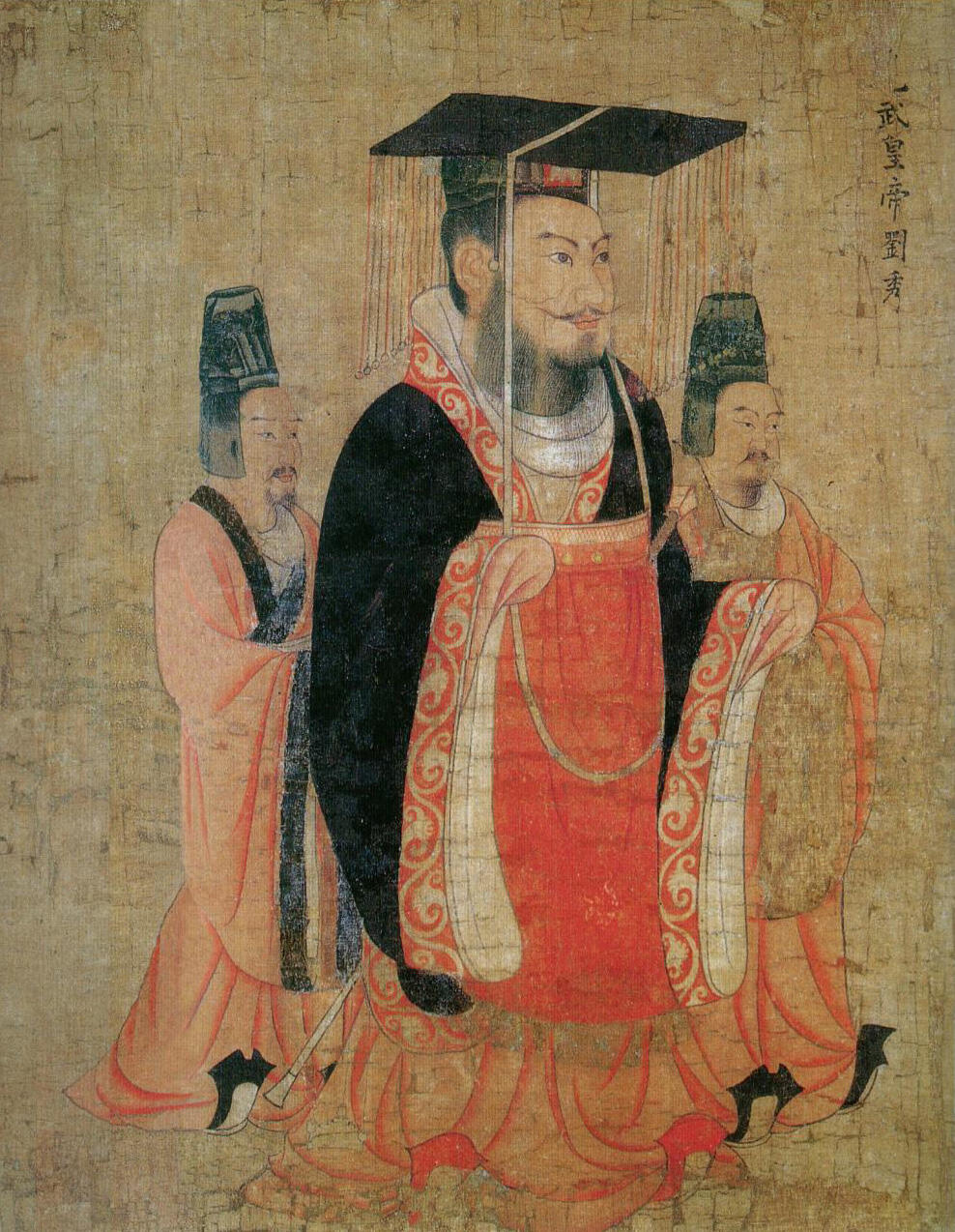
The Tang Dynasty lasted nearly 300 years (618-907 CE) and counts 28 rulers. By this time, advances in textile production (and new artistic sensibilities) afforded couples colourful Chinese wedding attire.
What men wore
- liáng guān lǐ fú (梁冠礼服)
- red outer garments with black and white trim
- jacket has very wide sleeves
- skirt features pleats
- headdress: lián huā guān (莲花冠)
What women wore
- chāi diàn lǐ yī (钗钿礼衣)
- dark green jacket over lighter green skirt
- wide, squared sleeves
- gold embroidered cuffs and collar gold
- phoenix headdress
With the black well and truly banished, style designers had no limits on their creativity. They embroidered dragons and phoenixes on the brides' jackets and skirts, and accessorised their creations. Among the most famous of such was a type of stole (霞帔 - xiá pèi) featuring embroidered phoenixes.
Toward the end of the Tang Dynasty and into the Qing Dynasty, the fèng guān xiá pèi (凤冠霞帔) Chinese wedding dress was the envy of every bride.
The Traditional Wedding Dress During the Qing Dynasty
The Qing Dynasty (1644 - 1912 CE) was a time of relative peace and prosperity in an increasingly united China. As such, rulers lived much longer; this dynasty saw only 12 emperors in power over its 268 years.
This time also saw rule change from Han, the majority population, to the Manchu, the 4th largest ethnicity. Naturally, Manchu rulers instilled their rules for proper attire, including for Chinese wedding clothes.
Today, practically every Chinese bride plans her wedding such that she will spend the most time wearing her elegant qipao. That's subject to change, though. Many people, celebrities as well as social media influencers, are doing their best to revive Hanfu styles.
What Chinese Wedding Clothes Represent
Modern Chinese brides have embraced the white wedding dress look, and the grooms seem equally happy to deck themselves out in Western suits and ties. Paying tribute to Western sensibilities lasts only so long, though.
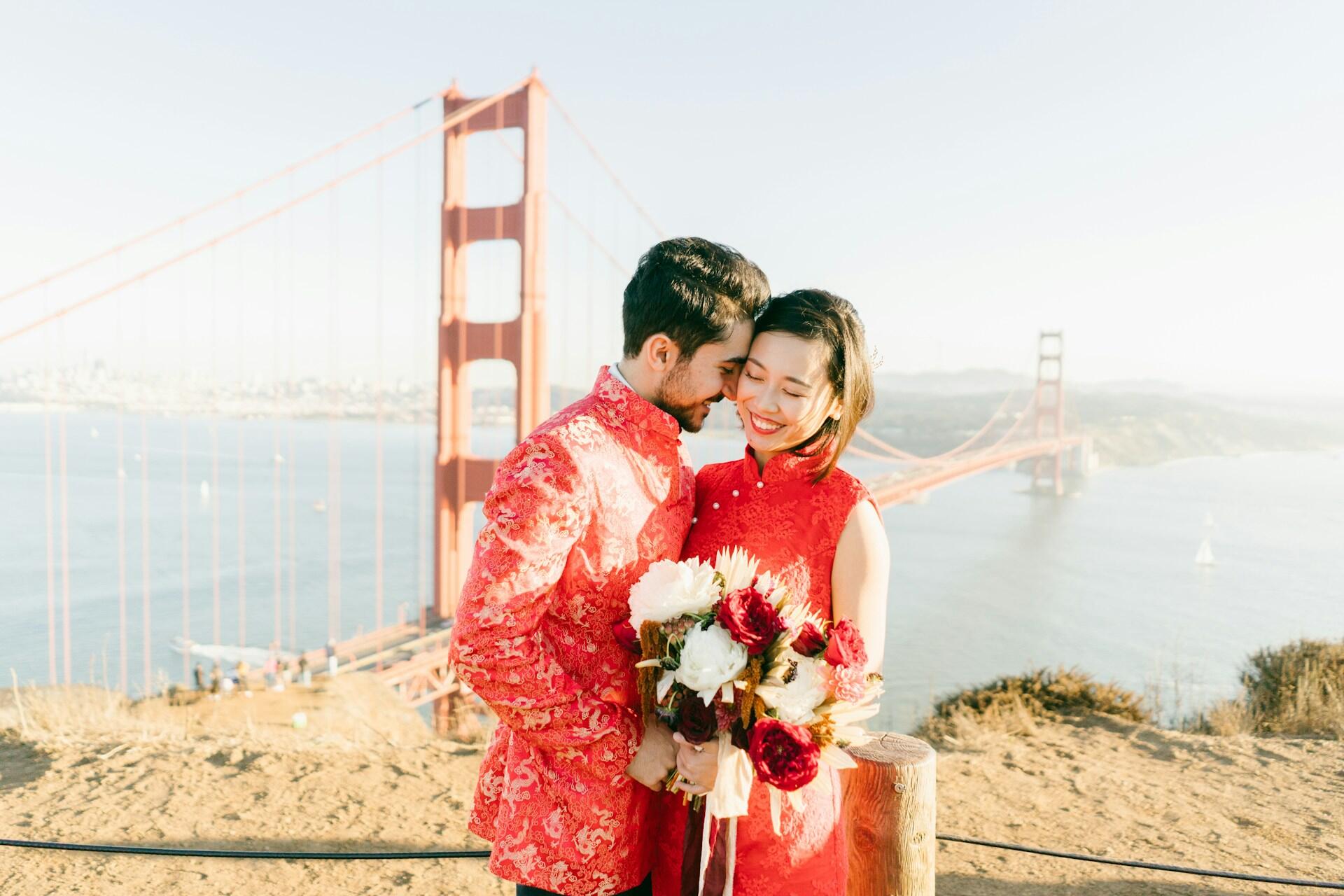
After the couple honour their parents and exchange vows, they rush to change their clothes. They re-enter the banquet hall wearing Chinese wedding attire. The bride is resplendent in her red-and-gold qipao; her groom is handsome in his red cháng shān (长衫) or táng zhuāng (唐庄).
Those wardrobe selections represent some of the most profound Chinese cultural markers. Those clothing styles themselves are a nod to China's past; their colours and decorations go even deeper.
Qí páo
- embroidered phoenixes
- phoenix represents empresses of old
- stands for virtue, harmony, and grace
- knot buttons, diagonal closure
- Qing Dynasty design
Táng zhuāng
- Embroidered dragons
- dragon represents past emperors
- stands for strength, prosperity, and wisdom
- knot buttons down the front
- Qing Dynasty design
Even while wearing their Western wedding clothes, the couple displays their Chinese cultural attachment. The bride may have peonies woven into her hair; the groom will likely have one on his lapel. Her 'Chinese' bride dress, though Western in appearance, has distinctly Chinese lines.
These must-know Chinese wedding symbols will help you weave elements of Chinese culture into your own big day. But don't take it from me; this clip points them out and explains them all.
What to Wear to a Chinese Wedding as a Guest
Full disclosure: this writer has attended weddings in deep-rural China as well as in major cities; in cities of all sizes, in fact. Weddings in all seasons, from people so bundled up they could barely hold their chopsticks to people fanning themselves in oppressive summer heat.
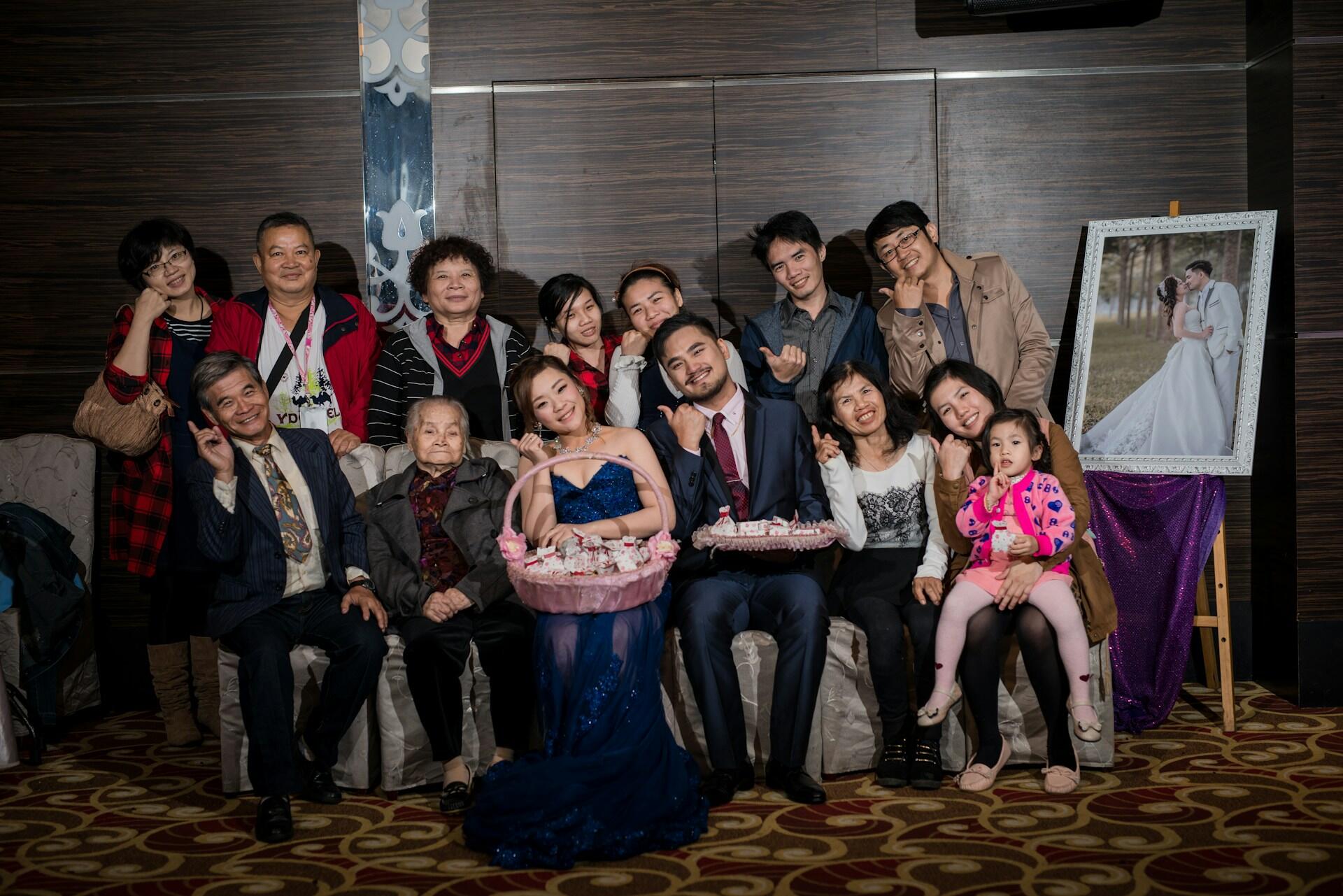
Thus, I speak from experience when I say that wedding participants have strict wardrobe guidelines. That group includes the bride and groom, their parents, and perhaps an attendant or two.
By contrast, guests have enjoyed wedding banquets wearing jeans with a decent shirt (not necessarily button-down).
Female guests are more likely to show off their style, wearing sassy or cute dresses, but they're under no obligation to do so. Everyone is very careful to not violate the one rule of wedding attendance in China.
Chinese wedding attire etiquette states that only the bride and groom (and, perhaps, their parents) may wear red.
In fact, it's best to avoid any shade of red when you attend a wedding in China, including maroon, wine red, and, especially, crimson. You're welcome to wear gold jewellery, so long as you limit yourself to discreet pieces. You probably couldn't outshine all the gold in the banquet hall, but it's best to err on the side of caution.
At the other end of the spectrum, you might be the type to dress formally — not a tuxedo, of course, but a nice suit and (not red!) tie. That's a nice way to show respect; just remember this rule.
Traditional Chinese wedding dress etiquette discourages wearing black because of its association with death and funerals.
Gentlemen cut just as dashing a figure in dark blue or grey pinstripes. But keep in mind that you might be overdressed in your suit. To be safe, you might ask the person who invited you. You never know; you might be attending a high-society wedding where formal dress is required!
With a modern guide to marriage rituals in China, you can avoid all these and other cultural faux pas. It would be such a shame for you to miss out on the full impact of a Chinese wedding because you're fretting over a cultural no-no!
Summarise with AI:
Did you like this article? Leave a rating!

 Loading...