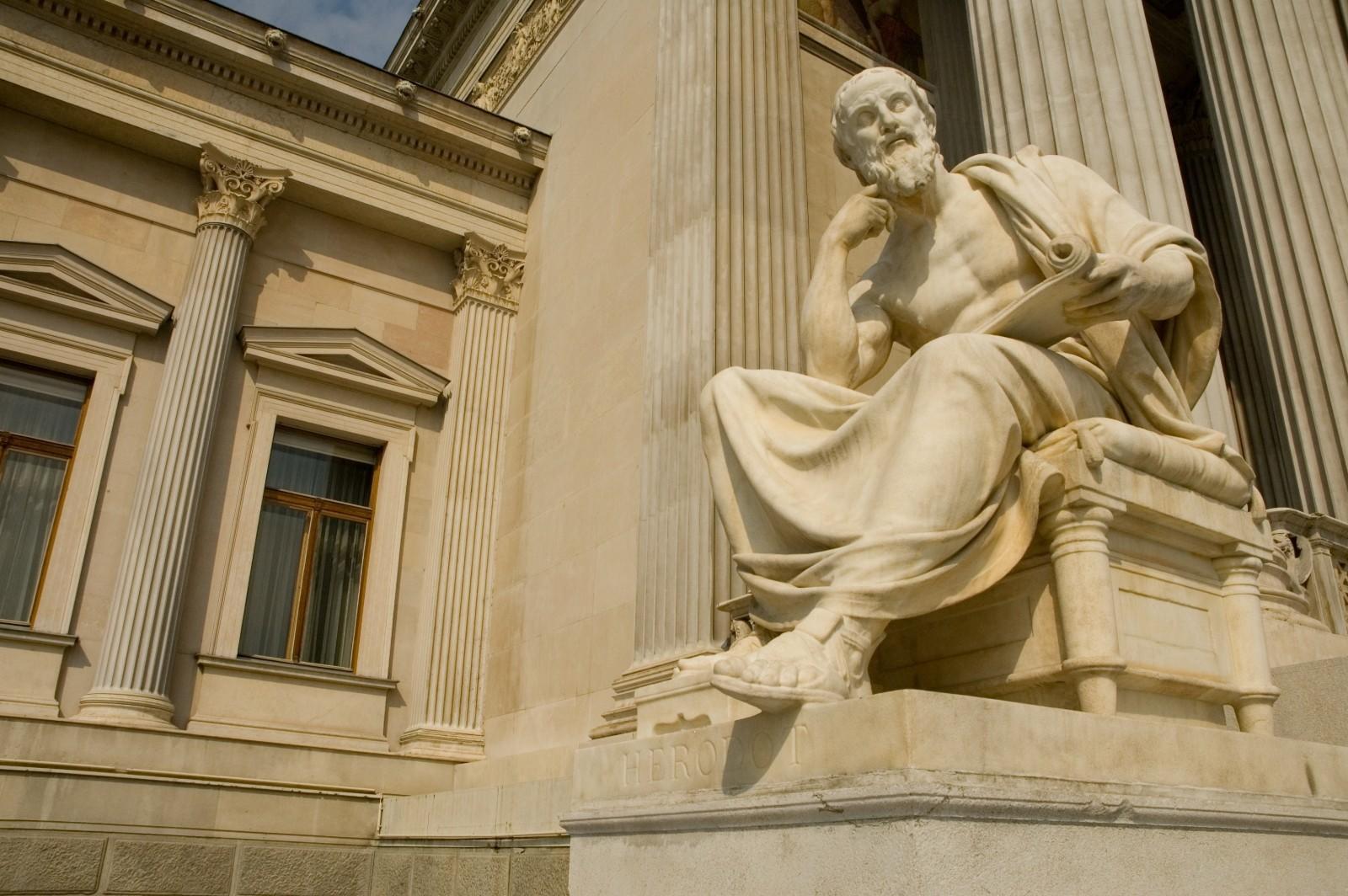

Anyone interested in the history of philosophy knows that France was one of the main centres of intellectualism during the Enlightenment. It has also produced some of the most famous modern philosophers. These influential thinkers appear on any comprehensive list of famous French people, so learning about their contributions is worthwhile!
| Philosopher | Birth | Death |
|---|---|---|
| Peter Abelard | 1079 | 1142 |
| Michel de Montaigne | 1533 | 1592 |
| René Descartes | 1596 | 1650 |
| Charles Louis de Secondat (Montesquieu) | 1689 | 1755 |
| François-Marie Arouet (Voltaire) | 1694 | 1778 |
| Jean Jacques Rousseau | 1712 | 1788 |
| Henri Poincaré | 1854 | 1912 |
| Jean-Paul Sartre | 1905 | 1980 |
| Simone de Beauvoir | 1908 | 1986 |
| Claude Lévi-Strauss | 1908 | 2009 |
| Maurice Merleau-Ponty | 1908 | 1961 |
| Michel Foucault | 1926 | 1984 |


Peter Abelard
At the top of our list of French philosophers is Petrus Abelaerdus, an 11th-century theologian. He was born in 1079 in Le Pallet in Brittany as the eldest son of a nobleman. His father encouraged his love of learning, and Peter first became known as a lecturer on dialectic, a form of philosophy based on the logical theory of Aristotle.
He subscribed to the school of Realism, according to which reality exists independent of perception. After his success in logic, he studied theology and in 1115 became master of Notre Dame and canon of Sens. He had an affair with the daughter of one of the canons during this time, which severely impacted his theological career. It ended with both Abelard and Héloïse living in convents. Their love letters to each other have survived as one of the great love affairs in history.
In the convent, Abelard focused more on religion but continued to teach dialectics until he died. He often came into conflict with the more traditional elements of the church. His greatest work is the Ethica (or Ethics), or Know Thyself. In it, he made the distinction between intent and action and argued that intent is where the true sin lies. He wrote in Latin, as French-language writers were still rare at that period.
Constant and frequent questioning is the first key to wisdom … For through doubting we are led to inquire, and by inquiry we perceive the truth.
Peter Abelard
Michel de Montaigne
Michel de Montaigne was born to a wealthy family in the region of Aquitaine in 1533. He was very influential at the French court and was known for his skill at mediation. At the age of 38, he retired to a tower room in the Château de Montaigne, where his library was located, isolating himself from friends and family. Ten years later, the noted scholar had finished his Essais.
Montaigne subscribed to Pyrrhonism, a school of sceptical ideology based largely on epistemology (the most renowned line from an essay is “I don’t know”); he frequently quotes the Greek philosophers Socrates and Plutarch as well as Erasmus of Rotterdam. The essays cover subjects ranging from child psychology (centuries before Freud) and education to religion to justice and politics. The essays had a fundamental influence on the great minds of the following centuries, from Francis Bacon to Pascal to Emerson.
Every other knowledge is harmful to him who does not have knowledge of goodness.
Michel de Montaigne
René Descartes
Born in France (La Haye) in 1596, Descartes spent many years in the Dutch Republic, where his writings would later influence a young Baruch Spinoza. A true polymath, Descartes is considered a founding father of Western philosophy and modern mathematics.
The most famous phrase from his writings is “Cogito ergo sum” - I think, therefore I am. In fact, the ontological theory of Cartesian dualism goes further and posits that the only indubitable reality is that of thinking and that the mind and body are separate and independent of each other. His moral philosophy sees ethics as a branch of science.
Descartes also ushered in an area of independent thinking in philosophy, breaking with tradition by refusing to base his reasoning exclusively on what others had written before him, extolling instead critical thinking. He heavily influenced the history of philosophy, inspiring other well-known thinkers such as Spinoza, Leibniz and David Hume.
In order to seek truth, it is necessary once in the course of our life, to doubt, as far as possible, of all things.
René Descartes
Montesquieu
Montesquieu, born in Château de la Brède in 1689, was a key thinker of the Enlightenment, best known for his theory of the separation of powers. As one of the most influential French political philosophers, his style of philosophy was with regard to government, law and politics.
In The Spirit of the Laws (1748), which he published anonymously, he argued that government should be divided into legislative, executive, and judicial branches to prevent tyranny. This idea was revolutionary at the time, directly challenging absolute monarchy. His work helped spread awareness of tyrants, whom he called despots, to help prevent their rise.
His work greatly influenced contemporary democratic systems, particularly the U.S. Constitution. As people were inspired by the notion of the separation of powers and a more even distribution of wealth and power. His ideas also helped set the French Revolution (1789–1799) into motion (indirectly). Montesquieu’s emphasis on balanced governance and individual liberty has shaped political attitudes for centuries.
Find great French classes Melbourne here on Superprof.
There is only one thing that can form a bond between men, and that is gratitude...we cannot give someone else greater power over us than we have ourselves.
Montesquieu
Voltaire
Voltaire was a fierce advocate for freedom of speech, religious tolerance, and reason. Through his writings, particularly Candide, he criticized superstition and oppressive institutions like the Church and monarchy. He, like Montesquieu, also believed in the separation of powers, particularly in the separation of Church and State.
His witty and often satirical style, in which he wrote many different types of media to appeal to a wide audience, made philosophy accessible to many. Of course, it also landed him in prison a few times, including an 11-month sentence in the Bastille, plus a mandated exile to England for two and a half years.
Voltaire’s ideas, conveyed in his books, plays, poems, and other writings, fueled the French Revolution and inspired later human rights movements. Napoleon Bonaparte I praised Voltaire's writings for their reasonable qualities. His belief in rational thought over blind faith helped shape modern secularism and free expression.
It is dangerous to be right in matters where established men are wrong.
Voltaire
Jean-Jacques Rousseau
Though born in Geneva in 1712, Jean-Jacques Rousseau was mainly active in France and was part of the Jacobin club during the French Revolution. He greatly influenced both Robespierre and Saint-Just’s ideology; it is believed he was their inspiration for making Deism France’s official religion during the first French Republic. Against Thomas Hobbes’ school of thought, Rousseau did not believe that man’s natural state was immoral.
Instead, he believed the universal ideal state of Humanity would be to live in a primitive society, according to his nature, but not without discipline. There was a lot of criticism of his moral principles in the eighteenth century. It bleeds into his political philosophy of a state self-governed by the people. Such a state needs are small, making certain there is a sense of community that would make a single person strive for the good of all.
His theories on child education emphasize teaching through consequence rather than punishment.
The supreme enjoyment is in satisfaction with oneself ; it is in order to deserve this satisfaction that we are placed on earth and endowed with freedom.
Jean-Jacques Rousseau
Henri Poincaré
Born in 1854 in Nancy, Henri Poincaré is most famous for his mathematical discoveries. He worked as a civil mining engineer and taught mathematics at the Sorbonne. Similar to Immanuel Kant and against, his philosophy saw mathematics not as an analytic science, but as a synthetic one.
Despite a generally deterministic view of the universe, he also saw creativity as consisting of two stages, one of random notions followed by the critical evaluation thereof, inspiring Daniel Dewitt’s notion of free will. He was not an empiricist, but somewhere between a realist and an anti-realist. Check for French lessons Sydney here on Superprof.
Thought must never submit, neither to a dogma, nor to a party, nor to a passion, nor to an interest, nor to a preconceived idea, nor to whatever it may be, save to the facts themselves, because, for thought, submission would mean ceasing to be.
Henri Poincaré
Jean-Paul Sartre
Born in 1905, novelist Sartre is well-known for his open relationship with Simone de Beauvoir, but he is also one of the greatest philosophers of modern times. A phenomenologist and existentialist, his ideas influenced various branches of the humanities, from sociology to literature.
He combined both philosophies, seeing the possibility inherent in phenomenology to understand, not the world around us, but human existence itself. One of the main aspects is the search for authenticity in the identity of the self. Since consciousness exists independently or in itself, yet it is always conscious of itself in terms of its relationship to other things, for-itself, to prevent self-delusion, it must find a project that is a universal expression of the human condition, thus allowing it to resonate with others. He long viewed Marxism as allowing that philosophy to unfold by striving toward the common good - a universal project based on authenticity rather than imposed power.
Find a great French language course here on Superprof.
I am condemned to be free.
I am condemned to be free.
Simone de Beauvoir
Oddly enough, three of the most influential French thinkers of the twentieth century were born in the same year: 1908. One of the great French writers of the 20th century, Simone de Beauvoir, did not consider herself a philosopher. And yet she was greatly influential in many areas of philosophy, especially feminist existentialism and the social theory of feminism, much in the tradition of earlier women philosophers such as Mary Wollstonecraft.
She pioneered sex-gender distinction and the idea that much of what defines a woman in modern society is learned, influenced by society’s views of how a woman should think or act. She first believed that a socialist revolution would bring about the necessary changes in belief and morality to equalize the gender shift. Later, though, she would abandon her Marxist views. She was a friend of Merleau-Ponty and had a long-time relationship with Jean-Paul Sartre.
Self-knowledge is no guarantee of happiness, but it is on the side of happiness and can supply the courage to fight for it.
Simone de Beauvoir
Claude Lévi-Strauss
Another social philosopher born in 1908 was Claude Lévi-Strauss. He approached philosophy from more of an anthropologist’s viewpoint and is considered one of the founding fathers of present-day ethnology and sociology.
Born of French Jewish parents in Brussels, he studied law and philosophy at the Sorbonne before accompanying his wife, an ethnologist, to Brazil to teach sociology. Unlike the thinkers of previous centuries, he saw no difference between the “savage” and the “civilised” mind and sought to understand the human condition and how we build societies.
He pioneered the theory of structuralism, or structuralist functionalism, according to which society is a complex system working in essence toward stability through political systems and social etiquette. He looks beyond the trappings of the different societies to the fundamental aspects behind them in search of the base level of man's mythological thought and the patterns into which it is translated.
I never had, and still do not have, the perception of feeling my personal identity. I appear to myself as the place where something is going on, but there is no ‘I’, no ‘me.’
Claude Lévi-Strauss
Maurice Merleau-Ponty
Influenced by Martin Heidegger and Edmund Husserl, Merleau-Ponty subscribed to the phenomenology school of thought, which concentrated on human experience and consciousness. However, he saw certain flaws in it and developed it further into existential phenomenology.
His ideas also fit into the structuralism and post-structuralism moulds. He also delved deeply into the French language and how children acquire it, working with sociology, psychoanalysis and group anthropology. He also wrote about Art and science and their relation to consciousness.
Language transcends us and yet, we speak.
Maurice Merleau-Ponty
Michel Foucault
Michel Foucault, born in 1926, focused mainly on the theory of knowledge and power. He challenges our view of power as something negative and imposed, and instead redefines it as something changing and interactive. His views correspond to the schools of poststructuralism and postmodernism.
His musings range from the field of psychology, in which he argues that madness is the normal state, with mental illness resulting from alienation. In that vein, he also studied the history of mental illness and its perception and that of modern medicine; much of his work is grounded in historical analysis, analyzing the shifts of perception throughout history and its impact on various theoretical constructs.
There are more ideas on earth than intellectuals imagine. And these ideas are more active, stronger, more resistant, more passionate than "politicians" think.
Michel Foucault
With these names, you will be well on your way to becoming a French citizen in your mind as well as in your heart! If you are intrigued by the above, then why not search 'French courses' in your search bar and see what more you could learn!
Summarise with AI:
Did you like this article? Leave a rating!

 Loading...