
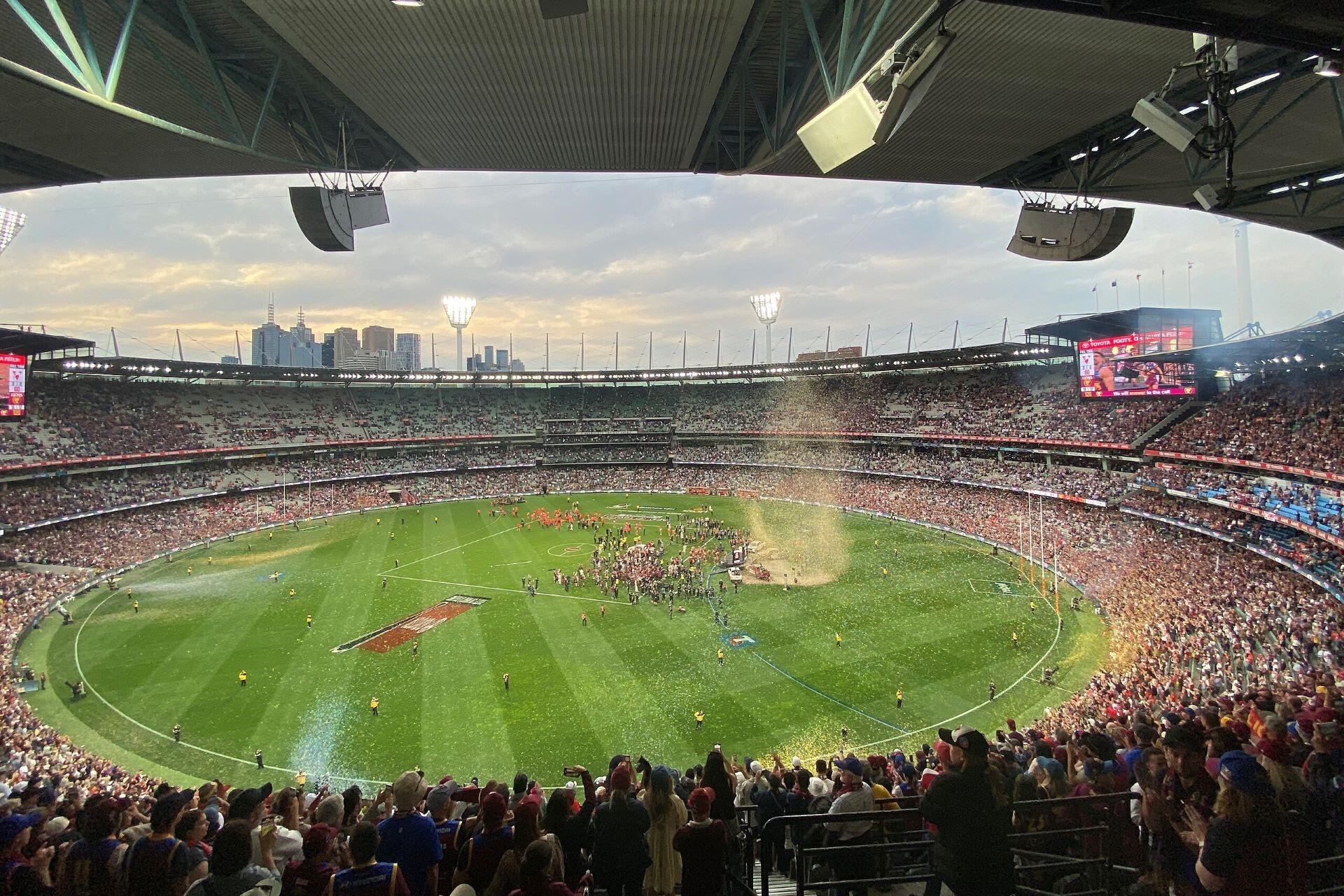

From 2000 to 2025, the AFL used the Final Eight system to determine its premier. The top eight clubs qualified for a four-week finals series, with the top four receiving a double chance and the teams finishing fifth to eighth facing elimination from their first match.
The system was replaced in 2026 when the AFL introduced the Final Ten and Wildcard Round, but the Final Eight remains an important part of modern AFL history — and much of its structure still forms the basis of the current finals bracket.
Looking for the current format? See our guide to how the AFL Finals work today


AFL Final Eight at a Glance
| Property | Description |
|---|---|
| Used | 2000–2025 |
| Teams | Top eight |
| Length | Four weeks |
| Top four | Entered through Qualifying Finals with a double-chance pathway |
| 5th–8th | Faced elimination from their first final |
| Replaced by | Final Ten system in 2026 |
What Was the AFL Final Eight System?
The AFL Final Eight was the finals format used from the 2000 season until the end of 2025.
At the completion of the home-and-away season, the clubs finishing first to eighth on the ladder qualified for the Finals Series. The official AFL regulations in place during the final season of the system still specified that the first eight clubs would compete under the Final Eight format.
However, all eight teams did not begin the finals on equal terms.
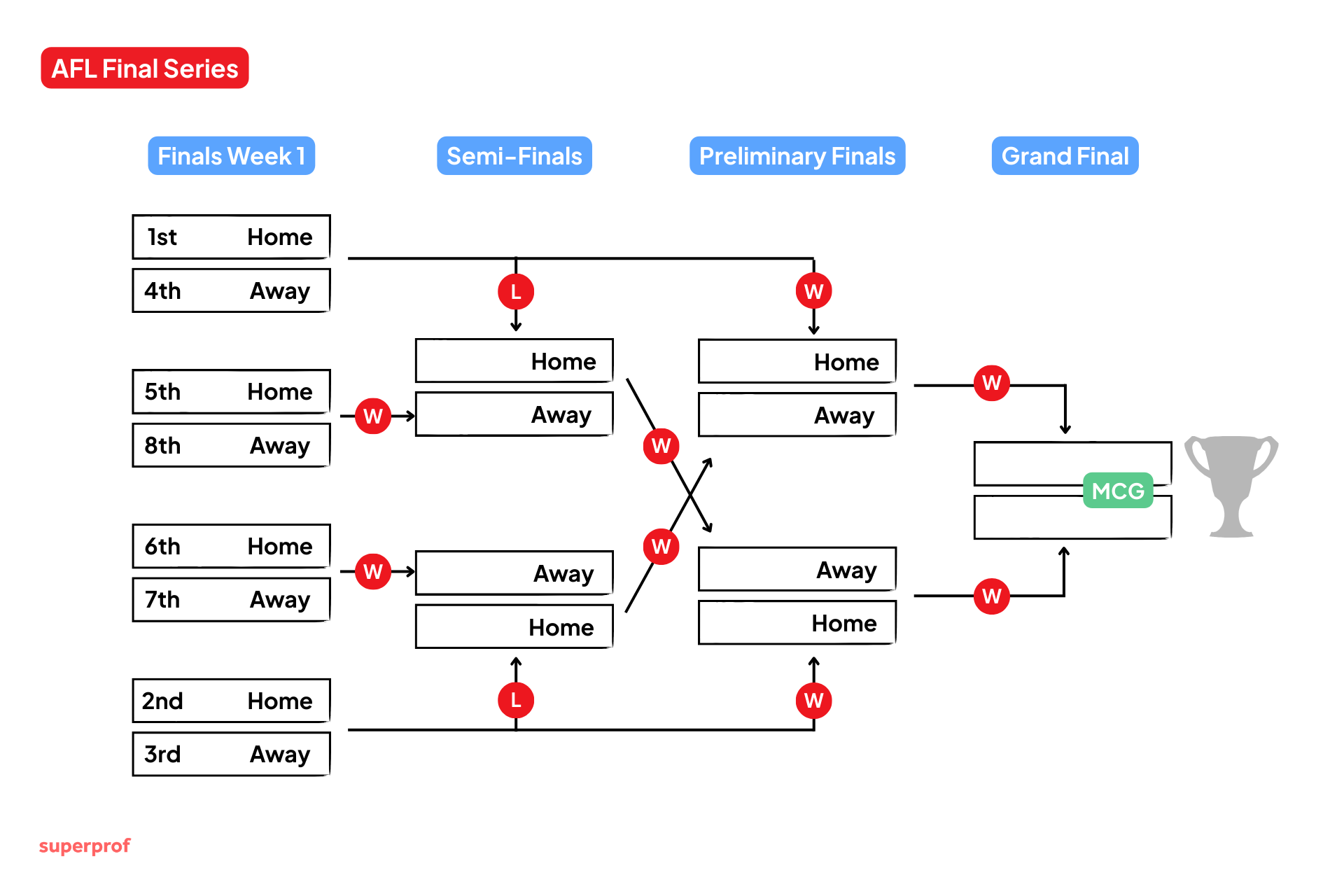
The clubs finishing in the top four entered through the Qualifying Finals. A loss in their opening match did not eliminate them immediately, giving them what is commonly known as the double chance.
Teams finishing fifth to eighth entered through the Elimination Finals instead. For those clubs, every finals match was knockout football: one defeat meant the end of their season.
The Final Eight therefore rewarded a strong home-and-away season while still giving all eight finalists a path to the premiership.
Week 1: Qualifying Finals vs Elimination Finals
The first week of the AFL Finals Series features four matches. These are split between the top four teams and the clubs that placed from fifth to eighth on the ladder. The system rewards clubs that finish higher up at the top of the ladder by giving them a second opportunity if they falter early. This is relatively unique in sporting leagues.
Qualifying Finals (Top Four Teams)
Elimination Finals (Fifth to Eighth)
Teams know that one bad game can end their premiership hopes. Conversely, a win can spark the momentum they need to reach the end of September. While the higher-ranked teams have a second chance, they don't really want to have to play extra matches on their route to the premiership.
What Did the Double Chance Mean?
The double chance was one of the defining features of the Final Eight system.
It did not mean that a top-four team could lose any finals match and remain in the competition. The protection applied specifically to its opening Qualifying Final.
If a top-four team won its Qualifying Final, it progressed directly to a Preliminary Final. If it lost, it received another opportunity by entering a Semi Final the following week.
By comparison, clubs starting in the Elimination Finals had no safety net. The difference created two very different potential routes through September.
A top-four team could reach the Grand Final through:
Qualifying Final → Preliminary Final → Grand Final
A team finishing fifth to eighth had to survive:
Elimination Final → Semi Final → Preliminary Final → Grand Final
That made a top-four finish particularly valuable: it offered both protection from an opening loss and the possibility of reaching the Grand Final after playing fewer matches.
Week 2: AFL Semi-Finals Explained
The semi-finals take place in the second week of the AFL Finals Series. By this point, two clubs are already eliminated. At the same time, the top four teams still have the advantage they earned during the regular season. These games are sudden-death contests. Winners move through to the preliminary finals while losers are eliminated from the series.
The semi-finals produce some of the most gripping matches of September football. This is where higher-ranked clubs are fighting to keep their season alive, whereas underdogs are looking to cause an upset.

Week 3: AFL Preliminary Final Meaning
The preliminary finals often produce an electric atmosphere. These decide who plays in the AFL Grand Final. Expect some intense games.
The preliminary finals are sometimes called the “final four” stage. The stakes couldn't be higher. This match takes you to the Grand Final. A loss will put an end to your season.
Week 4: The AFL Grand Final?
At the end of the four-week finals series, the two preliminary final winners meet to decide who will be crowned the premiership team for the season.

This is traditionally held on the last Saturday in September at the Melbourne Cricket Ground (MCG).
The only exceptions were during the COVID-19 pandemic, when the matches were held at the Gabba in Brisbane (2020) and Optus Stadium in Perth (2021). The Grand Final is the biggest day on the Australian sporting calendar.
This is more than just a football match. Over 100,000 fans pack into the stadium with millions more watching at home. The build-up includes the Grand Final Parade, half-time entertainment, and special presentations.
For the players, this is their chance to make AFL history by lifting the premiership cup. Fans get to witness the end of the season-long journey that started back in March.
What Happens if an AFL Final is Drawn?
It's rare, but AFL finals can finish with the scores level at the end. There are rules for handling a draw. These were overhauled in 2016, but here's how they were both before and after the change.
Before 2016
Since 2016
The 2010 AFL Grand Final between Collingwood and St Kilda ended in a dramatic draw, with both teams tied at 68 points each. More than 100,000 fans had to return the following Saturday for the replay, where Collingwood dominated to win by 56 points. This was the last replay in VFL/AFL history, as the rules changed in 2016 to introduce extra time and golden score.
Was the AFL Final Eight Always the Same?
No.
The system used from 2000 to 2025 was not the AFL's first eight-team finals format.
The AFL introduced its first Final Eight in 1994 using the McIntyre Final Eight system, which remained in place until 1999.
A different Final Eight format was then introduced for the 2000 season. That was the system based on:
- 1st vs 4th
- 2nd vs 3rd
- 5th vs 8th
- 6th vs 7th
and it remained in use through the 2025 season.
The distinction is important:
1994–1999
McIntyre Final Eight
2000–2025
Final Eight system explained in this article
2026–present
Final Ten system with Wildcard Finals
The term "Final Eight" can therefore refer to more than one historical system, even though the 2000–2025 format is the one most recent AFL supporters are likely to remember.

What Did the Final Eight System Reward?
The structure of the Final Eight created very different pathways depending on where a club finished on the ladder.
A top-four finish
The strongest advantage belonged to teams finishing first to fourth.
They:
- entered through a Qualifying Final;
- could survive an opening defeat;
- could advance directly to a Preliminary Final with a win;
- and potentially reached the Grand Final after playing fewer finals.
Finishing fifth or sixth
Fifth and sixth did not receive a double chance, but they entered the series against lower-ranked opponents in their Elimination Finals.
They still needed to win every match to remain alive.
Finishing seventh or eighth
Seventh and eighth qualified for September football, but their route was particularly difficult.
They entered immediately into an away or lower-seeded knockout pathway and needed four consecutive finals wins to claim the premiership.
The Final Eight therefore gave all eight clubs a possible route to the flag while providing clear advantages to teams that had performed more strongly across the home-and-away season. The AFL's own explanation of the system highlighted the top four's double chance and the need for teams fifth to eighth to win every finals match.
Sources
- Australian Football League (AFL), The Final 8 System Explained. AFL explanation of the Final Eight structure introduced in 2000, including the Week 1 match-ups, double chance and progression through the Semi and Preliminary Finals. https://www.afl.com.au/news/534772/the-final-8-system-explained
- Australian Football League (AFL), The Final Eight. Historical overview of AFL/VFL finals systems and the transition from the 1994–1999 McIntyre Final Eight to the system introduced in 2000. https://www.afl.com.au/news/74747/the-final-eight
- Australian Football League (AFL), AFL Regulations (14 February 2025). Official regulations from the final season of the Final Eight, covering qualification for the Finals Series and the procedure for tied finals. https://resources.afl.com.au/afl/document/2025/02/13/21512043-62ed-4256-b553-99f40450fcc5/AFL-Regulations-effective-14-February-2025-Final-.pdf
- Australian Football League (AFL), Explained: What Are the Wildcard Finals and How Do They Work? (2026). Official explanation of the transition from the 2000–2025 Final Eight to the Final Ten system and Wildcard Round. https://www.afl.com.au/news/1589531/what-is-wildcard-round-and-how-does-it-work-rankings-system-explained-finals-history-and-more
Summarise with AI:
Did you like this article? Leave a rating!

 Loading...
