

The AFL Finals Series decides the premiership at the end of every season, but the pathway to the Grand Final changed significantly in 2026.
The AFL now uses a Final Ten system: the top six teams bypass the Wildcard Round, while seventh to tenth play for the final two places in the main eight-team finals bracket.
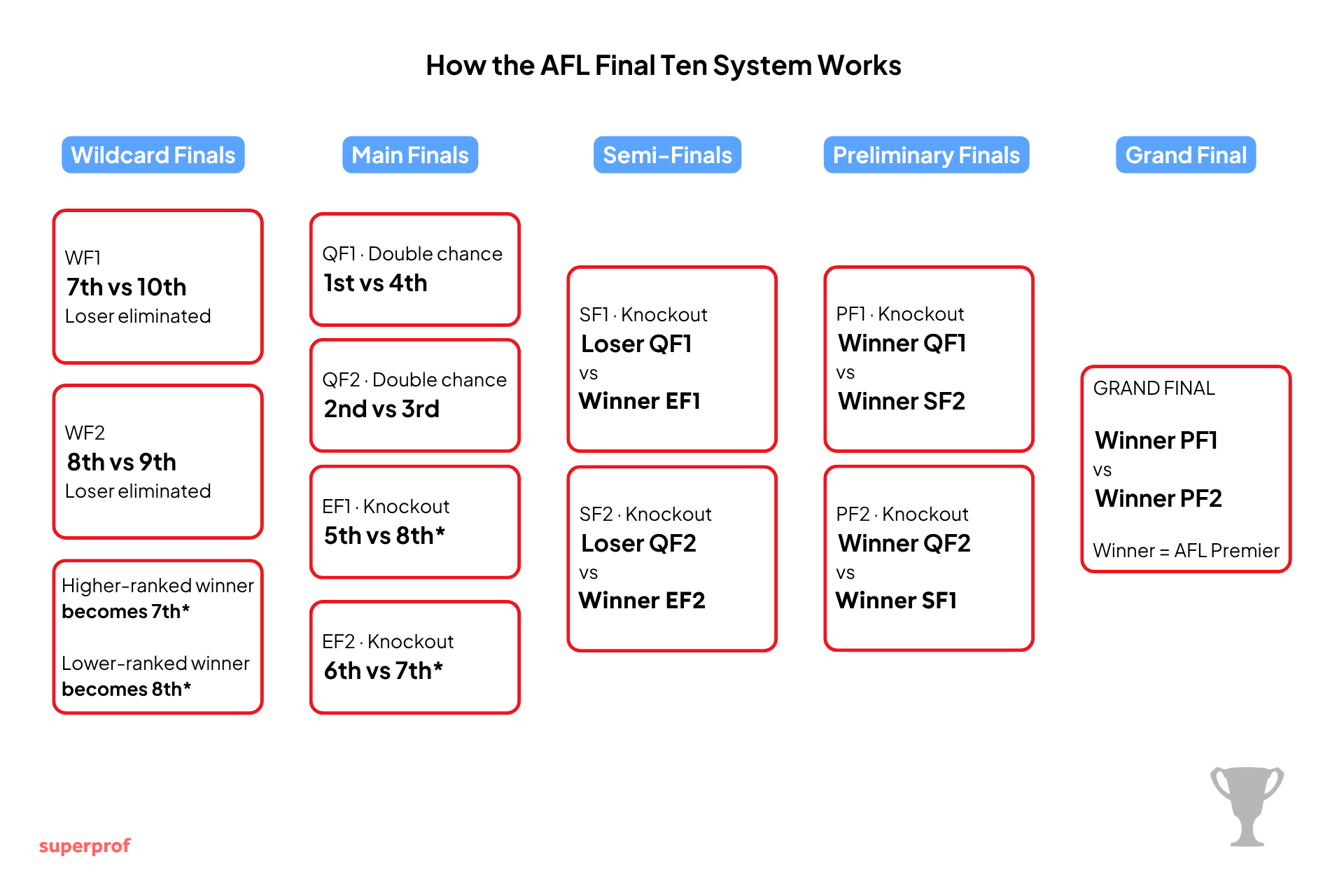
How to read the Final Ten bracket? The finals begin with 10 teams. After the Wildcard Round, eight remain and progress through Qualifying and Elimination Finals, Semi Finals and Preliminary Finals before the final two clubs meet in the Grand Final.


AFL Finals: Quick Definitions
Before diving into each round, here are the key AFL finals terms you need to know.
| Term | Meaning |
|---|---|
| Wildcard Final | 7th–10th elimination round |
| Qualifying Final | Top-four match with double chance |
| Elimination Final | Lose and you're out |
| Semi Final | Knockout match leading to prelims |
| Preliminary Final | Winner reaches Grand Final |
| Grand Final | Premiership decider |
| Double chance | QF loser gets another match |
What Is the AFL Finals Series?
The AFL Finals Series is the competition played at the end of the home-and-away season to decide the AFL premier. A team's finishing position on the ladder determines how it enters the finals and what route it must take towards the Grand Final.
Under the Final Ten system introduced in 2026, the first 10 teams remain in premiership contention when the home-and-away season ends. However, they do not all enter the finals at the same stage.
Teams finishing first to sixth receive the opening weekend off, while the teams ranked seventh to tenth compete in the Wildcard Round. The two Wildcard winners then join the top six, leaving eight clubs in the main finals bracket.
Here's the simplest way to understand what happens based on ladder position:
A simple way to think about the system is:
| Ladder position | Finals pathway |
|---|---|
| 1st–4th | Qualifying Finals and double chance |
| 5th–6th | Elimination Finals |
| 7th–10th | Wildcard Round |
| 11th–18th | Season ends |
Finishing higher on the ladder therefore remains extremely valuable. The higher a team finishes, the shorter — and potentially more forgiving — its route to the Grand Final.
How Does the AFL Wildcard Round Work?
The Wildcard Round is the opening stage of the AFL Finals Series.
An opening-round elimination match for teams finishing 7th to 10th. The two winners progress to the main eight-team finals bracket.
It involves the four teams that finish between seventh and tenth on the ladder:
- 7th plays 10th
- 8th plays 9th
Both are knockout matches. The two losing teams are eliminated, while the two winners progress into the eight-team finals bracket.
The teams finishing first to sixth do not play during Wildcard weekend.
What happens to the Wildcard winners?
The two winning clubs are ranked according to where they originally finished on the home-and-away ladder.
The higher-ranked Wildcard winner becomes the higher of the two remaining qualifiers, while the other becomes the lower-ranked qualifier.
That determines the Elimination Final match-ups:
- 5th plays the lower-ranked Wildcard winner
- 6th plays the higher-ranked Wildcard winner
For example, imagine the teams finishing seventh and ninth both win their Wildcard Finals. Seventh would be the higher-ranked winner and ninth the lower-ranked winner.
Sixth would therefore play seventh, while fifth would play ninth.
This system ensures that finishing fifth or sixth still provides an advantage even though those clubs do not receive the same double chance as the top four.
How Does the AFL Finals Bracket Work?
Once the Wildcard Round is complete, eight teams remain.
The competition then moves into a structure built around two Qualifying Finals and two Elimination Finals.
| Final | Match-up | What happens to the winner? | What happens to the loser? |
|---|---|---|---|
| Qualifying Final | 1st vs 4th | Advances directly to a Preliminary Final | Moves to a Semi Final |
| Qualifying Final | 2nd vs 3rd | Advances directly to a Preliminary Final | Moves to a Semi Final |
| Elimination Final | 5th vs lower-ranked Wildcard winner | Advances to a Semi Final | Eliminated |
| Elimination Final | 6th vs higher-ranked Wildcard winner | Advances to a Semi Final | Eliminated |
The crucial difference is therefore between a Qualifying Final and an Elimination Final.
Qualifying Final
A match involving the top four teams. Winners advance directly to the Preliminary Finals, while losers receive a second chance in the Semi Finals.
Elimination Final
A knockout match. The winner progresses to a Semi Final, while the losing team's season ends.
A club can lose a Qualifying Final and remain in the premiership race. Lose an Elimination Final and the season is finished. This is why a top-four finish is so valuable.
What Does the Double Chance Mean in AFL Finals?
You'll often hear AFL commentators talk about the importance of securing a double chance.
The advantage given to top-four teams: losing their opening Qualifying Final does not eliminate them, as they get another opportunity in a Semi Final.
The term can sound more complicated than it actually is.
Teams that finish in the top four enter the finals through the two Qualifying Finals:
- 1st vs 4th
- 2nd vs 3rd
Winning a Qualifying Final provides a major advantage. The winner advances directly to a Preliminary Final and receives another week off.
Losing a Qualifying Final, however, does not immediately eliminate the team.
Instead, that club moves into a Semi Final and gets another opportunity to remain in the competition.
That's the double chance.
Qualifying Final
- Lose → still alive.
- Win → Preliminary Final.
Elimination Final
- Lose → eliminated.
- Win → Semi Final.
It doesn't mean a top-four team can lose twice at any point in the finals and continue playing. Rather, it means that losing its opening Qualifying Final does not end its season.
Teams entering the Elimination Finals don't have that protection. From their first match onwards, every defeat means elimination.
Why is finishing in the top four so important?
Consider the difference between the two possible routes.
A top-four team could reach the Grand Final by:
Qualifying Final → Preliminary Final → Grand Final
A club entering through an Elimination Final must win:
Elimination Final → Semi Final → Preliminary Final → Grand Final
A team entering through the Wildcard Round faces an even longer route:
Wildcard Final → Elimination Final → Semi Final → Preliminary Final → Grand Final
Finishing higher on the ladder therefore reduces the number of matches a club needs to survive and can provide additional recovery time between games.
What Happens in the Semi Finals?
After the Qualifying and Elimination Finals, six teams remain. The two Qualifying Final winners have already progressed directly to the Preliminary Finals. The other four clubs contest two Semi Finals.
A knockout match between a Qualifying Final loser and an Elimination Final winner. The winner advances to a Preliminary Final.
Each Semi Final brings together:
- a team that lost a Qualifying Final, and
- a team that won an Elimination Final.
Unlike the Qualifying Finals, there is no second chance at this stage.
The Semi Finals are knockout matches. Win and the club reaches a Preliminary Final. Lose and its season is over.
This creates one of the defining features of the finals system: the higher-ranked teams receive an early safety net, but by the latter stages of September, every club faces elimination if it loses.
How Do the Preliminary Finals Work?
Four teams reach the Preliminary Finals.
The final step before the Grand Final. The two winners qualify for the premiership decider.
The two clubs that won their Qualifying Finals return after having a week off, while the two Semi Final winners arrive after surviving another knockout match.
Each Qualifying Final winner faces a Semi Final winner. There is no double chance at this stage.
The Preliminary Finals are straightforward knockout football:
Win → Grand Final
Lose → season over
For many supporters, Preliminary Final weekend is one of the most intense parts of the AFL season. There are only four clubs left, and each is one victory away from playing for the premiership.
How Do Teams Reach the AFL Grand Final?
The winners of the two Preliminary Finals qualify for the AFL Grand Final.
The Grand Final is the final match of the AFL season and determines the premiership winner. There is no second chance, no additional round and no ladder advantage once the match begins.
The team that wins the Grand Final becomes the AFL premier for that season.
A club's route to the Grand Final can therefore be very different depending on where it finished on the ladder. A team finishing inside the top four may need to win only a Qualifying Final and Preliminary Final to qualify. A club coming through the Wildcard Round could need four consecutive finals victories simply to reach the Grand Final.
Want to explore the history of the competition? Take a look at our guide to AFL Grand Final winners.
How Did the AFL Finals Format Change in 2026?
The AFL Finals Series did not always work this way.
From 2000 to 2025, the competition used a Final Eight system. Only the top eight teams on the home-and-away ladder qualified, and the finals began immediately with the Qualifying and Elimination Finals.
That changed in 2026 with the introduction of the Wildcard Finals Round.
The finals field expanded from eight to 10 teams, with seventh to tenth playing two elimination matches before the remaining eight teams entered the established finals bracket.
The Wildcard Round also replaced the pre-finals bye that had been part of the AFL calendar since 2016.
The result is a five-stage pathway:
Stage 1
Wildcard Finals
Stage 2
Qualifying and Elimination Finals
Stage 3
Semi Finals
Stage 4
Preliminary Finals
Stage 5
Grand Final
The structure after the Wildcard Round remains closely related to the Final Eight system used between 2000 and 2025, but the new opening round gives two additional clubs an opportunity to compete in the finals.
| Until 2025 | From 2026 |
|---|---|
| Final Eight | Final Ten pathway |
| Top 8 entered finals | Top 10 remain in contention |
| Pre-finals bye | Wildcard Round |
| 9 finals | 11 finals |
If you want to understand the old format in more detail, read our guide to the AFL Final Eight system and how the finals worked from 2000 to 2025.

Understanding the AFL Finals at a Glance
If all the different rounds still seem a little complicated, this is the simplest way to remember the system:
Teams 7th–10th:
Must survive the Wildcard Round.
Teams 5th–6th:
Skip the Wildcard Round but begin in an Elimination Final.
Teams 1st–4th:
Enter through the Qualifying Finals and have access to the double chance.
After the opening finals:
The competition narrows through the Semi Finals and Preliminary Finals.
Final two teams:
Meet in the AFL Grand Final to decide the premiership.
The higher a team finishes during the home-and-away season, the more favourable its path becomes. But once the competition reaches the knockout stages, one result can bring an entire season to an end.
Key Takeaways
- Since 2026, the AFL Finals Series has used a Final Ten system.
- Teams finishing 1st–6th bypass the Wildcard Round, while 7th plays 10th and 8th plays 9th.
- The two Wildcard winners join the top six to create the eight-team main finals bracket.
- The top four teams enter Qualifying Finals and receive a double chance if they lose their first final.
- Teams progress through Qualifying or Elimination Finals, Semi Finals and Preliminary Finals before the two remaining clubs meet in the Grand Final.
Sources
- Australian Football League (AFL), AFL Regulations (11 February 2026). Official competition regulations covering the Final Ten system, finals qualification, finals venues, club rankings and the additional-time procedure for tied finals. https://resources.afl.com.au/afl/document/2026/02/13/54c158af-15e9-483b-a195-62a0f4e33b11/AFL-Regulations-Final-11-February-2026-.pdf
- Australian Football League (AFL), Explained: What Are the Wildcard Finals and How Do They Work? (2026). Official explanation of the Wildcard Round, the 7th v 10th and 8th v 9th match-ups, Wildcard re-ranking, the Final Ten structure and the history of AFL finals systems. https://www.afl.com.au/news/1589531/what-is-wildcard-round-and-how-does-it-work-rankings-system-explained-finals-history-and-more
- Australian Football League (AFL), Wildcard Finals Round (2025). Official announcement introducing the Wildcard Finals Round from the 2026 season, including the expansion to 10 teams, the Wildcard match-ups and how the two winners are ranked before the main finals series. https://www.afl.com.au/news/1451971/wildcard-finals-round
Summarise with AI:
Did you like this article? Leave a rating!

 Loading...