

Pi is an irrational number that roughly equals 3.14159, though pi actually has an infinite number of non-repeating digits. Pi represents the ratio of a circle's circumference to its radius squared (C = πr2) or to its diameter (2π). You've likely seen pi in your maths textbooks but engineers, physicists, and scientists of all types also rely on pi. Now, get set for adventures in pi you never expected.
The Value of Pi Beyond Circumferences
- The Babylonians were the first to record the approximate value of pi in 1680 BCE.
- Pi did not have a widely accepted mathematical symbol until 1748.
- Pi has many applications in mathematics, physics and engineering, and even in everyday life.
- The World Pi Federation provides tools and tips to memorise pi for entry into the Pi-100 Club.


What is Pi?
Mathematically, π is essential for calculating the circumference and area of a circle, as well as the volume of a sphere. But pi has many more uses across various scientific disciplines, including to describe waveforms in physics.
Pi is a mathematical constant. Its value remains the same regardless of the size of whatever the dimensions of the form being calculated.
The mathematical symbol π is a Greek letter derived from the first letter of the Greek words periphereia (περιφέρεια, meaning "periphery") and perimetros (περίμετρος, meaning "perimeter").
The earliest recorded use of the pi symbol dates back to 1647, by Welsh mathematician William Oughtred. The Swiss mathematician Leonhard Euler popularised the use of π in 1748 through his influential work, Introduction to the Analysis of the Infinite.
1. Pi is irrational: it cannot be expressed as fraction.
2. Pi is transcendental: it answer any polynomial equation with integer coefficients.
3. Pi is possibly normal (a number with a finite sequence of decimal places): its digits may be randomly and evenly distributed.
Who Discovered Pi: Developments Throughout History
Today, the most powerful computers can determine up to 13 trillion decimal places of Pi. However, that wasn't always the case. In fact, ancient mathematicians established pi as an estimated value.
In his essay on the Measurement of a Circle, Archimedes describes how to estimate the perimeters of polygons1.
Other Civilisations That Studied Pi
Much of the mainstream focus remains on the keen minds of the ancient Fertile Crescent, such as those listed above. In keeping our focus so narrow, we overlook contributions by mathematicians such as Zu Chongzhi (429 - 500 CE). This Chinese polymath established the accurate value of pi to the sixth decimal place, a calculation that remained the standard for more than 900 years.
To achieve this standard, Zu Chongzhi relied on Liu Hui's π algorithm.
Lui Hui (ca. 220 to 295 CE), himself a mathematician, expanded Archimedes' theoretical polygon to a 3,072-sided gon2, resulting in an approximate π value of 3.14159. Zu took the idea further still, envisioning a 12,288-sided gon. In arriving at his 7-place pi value, set the measure that remained unchallenged for nearly a millennium.
The Value of Pi: Calculating Pi Through the Ages
Though not exactly among the most famous mathematical paradoxes, finding the 'end of pi' continued to obsess the sharpest mathematical minds. To wit, the Persian astronomer Jemshid al Kashi presented the first 14 decimal places of Pi in the15th century.

How many numbers are in pi? Western mathematicians didn’t approach Pi until a few centuries after clever minds elsewhere were addressing that question. In the 12th century, Leonardo da Pisa proposed interesting approximations of Pi. You likely know him better by his other name, Bonacci, the mathematician who gave us the Fibonacci Sequence.
The German mathematician Ludolph Van Ceulen established the first 35 decimals of Pi in 1596 using polygons with 480 billion (60 * 233) sides. Today, we call pi to the 35th decimal place the Van Ceulen number.
The real turning point in the calculation of Pi was the discovery of analysis and differential calculus. Many mathematicians like John Wallis, Leibniz, James Stirling and Newton understood that Pi was not only geometrically apprehensible, but could be in the form of an infinite series.
English mathematician Abraham Sharp took calculations to 71 correct decimal places in 1699.
The English astronomy professor John Machin applied the arctan function to attain 100 decimal places in 1706.
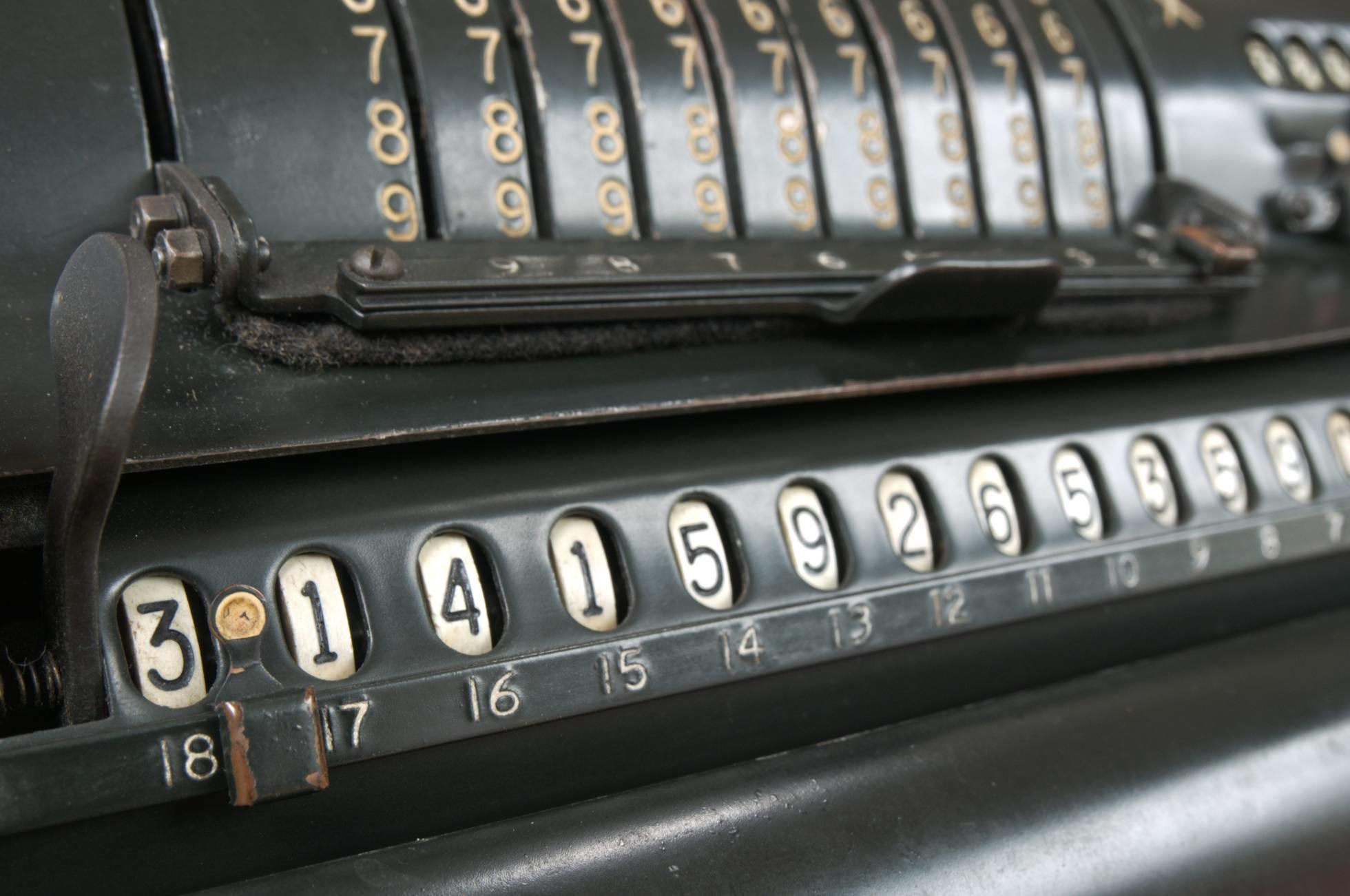
Nowadays, sophisticated computers give several thousand billion digits after the decimal point, raising the question of whether pi could ever be a normal number. You might debate that question with your maths tutor as a type of philosophical introduction to your lesson.
What Is Pi Used For? Applications of Pi
The omnipresence of Pi outside of schools' geometry classes continues to intrigue researchers and math enthusiasts alike. Pi effectively represents the limit of certain continuous fractions. Research carried out on transcendental and irrational numbers, largely related to Pi, provide an answer to the squaring of the circle.
It is, in fact, impossible to construct a square with an area equal to that of a given circle. In statistics and probability, the number Pi also appears, like in Buffon’s needle problem. This and other maths problems hint at the breadth of pi's reach across all disciplines.
Pi in Mathematics
You'll remember your introduction to pi from your maths classes. Early geometry lessons called for you to use pi to calculate circumferences and areas of circles. If you studied higher maths, you likely spotted pi in trigonometry and calculus equations. In all maths disciplines, pi remains a constant.
Calculations involving pi don’t end after high school. The whole of the human experience – artistic, professional, and natural – revolves around pi.
Pi In the Workforce
Throughout this article, you’ve read about algorithms, statistics, and other mainstream concepts that fuel our data-driven world. Pi feeds these calculations but this value’s most impactful manifestations are in engineering and science, specifically physics3.
Pi in physics
- to calculate waveforms
- standard waveform equation: y(t)=Asin(2πft+ϕ) 2\pi
- acts as a conversion factor between linear and angular frequencies
- this relationship makes it possible to model periodic phenomena
Pi in engineering
- used to calculate cylinder volumes
- used to estimate flow through hydraulic systems
- used to calculate stress on cylindrical structures.
Besides physics and engineering, organic chemistry relies on pi-bonds, which are covalent bonds that pair with one or more sigma bonds to provide stability (geometric isomerism).
Pi in Everyday Life
If you’re a bike rider, you must be grateful for the knowledge of pi.
The machine you power with your legs depends on several pi-dependent features. Your wheels and tires, of course, but also your gears and sprockets.
Lacking the ability to accurately calculate those components’ diameters, your ride would be uncomfortable, indeed. The same applies to your car, if you have one. Imagine the ride on wheels of different diameters!
And what if your transmission’s gears were improperly sized? Of course, that’s less of a concern with today’s electronic transmissions.
But for those who are passionate about driving, who insist on actual gears to shift, driving an automobile without pi to help set gear ratios would be a nightmare.

Pi also appears in ancient constructions that have no apparent connection to circles. See, for instance, the Pyramid of Cheops. Numerous works prove that Pi is the ratio between the perimeter of the base and double the height of the pyramids. This mathematical ratio for Cheops is almost equal to Pi.
Except for waveforms, all of these are examples of pi in the built environment.
But this value feature in nature, too.
Pi governs biological and geometrical patterns in nature, too. Spiral formations for flower petals, leaf placements, and even intricately woven spider webs may all be calculated using pi. You can actually calculate a tree’s growth cycles – the rings in its trunk, using pi. Perhaps your online maths tutor can give you more examples of pi in nature.
The ubiquity of Pi goes beyond the boundaries of simple mathematics. Pi exists wherever a circle is exists: in a tulip bulb, in the sun, in your eyes and your DNA. Pi is even present in the equation of Heisenberg's famous uncertainty principle, which seeks to cloud our understanding of the universe.
Now, we leave you with a quiz about pi. Play along! It will help cement everything you just learnt about this fascinating number.
What is Pi Used for and Other Resources
- Groleau, Rick. “Approximating Pi — NOVA | PBS.” Pbs.org, 2018, www.pbs.org/wgbh/nova/physics/approximating-pi.html. Accessed 14 May 2026.
- Li, Yansong. “Liu Hui’s 𝜋 Algorithm vs Archimedes’ 𝜋 Algorithm - Maths from the Past.” Maths from the Past -, 2 Mar. 2023, maths-from-the-past.org/liu-huis-%f0%9d%9c%8b-algorithm-vs-archimedes-%f0%9d%9c%8b-algorithm/. Accessed 14 May 2026.
- Storr, Wayne. “The Sine Wave Is a Periodic Sinusoidal Waveform.” Basic Electronics Tutorials, 25 Oct. 2024, www.electronics-tutorials.ws/accircuits/sine-wave.html. Accessed 14 May 2026.
Summarise with AI:
Did you like this article? Leave a rating!


 Loading...