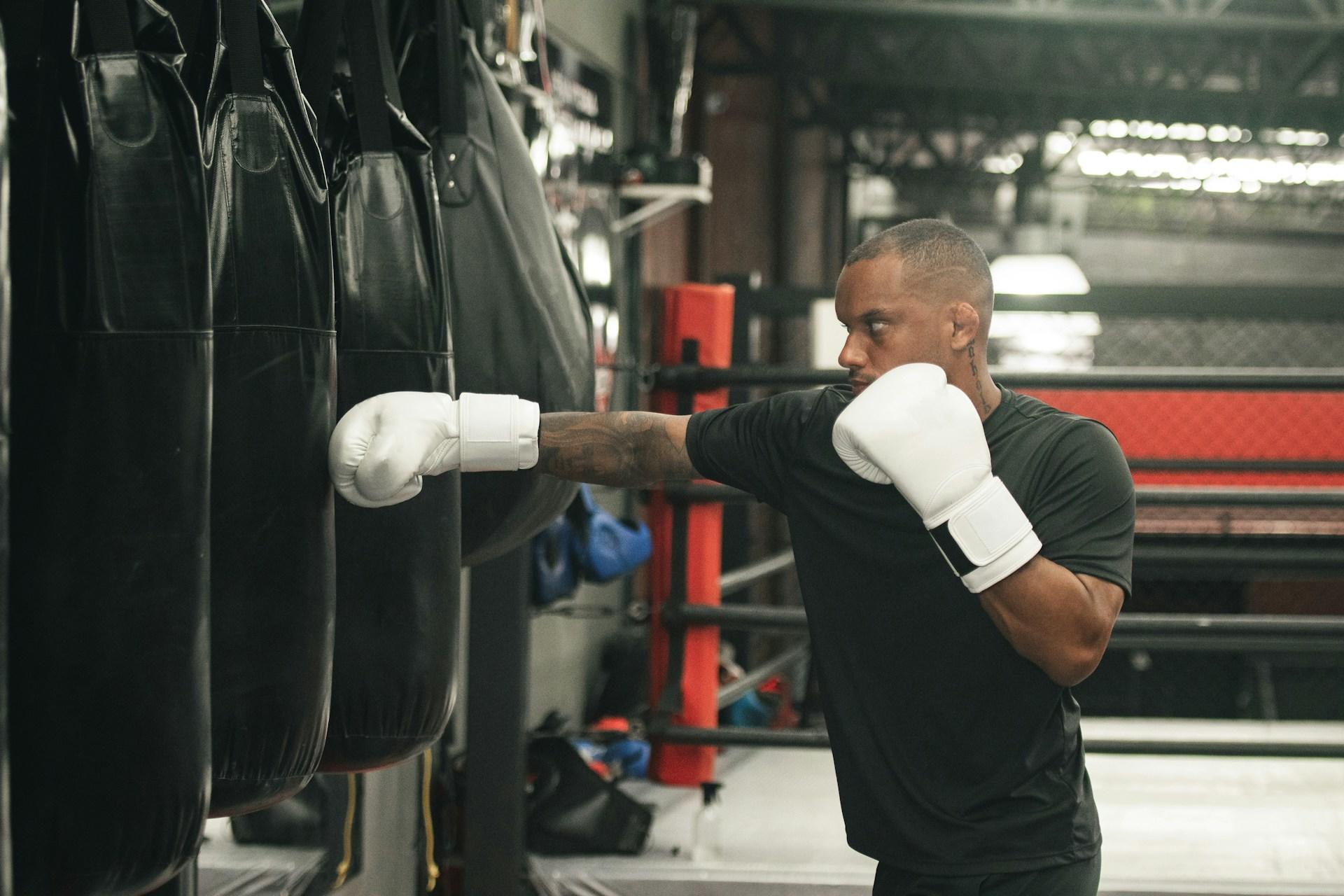

“Rhythm is everything in boxing. Every move you make starts with your heart, and that’s in rhythm or you’re in trouble.” – Sugar Ray Robinson
There aren't a million different ways to progress in a sport! You have to sweat and be motivated: if you're lazy and prefer your couch, beware, because daily training is necessary for almost any sport!
Are you a fan of boxing or savate? Are you looking to really train like a boxer? You may be okay when you're with a coach or when you're at your boxing club, but once you're on your own during the holidays you have no idea how to organize your training sessions.
Whether you practice on your own or with friends, here is a universal work-out in order for you to get your body into shape. You can of course add and subtract to this work-out based on what you like, the time you have, your form, your fortes, and the little boxing tricks you'd like to be better at.
First of all, answer this preliminary question: how long should a boxer train?
For a long boxing workout (which should happen at least once or twice a week), think 3 hours or longer.
If you are a beginner in amateur boxing and are looking to excel, then grab hold of your gloves and let's get going!
You can find boxing classes near me on Superprof!


1. The Boxer's Warm Up
It may not surprise you that Thai boxing and French boxing are no exceptions to the laws that govern the world of sports in general. Combat sports involve the whole human body, which requires for a serious warm up.
A successful warm up begins with some jogging.
Ideally, if you have the time and hope to become a boxing champion one day, you'll need to jog a total of 30-60 minutes.
Otherwise, especially if you are training indoors, you should run for a good 5 minutes, before getting to the rest of your warm up exercises.
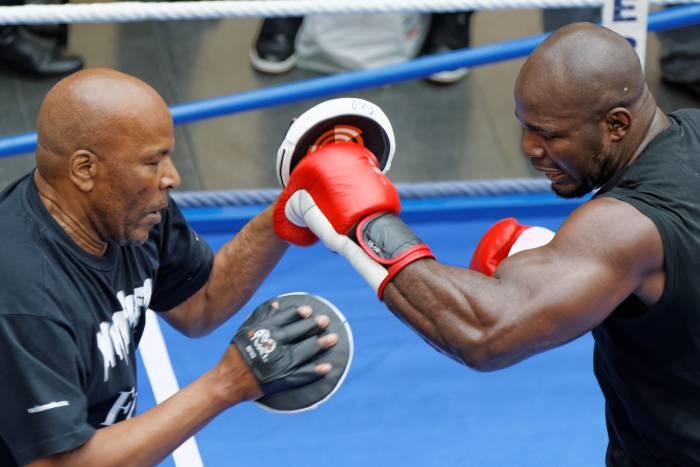
Boxing Ring | You should be in the best physical condition possible before grabbing your bear claws and boxing gloves... | source: upload.wikimedia.orgThis consists of preparing your body's joints, starting from the top (the nape of the neck) and working your way down (to the ankles). Go through them in order, and be sure not to forget anything otherwise a sprain will be waiting for you in the following exercises.
After the joints, you should prepare your main muscles in order to make sure you'll not hurt yourself with some pushing and pulling.
Another helpful warm up exercise is moving in the boxing stance. That does not only prepare your muscles but also improve your foot technique.
When you start boxing for real, you'll keep your boxing stance for long stretches of time, so you need it to become natural for you.
For example, when you throw a punch, you start by turning your foot and then you hand comes forward. Once the punch is over, you body returns to the initial position.
That basic position is crucial for performing any movement in boxing, from a simple jab to bobbing and weaving.
After your warm up, you should feel hot and sweaty, but not tired. This is the state you'll be in before a boxing fight.
Also discover fitness boxing!
2. Review Your Punching Skills
Your boxing training will start with reviewing the different punches. This will feel like a small break after all your efforts during the warm up.
This is where you'll learn to focus and stay in shape.
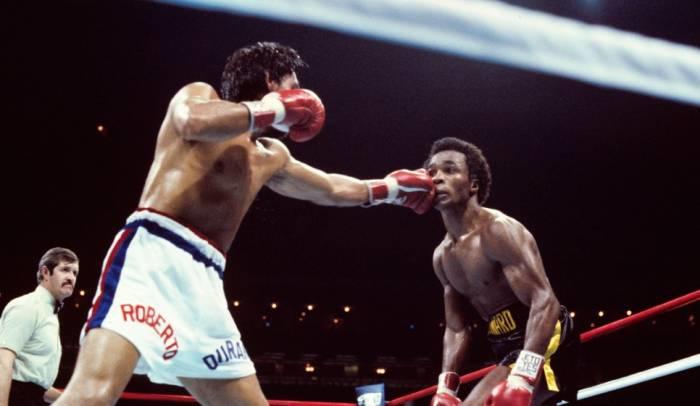
You'll go through the movement of each one with your bare hands, starting with the right hand and moving to the left. Better to go through them in slow-motion so that you better remember the movements and are able to notice if one of your movements does not work.
The slightest wrong gesture must be corrected, and it's important that you start the next boxing technique only when you have really assimilated the last one.
The jab, the uppercut, the hook, and the direct punch are the main shots of the boxer.
The jab is usually considered the easiest one. After learning the right stance, most boxers can start working on that punch.
You can first try to throw jabs in the air. Don't focus on their power at that point because your technique is much more important.
If you are a right-hander, you'll need to master the left jab and the other way round. As it is not your main hand, the punch doesn't always come easily to beginners.
Once you feel more comfortable with the jab technique, you can start honing the punch with a partner. They'll hold boxing paws for you and you'll throw as many punches as you can.
After you have mastered the jab, you can go on to learning the cross, the hook and the uppercut. Step by step, you'll expand your basic arsenal of punches to get ready for fighting.
Boxers spend different amounts of time on that part of training according to how many punches they are familiar with (the beginner will be less knowledgeable than an expert in the ring), their concentration, and how good their punches are on the first try.
It's a bit like starting a car. You should really make sure to press the pedal a few times in order to be sure the engine is warm enough before going out on the open road.
Find out more about boxing exercises.
3. Get Going with the Speed Bag...
Now we'll move from a slower warm up to a faster one, where you'll no longer be hitting the air in front of you, but a real target. Don't worry, your target is light and padded with low density materials.
What's important is to have the punching be quick and natural, with a fast pace suited to your breathing and boxing technique.
The fists and the speed bag must constantly be in movement in a circular motion which will be excellent if you are looking to maintain a high offensive guard during a boxing match.
No need for gloves here, bandages are enough.
You should box for a duration of 3 minutes, then take a break of 30 seconds, then resume everything for a full 5 minutes, then stop 30 seconds, then stop everything for another 3 minutes.
Depending on your boxing objectives and what kind of session you want to have, we can also replace the speed bag by a punching ball (same thing,but this one is planted in the ground) depending on what you want to do.
The main objective of that part of training is to improve you speed and reflexes. When fighting, you'll need to react to your opponent's movement in a fraction of a second.
That's helpful to throw effective punches as well as for defense.
Find boxing classes on Superprof.
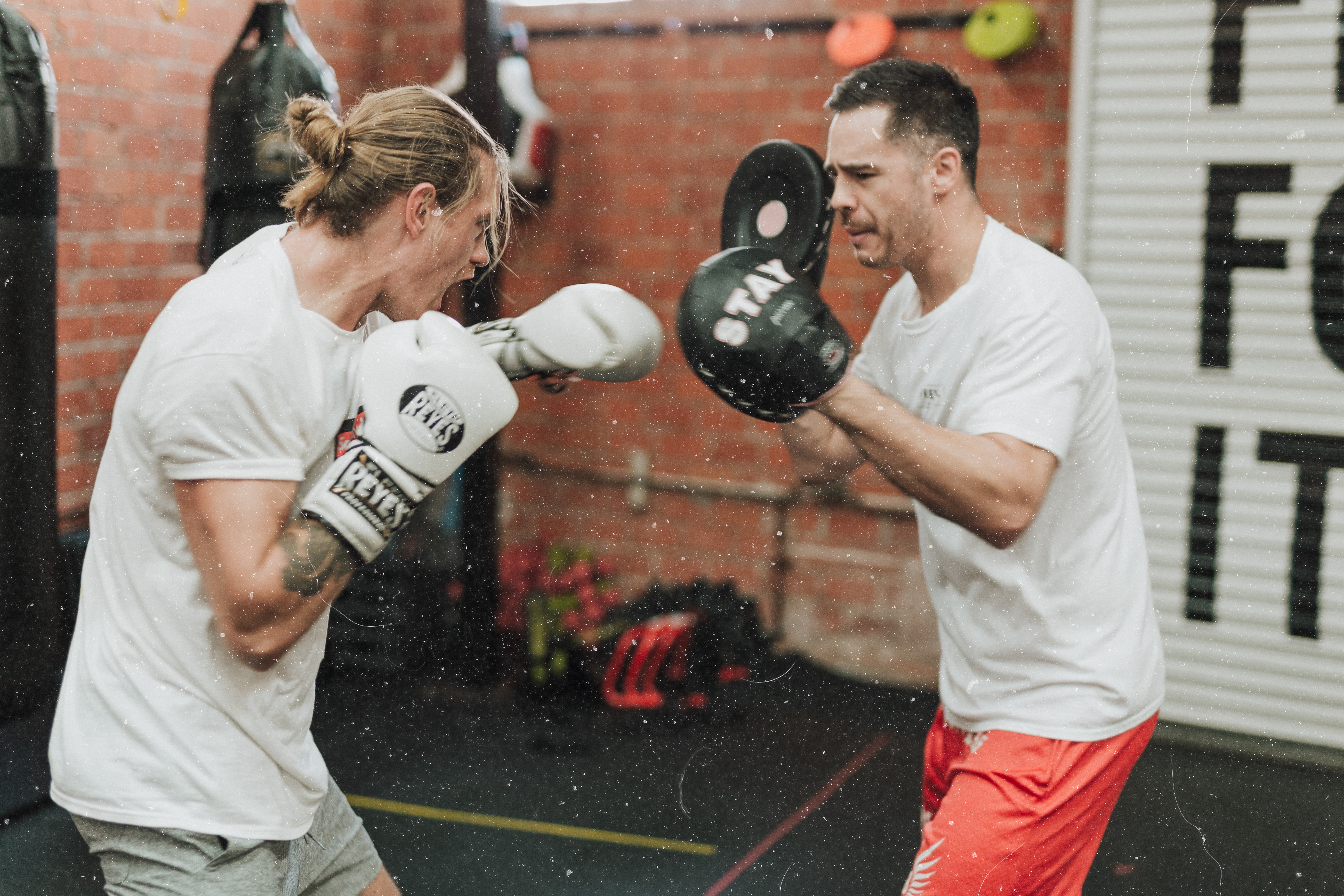
4. Boxing Training with a Heavy Bag
Now you need put on your boxing gloves because you'll hit something hard, heavy, and resistant: punching bags that are filled with sand, gravel, or grain...
Punch the bag, but do not throw yourself at the bag.
Stand on both feet and do not let yourself fall into the bag.
Be especially careful with your left-hand technique if you are a right-hander because that's your weaker hand and you are more likely to make a mistake.
Keep your balance in order to punch harder and have better footwork when dancing around the bag. Remember each jab or hook should start with the foot.
Don't use the bag as a counter-weight. Do not push into the bag with your shoulders.
This bad habit would have competent fighters throw you off balance by moving towards you when they feel you are leaning towards them.
Worst of all, do not push the bag with your head. It's a great way to leave yourself open for uppercuts.
When working with a punching bag, you can improve your basic technique, boxing stance and power, so it's really cool.
However, don't forget about your defense either. Of course, you don't risk to get hit by an inanimate object but the reflexes you develop now are the ones you'll use when you start fighting on the ring.
The heavy bag is supposed to represent a real opponent, hence its weight and a cylindrical shape, which can be likened to a human bust.
To motivate yourself, you can also train with "punch dummies" that have a human shape. If you want to feel even more motivated why not stick someone's photo on the dummie for even more motivation?
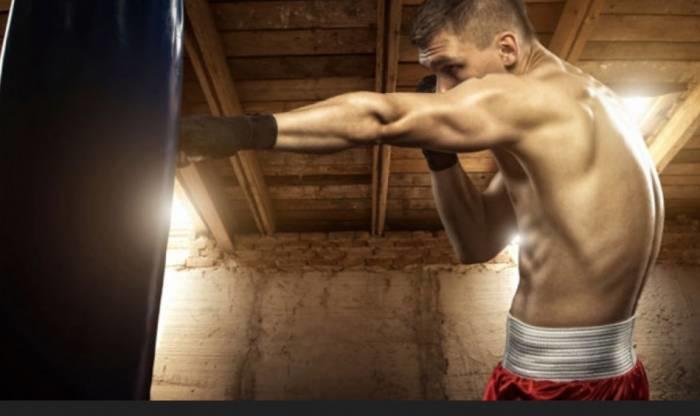
Rest for 30 seconds, then fight again for 3 minutes. Repeat this sequence again 1 to 3 times, depending on your form and the time you have available.
Stay focused and pretend you are boxing a real-life challenger of flesh and bone: don't give up until you feel like you've won the fight!
Don't slow down, never stop moving quickly on your feet, and make sure you know how to defend yourself against someone who may be much faster than you!
To make sure this exercise does not become too boring, do not hesitate to swing your fists at the bag before each "recovery." It will make the exercise a little harder.
Training with music
A lot of boxers prefer to train on punching bags with music. It's a great way to add rhythm to your jabs and hooks, while not getting bored with repetitive movements.
Music can also give you energy to train more and continue working out even when there is almost no energy left in you arms.
You can also use music to measure your training sessions. For example, you can start your work out when a new song begins and keep on exercising until the new one.
It's a little bit more pleasant than simply setting a timer because this way, you won't keep thinking constantly about how much is left.
There is plenty of music for boxing training online. You can find a ready-made boxing playlist on Spotify or choose your own tracks for even more motivation.
5. Train Like a Boxer to Build Your Muscles
An interlude to pure boxing: gaining strength is the most important part of training. You have dedicate time to training your muscle.
Though your whole body should be fairly muscular, it is mainly the arms and the torso that will worry amateur boxers.
Check out these kickboxing classes.
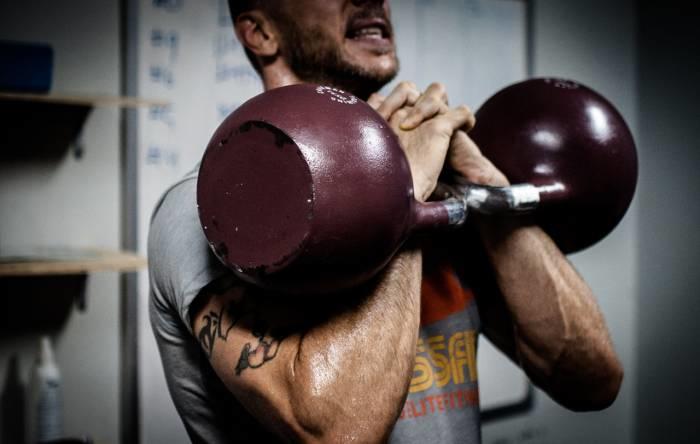
Depending on where you are training - the gym for example - you may be able to access professional weight machines.
If not, at least think about acquiring a pull-up bar and dumbbells. The weight of the human body is also very useful when you are doing push-ups or other abdominal work.
For beginners, think about doing 1 hour of bodybuilding to take on some muscle mass; for seasoned boxers, a quarter of an hour is required each time.
6. Moving On to Sparring or Shadowboxing
The 6th part happens in the ring. If you are alone, your choice will be limited: only shadow boxing will be possible.

The important thing is to forget yourself and to really believe you are fighting an other, with maximum concentration and varied punches. The footwork must be a testament to your vivacity.
The best way to advance however is to have a partner with whom you can engage in some sparring: this is one-on-one boxing in slow motion. The principle is not to get hurt - you just have to touch yourself or rather, graze each other.
Your gestures should be slow, which will allow you to pay attention to your partner's guard, his offensive gestures, and his footwork, while observing his attitude and style in order to be inspired. It's good to have some technical experience at this stage!
The way you apply what you have learned is key at this stage. Make sure your moves are how you learned them and be sure you will not hurt yourself for lack of preparation.
Read your opponent
As every boxing amateur may know, this sport is not as much about brute force as strategy and psychology. An experienced fighter need to understand their adversary and choose the right moment for attack.
That abilities can hardly be acquired through hitting bags or shadowboxing. Instead, you need to have a real person in front of you to get used to learn to read their movements.
That skill is probably the most important feature that distinguishes a beginner from an experienced fighter. If an amateur spends a lot of time in the gym, they can get into a get physical shape and hone their jab, cross, hook and other technical elements.
However, what they won't have is strategy and the ability to see through the competitor's plans. A good fighter can know about a coming blow even before it has been thrown.
The best way to develop that essential capacity is, of course, participating in real fights but if you don't have the opportunity to get on the ring regularly, sparring sessions can also do.
Want to discover Thai boxing?
7. Perfect Your Footwork and Build Up Your Endurance
Time to leave the ring again a few moments in order to focus on your legs which are very important when you are there.
The boxer must have enormous body strength in the upper body but also be able to be swift with the lower body.
Stamina is very important for a fighter because you'll need to keep on moving and throwing punches for several three-minute round.
If at some point, you get too tired and become slower than your adversary, the situation can quickly turn risky for you. Even if you don't get knocked down, you'll lose a lot of points because of taking blows and are likely to lose the match.
Test your endurance, but especially your resistance with running. This will work both your lungs and heart out very hard.
Start by running 400m to bring up your endurance (you could talk at the same time, it will make things harder) and warm up your calves and thighs.
Then run as fast as you can 3 times for 500 m, with 5-minute breaks between each running session.
It is best to follow a 500 or even 1000m race with stops in between in order to regain a lower heart rate after your sprints.
From time to time, the athlete will opt for the 3000 m race, the 100 m sprint or running backwards for 200 or 400 m - but beware of falling and breaking something!
8. Become More Flexible and Energised with Cardio Boxing
In order to stay limber and make sure you stick to your crescendo, jump rope for at least 10 minutes. This is the best cardio ever.
Don't forget that cardio boxing exists in its own right!
A boxing champion is by nature fast and fit. The rope has taught him to improve his flexibility and to have good reflexes, in addition to knowing how to improve healthy movements.
There are many ways to jump rope - on the spot with feet together, crossing your feet everytime you jump, advancing, going backwards... It's up to you to enrich this exercise and make it as effective as possible for you!
Otherwise, like soccer players, you can use a ladder or hoops on the ground and hop on tiptoe, which is a great prerequisite for any good footwork in the boxing gym!
Discover the benefits of boxercise classes.
9. Facing an Opponent
This is the highlight of these ten steps. Now it's time to really box against an opponent, but being fair, after having put on your boxing gloves and boxing helmet, as well as your mouthguards and possibly (especially for French boxing) your shin guards.
The fight should be relatively short (lasting 5 to 10 minutes).
Ideally you will constantly be boxing with a different partner so as not to get tired and to be confronted to various styles of boxing. This is also a better way to learn!
If you are alone and you have no one to box with, replace this step with an observation of how boxing champions box.
You can find quite a lot of inspiring matches online. Some of the name you may want to check are Muhammad Ali, Floyd Mayweather, Tyson Fury, Lennox Lewis, Roy Jones, Jr., Evander Holyfield and many others.
When you watch their fights, try to spot differences in their styles, understand their strategies and pay attention to how they move.
You could also watch amateurs (YouTube, Dailymotion and INA will give you the material you need). Get in the shoes of a real fighter by watching them at work and learning from their boxing techniques.
10. Stretching After a Boxing Match
All sports training, whatever the discipline, must begin with a warm up. In the same way, it must also end with a stretching session.

Stretching helps you recover from your intense work-out all the while helping you take advantage of the exercises in order to increase your muscles.
Similarly, it will prevent you from having sore joints and allow you to transform physical fatigue into a feeling of well-being athletes are very familiar with.
Stretching is one of the most underused techniques to improve athletic performance, prevent sports injuries, and properly rehabilitate sprains and strains.
Do not make the mistake of thinking that something as simple as stretching will not be effective.
Here are 4 very beneficial stretches for boxing. Of course, there are many more, but these are great to start.
Find boxing classes Melbourne here.

Don't forget that you will sleep like a baby after stretching all of your muscles...This may be the defining factor for you!
Summarise with AI:
Enjoyed this article? Leave a rating!

 Loading...