

Today, French is the official language of 29 countries and is spoken by three hundred million people. As one of the world’s most widely-studied languages, coming second only to English – but where did it come from? In the English-speaking world, we see aspects of the French language every day, whether it’s in the etymology of our own vocabulary (such as affair and crayon) or when we directly borrow a French phrase that the English language is lacking (like cliché and vis-à-vis). In fact, our own language would have sounded completely different if it were not for the Norman conquest of 1066 which brought the French language to England, where the vast majority of the population spoke Anglo-Saxon. Before this, French was a language reserved for the aristocracy on British soil as a language of prestige. It's now something that is studied in many schools globally, with eager students preparing for their end of year exams. So, how has the French language changed since the days of William the Conqueror? And where did it originate from in the first place? The French language has an incredibly rich and interesting history behind it – so, read on and learn all about its Latin roots, popularity in Europe, variations and what the French language looks like today!


How the Romans Influenced the the Old French Language
French is part of the family of romance languages, which means that it is originally derived from Latin – the language spoken by the Romans about 2000 years ago.
The Romans are famous for their tireless efforts to expand their empire, and one of the consequences of this was the spread of Latin as an adopted language.
When the Romans started conquering French soil (known then as Gaul) in around 1BC, the language spoken by the inhabitants wasn’t French – instead they spoke a variety of Celtic dialects which would have been similar to Welsh. The Roman settlement in Gaul resulted in the mixing of cultures to produce what is now referred to as ‘Gallo-Roman’ culture.

Languages Spoken in France: Dialects and français régionale
It might surprise you to know that almost half of the population living in Southern France, Alsace and Brittany did not speak French as their mother tongue at the beginning of the 20th century – instead, they spoke regional languages and dialects. The outcome of the introduction of Latin by the Romans was a patchwork of Gallo-Romance dialects which differed from town to town. Despite the differences in these dialects, speakers from different towns and villages would have been able to communicate effectively with one another as long as they didn’t travel too far afield. Linguists have been able to group these dialects according to evidence given by their speakers as well as the languages themselves to identify the geographical frontiers of each language. Here is a map of the traditional French dialects spoken in each region:
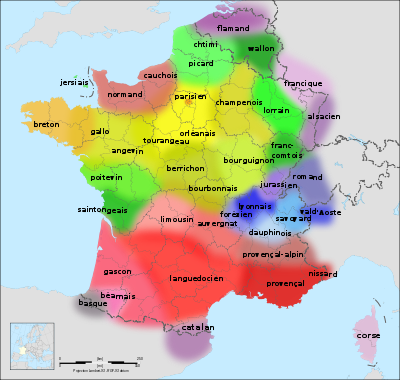
The Spread of French Languages
The reign of regional languages and dialects in France lasted for centuries – but how did French replace them? We know that one of the main reasons for the victory of French over traditional dialects was the French education system. Education in France has been compulsory and universal since the early 20th century and has promoted the widespread use of French by educating children in the prestigious language of the capital: français normé or standard French. This meant that children who were brought up speaking traditional dialects were starting to use standard French in social situations more often than their native dialects. Find great French classes here on Superprof.

What the French Language Looks Like Now
Many of the new varieties of French which are spoken overseas have been standardised, which means that they are recognised as languages in their own right, with a specific spelling and grammar system – think of the difference between French in France and Canadian French as the difference between US English and British English. The same way that Brits walk on a pavement whereas Americans take the sidewalk, French people take their voiture (meaning car) for a spin, while Canadians will take their char. France’s history of colonialism has also led to changes the language spoken on its own soil. The school French you learn doesn't necessarily reflect the French that is spoken by natives. Because of France’s efforts to colonise the area of North Africa known as the Maghreb, which consists primarily of Algeria, Morocco and Tunisia, some features of Arabic have entered the French language as North African people have begun to settle in France. The Arabic words which have been adopted by French speakers are mainly used in familiar contexts as slang and include words such as flouze (meaning money) and hachmah (which means shame). Click here to see a list of Arabic alternatives to French in use. From Latin to Arabic, it’s not difficult to see that there are many linguistic consequences to people mixing between cultures – so, where is the French language headed?
The Future of the French Language
As one of the fastest-growing languages is in the world, French is not under any threat. It's important to note that French curriculum can vary from school to school, but at the foundations, you'll find a very similar structure of learning. Some French language purists are concerned about the further evolution of the French language, worrying that It will become ‘polluted’ by foreign vocabulary and will therefore become ‘less French’. As technology advances and education and media in other languages become more accessible, the adoption of foreign words becomes more likely. Sadly, however, the popularity of the French language and the increased need for speakers of international or ‘useful’ languages mean that the future looks bleak for the traditional French dialects. Continue on your search here, check out these other articles:
- GCSE French revision
- A level French revision
Summarise with AI:
Did you like this article? Leave a rating!

 Loading...