
Every year, hundreds of students across Victoria select VCE Japanese Second Language as one of their optional courses. Their passion for the Japanese language and culture aside, most of them ask pointed questions about this course: is it difficult? Will there be an oral exam - what are the assessments like? This guide aims to answer the most frequently asked questions regarding this course.
From the VCE Japanese Second Language Study Design
- Unit 1: informal personal communications, reading comprehension, and writing an original text.
- Unit 2: written communication, information analysis and interpretation, and creating a presentation on a selected topic.
- Unit 3: communications in negotiating, distilling information from selected texts, and writing a longer paper from a prompt.
- Unit 4: researching and sharing information and opinions on a selected topic, comparing/contrasting details of a written text, and a persuasive or evaluative essay.


Defining VCE Japanese Second Language
The Victorian Certificate of Education (VCE) is the tangible, visible proof that students have successfully completed all of this state's educational requirements. Victoria's education department identifies courses of study with the VCE acronym, followed by the course of study. Thus, we get VCE Japanese.
The 'Second Language' designation further defines this course's orientation. Its related course, VCE Japanese First Language, is targeted at a different student demographic.
For students whose first language is other than Japanese.
For students who have a first-language connection to Japanese.
Let's say an Australian student grew up in a Japanese-speaking household. Their first language experience is Japanese; they may even have learnt to speak Japanese before - or in tandem with - English. These students may qualify for the VCE Japanese First Language track.
Most Australian students qualify for the Second Language track. They grew up in English-speaking households, honing in on Japanese as a second language sometime during their educational career. However, their eligibility for the course depends on the Victorian Curriculum Assessment Authority (VCAA) criteria for admission.
Before setting your sights on VCE Japanese Second Language as an elective course, ask your school if you're eligible.
VCE Japanese Second Language Student Profile
Many of us appreciate Japanese cultural elements: manga and anime, J-Pop, sushi, and perhaps even the Shinto belief system. Those are just a few 'surface' cultural markers to identify the Japanese culture.

Students eligible for the VCE Japanese Second Language course should delve deeper into Japanese culture. They should become familiar with customs and traditions, and know those practices' history. Naturally, doing so demands knowledge of the Japanese language, because many of those concepts don't have a direct translation into English or the culture they grew up in.
The ideal VCE Japanese student enjoys learning about the language and culture of their target nation. They have a knack for memorisation and communication, and will go out of their way to build their pronunciation skills.
For them, learning kana was a snap and exploring kanji will be a lifelong pursuit. They love teasing meaning out of Japanese writing; this language's nuance is itself a challenge. They consider speaking Japanese a privilege reserved for the dedicated few, and reading historical texts is their favourite treat.
If you've been studying Japanese since at least Year 10, have strong language skills and a knack for memorisation, and love communicating in Japanese, you are the ideal student for this course.
Skills Needed for VCE Japanese
Continuing Japanese studies from Year 10 may as well be considered a prerequisite for higher VCE Japanese courses. Candidates should have some background in Japanese language studies, even if they're transfer students from another state1.
They should have already grasped basic phrases in Japanese, a decent beginner's vocabulary, and all the kana - 48 hiragana and 48 katakana. They should be able to write in Japanese, and also know a fair number of kanji; the VCE Japanese study design specifies 200. Other required skills include:
VCE Japanese Study Design
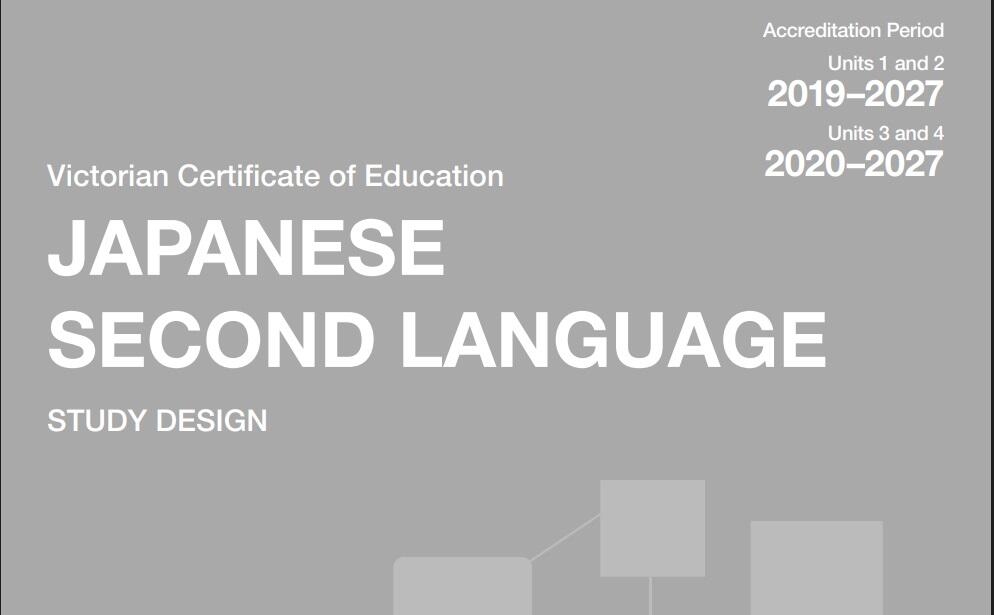
The 40-page handbook that describes this course is exquisite in its detail. In fact, it is so detailed that it may overwhelm the already anxious student. Here, we break down its contents into plain language.
The final two chapters, kanji and grammar, outline what eligible students should know before signing up for this course. The rest of the booklet covers the course's study units.
VCE Japanese Units 1 and 2
These two units help you build a strong foundation for your Japanese language skills. You'll develop deeper knowledge of the language and culture, and get plenty of chances to exercise your abilities.
All four study units feature three components: interpersonal, interpretive, and presentational communication. Each of these addresses a selected subtopic that the student needs specific language skills to address.
The VCE Japanese study design outlines possible topics but each school chooses how and when they will address the topics. The mandatory themes are: The Individual, The Japanese Community, and The World Around Us.
Unfortunately, that means we cannot be more specific about your school's plan for addressing these topics. However, we can say that Unit 1 and 2 assessments are administered at the school level. They will gauge your readiness to move into higher-level study.
VCE Japanese Units 3 and 4
These study units revolve around the same components and themes your first two study units do. But the work is more intensive and the expected outcomes, more demanding. The work you do for these units counts toward your assessment, even as they prepare you for your formal language exams.
VCE Japanese Assessments
Preparing for oral and written Japanese exams seems to be a daunting idea, but these assessments loom larger than they should. In fact, they break into just three categories.
School-based assessments
- at the end of each study unit.
- Include oral and written components.
End-of-year oral exams
- last around 15 minutes
- address themes you're familiar with
End-of-year written exams
- last 2 hours, 15 minutes
- feature listening, reading comprehension, and writing exercises
These exams are no different than any other VCE exam you'll sit; you're just doing them in another language. Following revision best practices and being consistent in your study are the one-two punch you need to score well on your VCE Japanese assessments.
Preparing for VCE Japanese
As you move into Year 10 or Year 11 VCE Japanese, you should make sure you have the skills bank to draw on that makes you a competitive learner2. This outlines the basic skills to build as you advance in your Japanese studies.
VCE Japanese Study Timeline
Where and how should you find the time to fit all this into your ordinary studies? It helps to create a timetable to help you meet these goals. This chart gives you a foundation to customise your Japanese studies around everything else you have going on.
| ⌛ Timeframe | 🔎 Focus | 👍 Tips |
|---|---|---|
| Year 10 | Grammar, kanji, kana, and confidence building. | Create flashcards for kanji and kana retention. Create mind maps to connect grammar concepts. Keep to a regular study schedule to build confidence in your knowledge base. |
| Unit 1 | Strengthen core communication skills. | Record yourself as you practise speaking Japanese. Practise chatting with Japanese speakers. Deliver oral presentations to classmates and your tutor. |
| Unit 2 | Expand assigned topics and build writing skills | Practise writing short, topic-specific passages. Try different writing styles: casual, formal, email, announcement, etc. |
| Unit 3 | SAC preparation and exam-style practice | Drill into your school assignments. Form a study group; work with your classmates. Focus on particular aspects of Japanese culture. |
| Unit 4 | Exam revision and final consolidation. | Practise speaking: casual exchanges and informative discussions. Practise listening, reading comprehension, persuasive writing, etc. |
Is VCE Japanese Hard?
Admittedly, it might seem hard, especially Units 3 and 4. You'll learn a lot and do a lot of work but, at the end of the day, 'hard' depends on a lot of factors. For example, a student with a gift for languages won't find it hard, but one whose strengths lie elsewhere will have to work much more diligently.
A lot of the 'hard' perception comes down to the type of student you are. An organised learner with a solid study strategy3 will do much better than one who procrastinates or revises in stops and starts. It's like the difference between sprinting and jogging: one is infinitely more challenging and the other is more beneficial.
Most VCE Japanese students find the oral portions most challenging, especially presenting in front of the whole class. You may benefit from practising presentations in front of a few classmates, your family, or your Japanese language tutor. Even if shyness plagues you, practising presentations can help you overcome that barrier.

Other aspects learners find difficult include remembering kanji and writing in Japanese. For both of these aspects, regular practice is the best remedy. You might use flashcards to build your kanji memory, and focus on one type of writing per week - expressive, persuasive, etc.
Otherwise, following best practices for VCE revision is your ticket to successfully completing this course. Regular study is the top recommendation, with each student focusing on their specific areas of weakness. In the thick of your studies, it will never occur to you that your upcoming assessments may be difficult.
References
- “Japanese - Curriculum - Victorian Curriculum.” https://victoriancurriculum.vcaa.vic.edu.au/languages/japanese/curriculum/f-10#level=1-7-8. Accessed 19 Aug. 2026.
- Arc, Tutoring. “How Year 10S Should Prepare for VCE Japanese Second Language - Arc Tutoring.” Arctutoring.Com.Au, 2021, https://www.arctutoring.com.au/blog/how-year-10s-should-prepare-for-vce-japanese-second-language. Accessed 19 Aug. 2026.
- Atar, Notes. “Japanese VCE - ATAR Notes Discussion.” Atarnotes.Com, 2026, https://discussion.atarnotes.com/d/7411-japanese-vce. Accessed 19 Aug. 2026.
Summarise with AI:
Did you like this article? Leave a rating!

 Loading...