

One of three Japanese writing systems, Hiragana, is used almost as much as the Kanji writing system. It comprises 46 characters, which makes it one of the easier scripts to learn in its entirety. On this page, you'll explore Hiragana's history and learn how it's used in everyday Japanese interactions. You'll also discover how you can master this writing system.
What to Know About Hiragana Characters
- The Hiragana script is a syllabary: each character corresponds to a sound or syllable.
- Though they look complex, the characters are easy to draw, often with five strokes or less.
- Hiragana is typically used for native Japanese words and grammatical particles.
- This 'alphabet' includes diacritics, which boost the total character number to 71.



An Overview of Hiragana
This phonetic syllabary consists of 46 basic characters, some of which can be enhanced with diacritical marks. Each character represents a sound, rather than an entire word. To write words in Japanese, you need at least two characters, but they don't have to be only Hiragana characters.
This 'alphabet' works seamlessly with Japan's other two syllabary writing systems. It's not uncommon for a single sentence in Japanese to contain all three types of Japanese characters. In itself, that seems rather strange to beginner learners. The greater curiosity remains, though: where did this writing system originate from?
When Was Hiragana Invented?
Hiragana originated from the ancient Chinese writing system, which was adapted to write the Japanese language. Those adapted characters are called man'yōgana; their appearance remained the same as the Chinese version but their pronunciation was different1.
In Chinese writing, 'regular script' refers to clean lines seen in everyday writing.
Chinese cursive script is more elaborate; it is typically used in calligraphy.
Around the fifth century, the Japanese began adapting the Chinese cursive script to suit its writing needs. Before then, no cursive writing system existed in the Japanese language, so this was a defining moment in its history and development.
It took several centuries to fully flesh out and accept the Hiragana writing system. Many people opposed its use, particularly academics and the elite, who favoured the well-established Kanji writing system. That was due, in part, to an odd gendering of writing styles in those days.
Men's writing
- called otokode (男手)
- considered the 'regular' script.
Women's writing
- called onnade (女手)
- used by ladies exclusively.
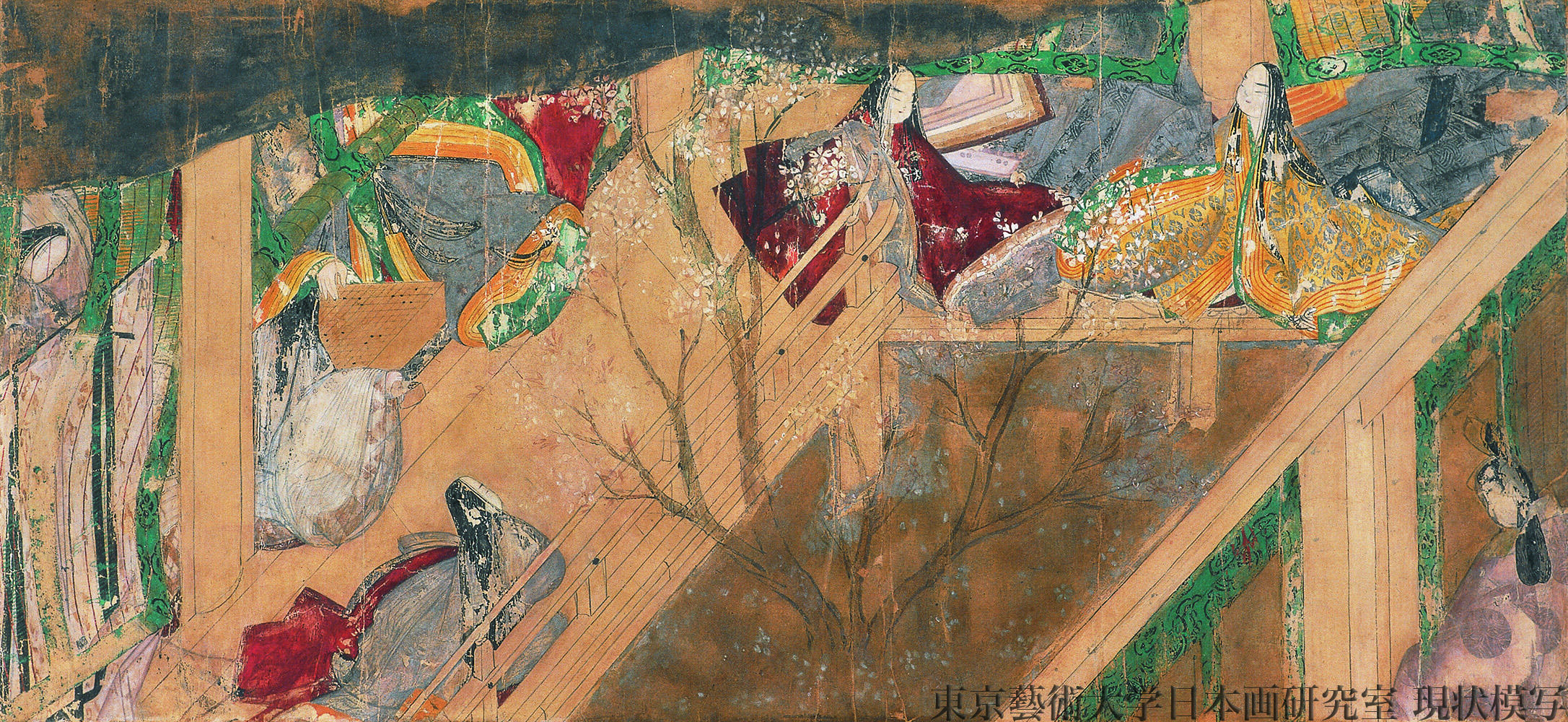
While the women used Hiragana to exchange letters at court and to write stories, men eventually came around. Over time, male authors began composing literary pieces using Hiragana, reserving Kanji and Katakana for official correspondence. That distinction changed over time, too, such that Hiragana became an integral part of all Japanese writing.

Comparing Hiragana to Other Japanese Writing Systems
To get a better understanding of Hiragana and how to use it, we should compare it with the other Koni writing script, Katakana. And, while we're at it, we'll pit it against Kanji, too.
Hiragana Differences with Katakana
Perhaps the easiest way to appreciate these differences is to see them side by side. When compared that way, the first thing you'll notice is that Katakana involves more lines and angles, while Hiragana is curvier.
Hiragana
- provides suffixes to Kanji stems.
- more cursive in style.
- appearance: あ, い, う, え, お (a, i, u, e, o)
- comprises up to 71 characters (with diacritics)
Katakana
- for spelling of foreign loanwords.
- more of a print-like style.
- appearance: ア, イ, ウ, エ, オ (a, i, u, e, o)
- comprises 46 characters
Pronunciation remains the same across both syllabaries; 'ka' is 'ka', no matter which script it's written in. However, Hiragana has one more advantage over its Katakana counterpart. It is typically the first writing system that Japanese speakers get to grips with.
Hiragana Differences with Kanji
The biggest difference between these two writing systems is that one represents syllables while the other conveys full concepts. This comparison shows how dramatic the distinctions between these two writing systems are.
Hiragana
- a phonetic syllabary
- represents only sounds
- looks curvy, rounded, and flowing
- originated from Chinese calligraphy
- used for native words, for grammatical accords, and as particles
Kanji
- a logographic writing system
- represents whole concepts
- looks grid-like, angular
- originated from Chinese characters (hanzi)
- used to express nouns, adjectives, verb stems
You might say that Hiragana completes Kangi, in a way. It provides endings for verbs and adjectives, and helps define sentence structure.
It is possible to write entire sentences in Hiragana only.
However, this script’s lack of visual breaks makes such sentences hard to read.
Blending Kanji with Hiragana makes for more precise writing.
For comparison, consider “I’m going to Tokyo”, written both ways. Which one is easier to read? Which one appears more balanced and precise?
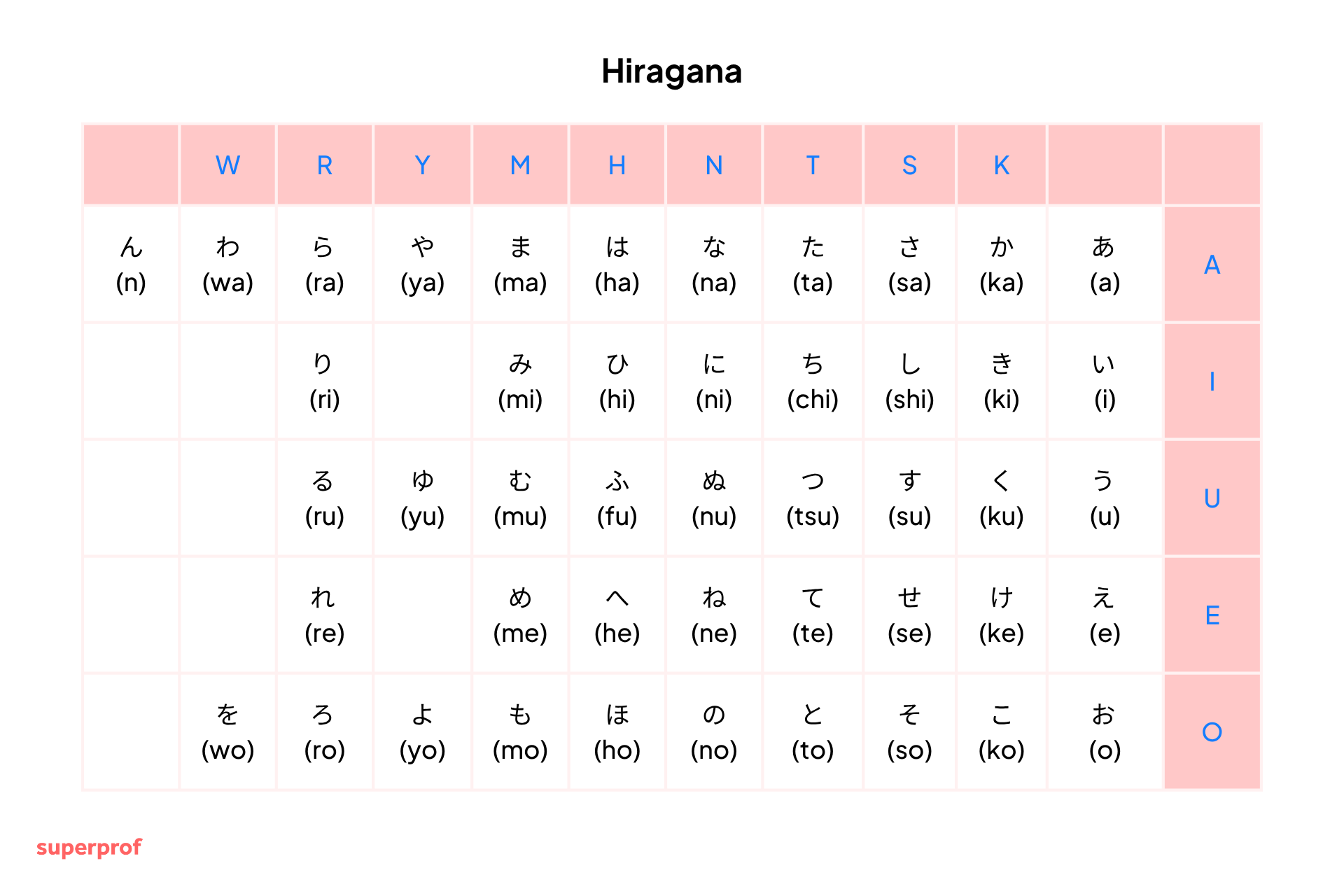
The Hiragana Chart
As is ever the case, words can only take one so far before needed visual examples of the subject in question. So, before progressing further, it's time to study the 46 basic Hiragana characters2.
| Vowels Consonants | a | i | u | e | o |
|---|---|---|---|---|---|
| vowel characters | あ | い | う | え | お |
| k | ka - か | ki - き | ku - く | ke - け | ko - こ |
| s | sa - さ | shi - し | su - す | se - せ | so - そ |
| t | ta - た | chi - ち | tsu - つ | te - て | to - と |
| n | na - な | ni - に | nu - ぬ | ne - ね | no - の |
| h | ha - は | hi - ひ | hu - ふ | he - へ | ho - ほ |
| m | ma - ま | mi - み | mu - む | me - め | mo - も |
| y | ya - や | --- | yu - ゆ | --- | yo - よ |
| r | ra - ら | ri - り | ru - る | re - れ | ro - ろ |
| w | wa - わ | wi - ゐ | --- | we - ゑ | wo - を |
The Proper Stroke Order for Hiragana Characters
When we were the littlest students, our teachers and parents spent hours teaching us how to write our letters properly, and even longer teaching us how to spell. Wee students can’t go off, writing words anyway they like, after all. Well, the same applies to writing in Hiragana.
It might seem easier to write these characters in any way you find comfortable and efficient. However, learning how to write this way doesn’t help you master the Hiragana syllabary.
Writing the characters following proper stroke order helps you master and memorise them faster. It also helps you distinguish the characters’ kanji components, which gives you a head start on mastering kanji.
You might also find this historical perspective interesting: the Hiragana stroke order was established to prevent smudged writing and ink transfers onto the writers’ sleeves. If you’ve ever written with a gel pen or fountain pen, you might know how annoying that can be. So, we can count the lack of smudging as another reason to follow these characters’ stroke order:
The Role of Diacritics When Using Hiragana
You might be familiar with how letters change their sound in English. It most often happens with vowels, but some consonants change their sound based on the letters around them. For example: 'c' sounds like 'k' when followed by 'a', 'o', and 'u'.
Writing in Hiragana, you must use dakuten or handakuten to signal a particle's sound change.
The dakuten looks a bit like a quotation mark (゛), while the handakuten resembles the 'degree' symbol (゜). You must place them in the top right-hand corner of the kana you are modifying3, like so: ぎ (gi), ざ (za); and ぱ (pa), ぽ (po)
These diacritic marks indicate that the kana should be 'voiced', meaning that the kana changes sound. For example, voiceless particles ka, sa, and ta (か, さ, and た) become ga, za, and da when so marked. That's all good to know, of course, but what purpose do these diacritics serve?
The Purpose of Hiragana
The main use for the Hiragana writing system is okurigana. Okurigana refers to suffixes that are used after a Kanji stem or root. As an example, you would form the word ‘watching’ in Japanese using a Kanji stem for the verb ‘watch’ and a Hiragana suffix for the ‘ing’ ending: 見て (mi te).
This process of okurigana lets you express more nuance with your writing. While it’s possible to communicate solely using Kanji, Hiragana gives you myriad more options when it comes to written expression.
Hiragana can also be used in instances where there isn’t a Kanji you can use, almost as if they were Kanji substitutes.
You could make a case that Kanji is the most important writing system to get to grips with, but we cannot discount the importance of Hiragana. After all, many Kanji would be left as stems if it weren’t for the Hiragana suffixes giving them more specific meaning.
Trying to learn writing in Japanese without Hiragana is like attempting to write in English without a lot of the letters of the alphabet. It’s possible, but very difficult, and a lot of meaning would be left out.
You could also look at Hiragana as the glue that holds Japanese text together, since it serves many grammatical functions that influence meaning.
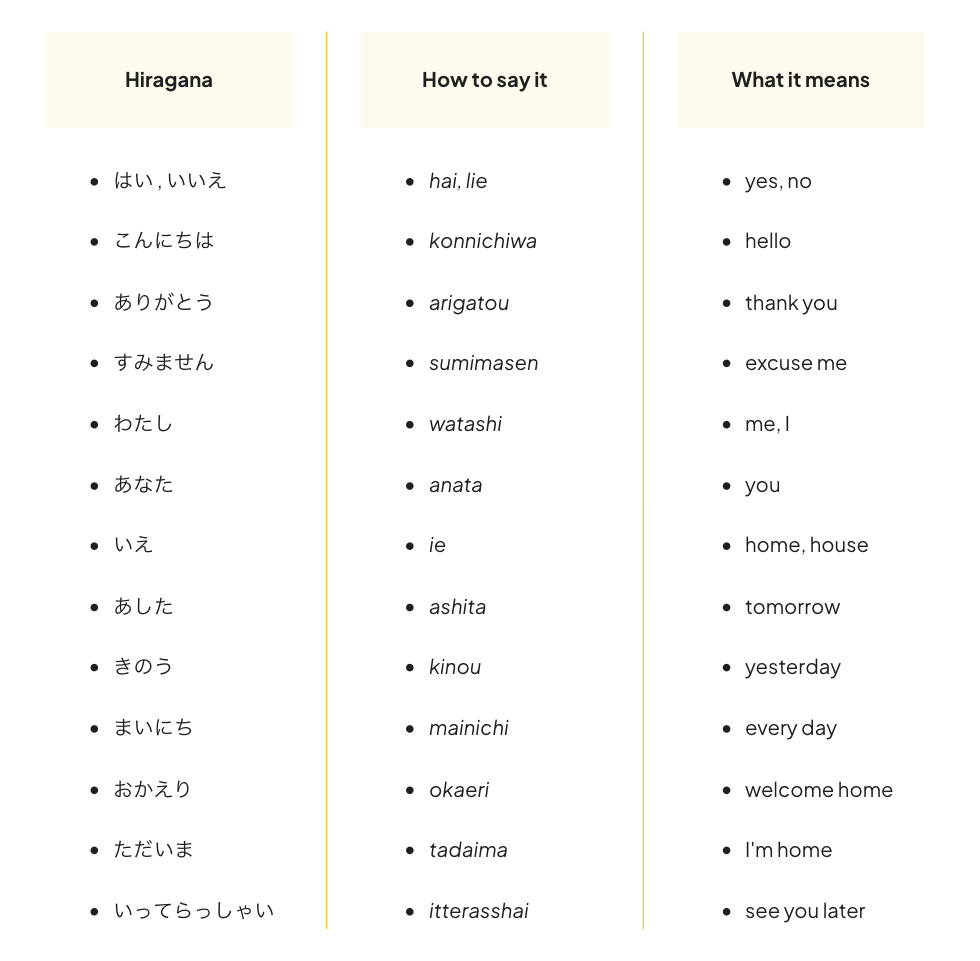
Common Words and Phrases in Hiragana
With all the new information gained in this learning session, you’re no doubt ready to put your new knowledge to work. So, we end our lesson with a few common words and phrases written using Hiragana characters4.
Resources to Master Hiragana Characters
- Pratt, Ian . “Hiragana, and the 2000 Year Journey from Then to Now - Lexis Japan.” Lexis Japan, 3 May 2023, lexisjapan.com/hiragana-and-the-2000-year-journey-from-then-to-now/. Accessed 11 Apr. 2026.
- “Hiragana Chart | Genki-Online.” Japantimes.co.jp, 2024, genki3.japantimes.co.jp/en/student/hiragana/. Accessed 11 Apr. 2026.
- maegantrish543. “Hiragana Diacritics and Digraphs.” Scribd, 2023, www.scribd.com/document/682376786/Hiragana-Diacritics-and-Digraphs. Accessed 11 Apr. 2026.
- Shyam, and Shyam. “50 Must-Know Basic Japanese Words Written Only in Hiragana.” JLPT Samurai, 5 Nov. 2025, jlptsamurai.com/2025/11/05/50-must-know-basic-japanese-words-written-only-in-hiragana/. Accessed 11 Apr. 2026.
Summarise with AI:
Did you like this article? Leave a rating!

 Loading...
i dont like it…
Thanks for the feedback! We’d love to know what didn’t work for you, the pacing, the examples, the format? Your thoughts help us improve. What would’ve made it better?