
The Kanji writing script in Japanese is the most challenging to master, if only because of its sheer volume. The full lexicon comprises more than 45,000 Kanji, and some ideograms have more than 20 strokes. In this guide, we demystify Kanji characters, first by detailing their origins, and then explaining some of the most common uses.
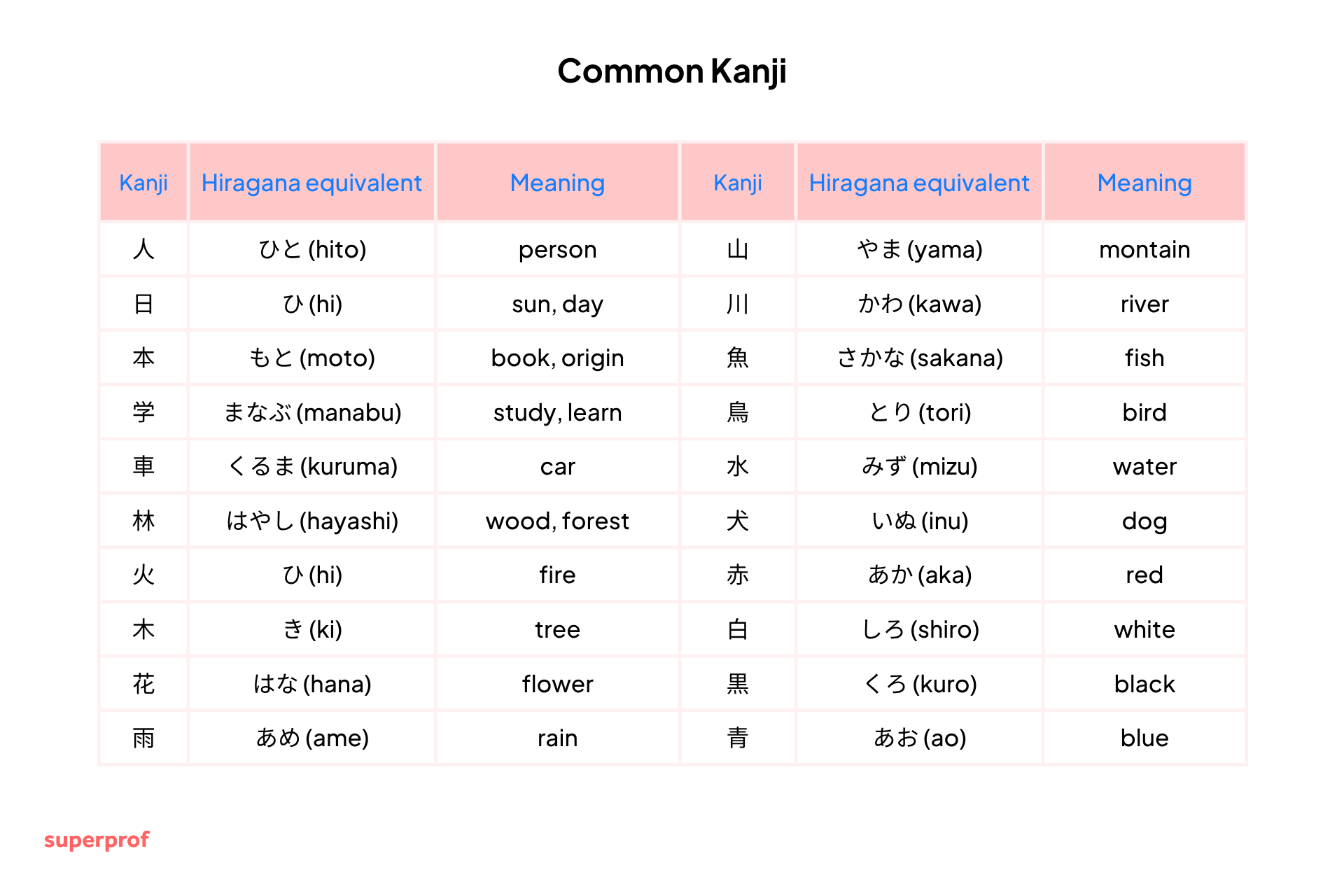
What to Know About Japanese Kanji
- This writing system is a direct descendant of the Chinese hanzi.
- Kanji may be read one of two ways: Chinese reading or Japanese reading.
- Japanese dictionaries list more than 10,000 kanji but you may count yourself as fluent after mastering around 2,136 of them.
- Japanese speakers use Kanji alongside Hiragana and Katakana to express themselves in writing.



What is Kanji?
As a Mandarin speaker, I can assure you that Kanji are plenty confusing. They look like Chinese characters, but they don't (always) sound like them, and often, they have completely different meanings.
Japanese Kanji originated in China.
In Chinese, these characters are called 'hanzi' (traditional Chinese: 漢字).
Kanji (also 漢字) is the Japanese pronunciation of 'hanzi'.
Note that the word han represents the Chinese ethnic majority (Han) population; zi can mean 'word' or 'particle'. So, the word hanzi literally means 'Han words'. That same character combination doesn't sound the same, nor does it mean the same thing in Japanese.
The History of Kanji
Hanzi first arrived on Japanese shores via diplomatic communications, coins (and later bills), and swords. Other trade items imported from China often bore these characters, too. The Japanese people had no idea what they meant; written language was not common in Japan in those days.
The historical record of how hanzi became Japanese kanji is a bit sketchy1; it details a semi-legendary scholar, Wani, arriving in Japan from Korea. He brought with him the Chinese writing style (and Confucian teachings). His efforts to educate the public launched Japan's long quest towards literacy.
And towards diplomacy. Empress Suiko (593-628) began sending diplomatic missions to China, which greatly enhanced the need for written language skills.
Until the Japanese adopted and adapted kanji, their tongue had no written form.
A few centuries later, during the Heian Period (794 - 1185), Japanese written language underwent many changes. For example, kanbun consisted of Chinese characters (by now called kanji), with diacritical marks. Those marks accommodated Japanese grammar and syntax, making the language conversion easier.
Ultimately, the Japanese established the kana system to further flesh out Japanese writing. The Katakana writing system emerged around the late eighth to ninth century to assist in reading Buddhist texts. Hiragana made its appearance later in the ninth century.
Adapting Hanzi to the Japanese Language
A language does not become fixed ...
Victor Hugo, French author
Mr Hugo is right, of course. As we discover, invent, and experience new things, we form the words to describe them. Rest assured that, back then, nobody in Japan consulted with Chinese authorities when they needed a new word or phrase. Once they got the sense and rhythm of writing words, they were quite keen to form some of their own.
Kokuji (国字) are kanji established in Japan to express authentic Japanese words and concepts.
Though written in the convention of the Chinese hanzi, these characters have no equivalent pronunciation in Mandarin. Nor do they have any meaning in the Chinese language. This sampling describes situations common to Japan, but don't feature in the Chinese tongue:
We could fill this entire article with further examples, but these three are enough to get the point across. Kokuji are perfect to illustrate how Japanese speakers adapted the Chinese written language to their own linguistic needs.
Kanji Meaning and Reading
If you've taken away nothing else from this lesson so far, you must have picked up on how confusing it is to adapt one language's writing system to a completely separate language. Obviously, such cannot happen overnight, or even in a few years.
This process took centuries. During that evolutionary period, the clever Japanese devised ways to make the transition work2. Today, we call them 'kanji readings'.
on'yomi (音読み): Chinese reading; Japanese pronunciation borrowed from Chinese.
kun'yomi (訓読み): Japanese reading; native Japanese pronunciation assigned to a kanji.
We must keep in mind that, from the start, the Japanese had their own oral language; they only lacked the written part. Borrowing the writing from China meant they had to also borrow a rough approximation of the characters' sounds. Particularly when reading combined characters like 学校 (gakkou in Japanese, xue xiao in Mandarin.)
By contrast, kun'yomi worked better for concepts expressed with a single kanji, like 姫 (hime). These standalone characters can then be expanded on by adding Hiragana characters to adjectives and verbs.
Japanese dictionaries typically list on'yomi in Katakana and kun'yomi in Hiragana.
Kanji With Multiple Readings
In English, homographs are a class of words that feature the same spelling and perhaps the same pronunciation, but the meaning is different. The word 'bear' is a fine example; it's either a large mammal or the act of carrying something.
In Japanese, the kanji 生, meaning 'life', has eight basic readings.
They are: sei, shō, nama, ki, o-u, i-kiru, i-kasu, and i-keru.
Just as in English, Japanese speakers understand their homographs through context. If the kanji is a part of a compound word (on'yomi), they get the character's meaning from that structure. However, if it presents as a standalone character, kun'yomi logic typically applies.
In the case of 生, the meaning remains (relatively) the same: 'life', 'to be born', and related concepts (生日 = birthday). It's just that the character's pronunciation varies depending on context. So, it's not a true homograph.
However, the character 金 is. It's pronounced either kane (money) or kin (gold). Leaving aside the discussion over gold being money, the reading you assign this character depends on the setting you find it in3.
A story about treasure hunting
- 金はどこだ?!
- Reading: kin wa doko da?!
- Meaning: Where is the gold?!
A story about the mafia
- 金はどこだ?!
- Reading: kane wa doko da?!
- Meaning: Where's the money?!
This aspect of Japanese reading confuses even native Japanese speakers. Most of the furore over meaning arises over legal documents and personal names, which are always written in kanji. Often, these characters include furigana, a smaller kana character, to show how they should be pronounced.
How Many Kanji Are There?
The beginning of wisdom is to call things by their proper name.
Confucius
There's a certain elegance in the parallel ideas that Kanji originated in China, and China's greatest philosopher, insisting on giving everything its proper name. It also helps explain the boundless number of Kanji.
The historical dictionary dai kan-wa jiten lists a more modest count of around 50,000; still an off-putting number. Fortunately, you don't need to learn them all. The Japanese government recognises fewer than 3,000 characters for official use.
common-use characters
'name' characters
Standard dictionaries in Japan typically list around 10,000 kanji. Native Japanese speakers know between 2,000 and 3,000 jōyō kanji (常用漢字). That's enough to read newspapers and books, and handle everyday written matters. Those who have time and passion might pursue deeper knowledge of kanji, particularly if they practice calligraphy.
Kanji in Names
You may have raised an eyebrow over the 'name' characters cited above. It refers to the Japanese convention of choosing names from the officially sanctioned list. In Japan, as in most other countries, it is illegal to name one's child anything offensive or provocative. Furthermore, names are typically written in kanji.
Whether by tradition or actual belief, Japanese society is overwhelmingly spiritual. Giving a child a 'power name' promises a bright future, full of success. Name choices may also reflect family legacies, cultural symbolism, and heritage.
Kanji names are then modified with an additional character to indicate gender. Male names typically end in -o, -shi, or -suke; female names finish with -e, -ko, -mi, or -na. Which of these Japanese prime ministers' names demonstrates this convention?
Shinzo Abe
Shigeru Ishiba
Fumio Kishida
Sanae Takaichi
How to Use a Kanji Chart
Of the three different scripts used in the Japanese language, Kanji is, by far, the most artistic. Still, whether studying Japanese or you wish to practise calligraphy as an art form, you must have a guide for writing kanji.
You'll find that most Kanji charts available for free online organise the characters by levels of difficulty. They are aimed at learners, often presenting these materials by grade.
Select Kanji writing charts organised by stroke number.
Some Japanese kanji involve only one stroke (一, the number 1), while others may take as many as 20. Obviously, it makes sense to build fundamental skills before moving into the more complex characters. Besides, starting simple is a fantastic confidence booster; soon, you'll be writing Kanji like a pro!
More Kanji Charts and Learning Resources
- Mathieu. “The History of Kanji 漢字の歴史 - It’s Japan Time.” It’s Japan Time, 19 Nov. 2017, itsjapantime.com/the-history-of-kanji-%E6%BC%A2%E5%AD%97%E3%81%AE%E6%AD%B4%E5%8F%B2/. Accessed 12 Apr. 2026.
- P, Kelsey. “Kun-Yomi vs. On-Yomi Explained: Why Do Japanese Kanji Have Multiple Readings? - Immersion Japanese Club.” Immersion Japanese Club - Immersion JLPT Japanese Studies, 4 Mar. 2023, immersionlanguageclub.com/2023/03/04/kun-yomi-vs-on-yomi-explained-why-do-japanese-kanji-have-multiple-readings/. Accessed 12 Apr. 2026.
- Japanese with Anime. “Kanji Read Different Ways.” Japanese with Anime, 22 Dec. 2017, www.japanesewithanime.com/2017/12/same-kanji-different-reading.html#Homographs. Accessed 12 Apr. 2026.
Summarise with AI:
Did you like this article? Leave a rating!


 Loading...