
The lesser used of the three Japanese writing systems, Katakana is largely for spelling foreign words. However, it has other interesting uses. For example, Japanese Manga features many katakana characters, and if you set your Pokémon Go app to Japanese, you'll see plenty there, too. In this article, you'll learn how katakana came about, how to use it, and practical guidance for mastery.
What to Know About Katakana Characters
- They are not a complete alphabet, they are used alongside Kanji and Hiragana writing systems.
- Katakana is dedicated to expressing foreign words in Japanese.
- Onomatopoeia is an important cultural marker in Japan; katakana serves to express those sounds.
- Katakana is also used to write technical and scientific terms.



The History of Japanese Katakana
Katakana came about around the 9th century, thanks to Buddhist monks in Nara seeking to translate works of art and texts from India1. Those monks devised their new writing system from an ancient form of Chinese writing, known in Japan as man'yogana.
The monks didn't use the full Chinese character to create their new writing system.
The parts they used are called kata (片), which means 'partial' or 'fragmented'.
This explanation gives us half of the writing system's name. The other half, kana, typically translates to 'form' or 'method'. In short, katakana (片仮名) literally translates to 'fragmentary form' or, more accurately, 'fragmentary kana', in the sense of 'syllabary'. to use alongside the Kanji system.
Japanese Katakana Purpose
The period Katakana was established in, the Japanese Heian period (794 - 1185), was notorious for its literary and religious contributions to culture and society. The imperial court feasted on poetry, and several new literary genres emerged. This historical perspective shows us why an additional, more expressive writing system was needed.

The Katakana writing system was developed to convert foreign words into Japanese, and to express literary effects. Over time, it also became the go-to syllabary to describe scientific and technical terms. It has also been historically used as the main writing system for company names and logos.
As for why Katakana looks different from the other writing systems, the story goes that Katakana developed its characteristically blocky style with straight lines due to the way it was first conceived.
If you look at Chinese writing, it too lacks the loops and swirls that characterise Hiragana. As the story goes, etching clean lines makes for more efficient writing.
Katakana Breakdown
Whereas you’ll likely find a combination of Hiragana and Kanji in just about every basic text you’ll come across in Japanese, Katakana is slightly more niche. Even so, it is still very common, and definitely isn’t something you can afford to skip over if you want to learn how to write in Japanese.
This is where the rubber meets the road. Before studying each of these characters in detail, let's go over some vital general information about the Katakana alphabet2.
Writing in the Roman alphabet as we do, it's easy to see when a syllable contains an 'a' or an 'o'. In Katakana, recognising which vowel is in play is a bit trickier. Let's examine the first sequence above, 'ka-ki-ku-ke-ko'. In kana, it looks like 'カ, キ, ク, ケ, コ'.
None of these kana offers any visual clues to recognise which vowel is in play. Therefore, you must remember all 46 of them, and the sounds they represent.
1. It is the only kana that does not end in a vowel sound.
2. It does not begin any words in standard Japanese.
3. Its pronunciation can change depending on what sounds surround it.
Katakana Extended Characters
Neologism: a new word or expression, or a new meaning for an existing word or expression.
Collins dictionary
Language is not static, we're forever inventing new words, or new pronunciations for existing words, to describe novel concepts. These days, we commonly talk about things going viral and influencers' selfies. That sentence includes three words that didn't exist 20 years ago.
The same thing happens in Japanese, typically to more closely mimic sounds in other languages. Except that linguists develop new combinations of katakana characters to make new sounds. For instance, ‘ki’ (キ) becomes ‘kye’ (キ工) by adding the ‘e’ character.
Once you master the fundamental set of Katakana characters, you only need to focus on how they combine to make new sounds.
This syllabary writing system shares one aspect with the Japanese Hiragana writing system: they are both called kana. However, these two systems differ in many ways, and Katakana has its own unique look and special usage.
Katakana Stroke Order
Writing kana in their proper order is as important as putting letters in their proper order when spelling in English. Not just out of respect for the language and culture, but to help you build muscle memory and handwriting speed.
1. Top to bottom.
2. Left to right.
3. Horizontal strokes before vertical ones.
Now, for another vital reason to follow proper stroke order. Much of katakana's syllabary is visually similar and easy to confuse, especially for beginner Japanese learners. Consider these four characters and the sounds they represent.
Failing to follow stroke order rules could lead to confusion; they may appear unbalanced or simply incorrect3. As a student of Japanese, you'll likely sit many exams that will be marked with handwriting recognition software. How terrible it would be to have an answer marked wrong because of an errant or misplaced stroke.
Katakana Chart
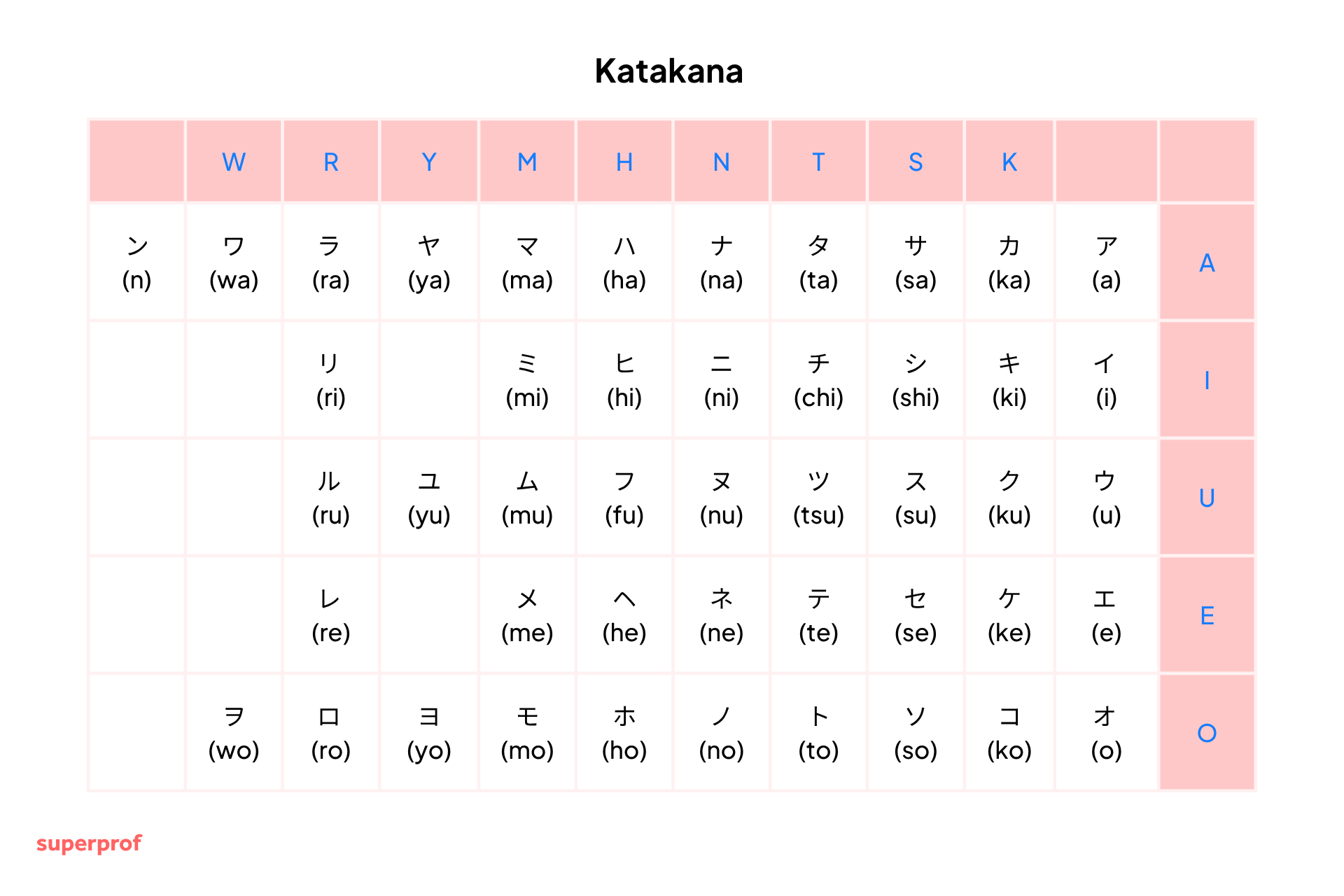
Now is the time to get serious about the 46 characters in Katakana. You may be pleased to know that the characters in this writing system are made up of clean, straight lines and angular corners. No curves or swirls, like in the other writing systems, as you can see.
| Vowels Consonants | a | i | u | e | o |
|---|---|---|---|---|---|
| vowel characters | ア | イ | ウ | エ | オ |
| k | ka - カ | ki - キ | ku - ク | ke - ケ | ko - コ |
| s | sa - サ | shi - シ | su - ス | se - セ | so - ソ |
| t | ta - タ | chi - チ | tsu - ツ | te - テ | to - ト |
| n | na - ナ | ni - ニ | nu - ヌ | ne - ネ | no - ノ |
| h | ha - ハ | hi - ヒ | fu - フ | he - ヘ | ho - ホ |
| m | ma - マ | mi - ミ | mu - ム | me - メ | mo - モ |
| y | y - ヤ | --- | yu - ユ | --- | yo - ヨ |
| r | ra - ラ | ri - リ | ru - ル | re - レ | ro - ロ |
| w | wa - ワ | wi - ヰ | --- | we - ヱ | wo - ヲ |
While a brief glance at the katakana character chart might be intimidating, once you learn the correct stroke order, each character should be easy enough to reproduce. As with anything, you need to dedicate time to this practise in order to master it.
Katakana Usage in Modern Japanese
As we’ve already touched upon a couple of times, the usage of the Japanese Katakana writing system may be infrequent, yet it is still necessary. Some say that until you have mastered the basics of reading and writing Hiragana, you needn’t bother with Katakana.
Yet on the flip side, if Katakana is one of the writing systems you start with, you might have an easier time staying motivated. This is due to the abundance of foreign loan words that should be recognisable to the learner. That aside, Katakana can be used to express a variety of concepts, from the foreign to the scientific and even the literary, as we’ll explore now.
Foreign Words
First and foremost, Katakana is used to write words that are borrowed from other languages. If you’ve ever heard a Japanese speaker pronounce a word that sounds awfully similar to an English one, then chances are it’ll be written using Katakana characters.
You can write coffee in Japanese as ‘kohii’ (コヒ), and 'spoon' is pronounced ‘supūn’ (スプーン).
Don’t be surprised to come across many English-sounding words during your Japanese studies, since they are vast in number. If you do, then you know that they will be expressed using the Katakana writing system.
Names
Katakana is used for a wide variety of different names. Not people or object names, but just about everything else. This includes company names, technical terms, plant names and scientific terms.
As a result, if you find yourself writing an essay in Japanese at some point, then a sound knowledge of Katakana will help you with the technical references.
While it may not be important to learn all scientific or technical terms, it can be useful to know some of the more important ones. For example, ‘homo sapiens’ is written ホモサピエンス (homosapiensu) in Katakana.
Literary Effects
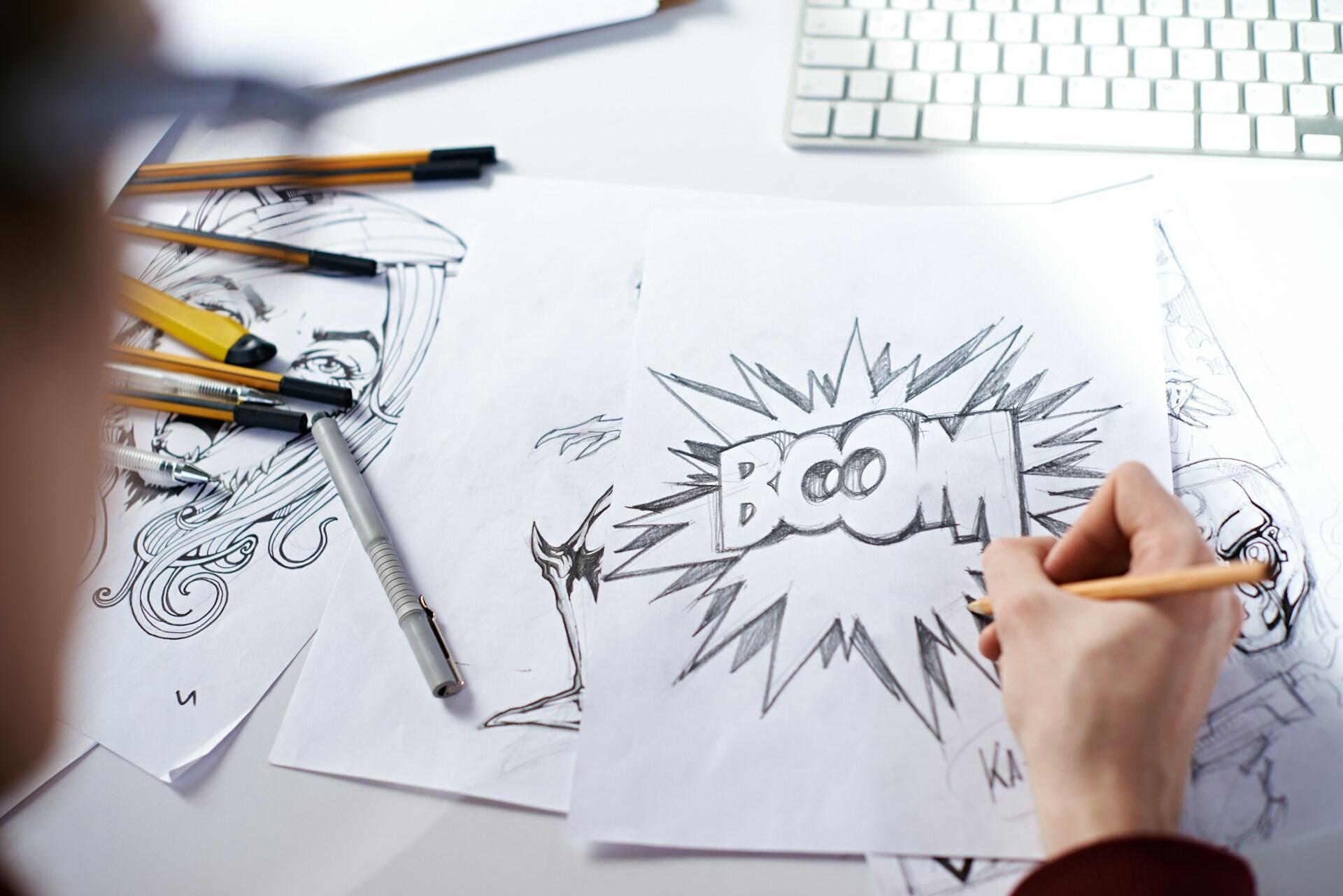
Katakana is also used for some literary effects like onomatopoeia. This captures everything from the sound a doorbell makes, to the crashing sound associated with a car crash.
The reason why this is worthy of mention is due to its prevalence in manga and other forms of Japanese writing. You’ll struggle to read any Japanese comic that doesn’t use Katakana heavily. So, if you’re an avid manga reader or even a gamer, then you’ll need to know how to read Katakana.
Importance of Katakana
While it’s easy to think that learning foreign loan words in Japanese shouldn’t be your number one priority, there’s actually a very good reason to make it one. When you go out to eat in Japan, you’ll find that the menu is likely written in Katakana.
If for no other reason than sampling delicious Japanese foods, it’s worth getting to grips with this writing system and some of the most common foreign loan food words.
This can also be considered as an early win in your struggle to master the complex Japanese language. The first time you are able to successfully identify what you want to order in a restaurant without consulting the English, you’ve taken one small step towards your reading comprehension goals.
A word of warning, though, not all loan words are derived from English. Some, like ‘tempero’, come from Portuguese, so you need to be careful that you don’t mistranslate, as you could end up with a very different dish than the one you were expecting.
Resources to Learn Katakana Characters
- “Katakana | Chart, History, Difference from Hiragana, & Japanese Alphabet | Britannica.” Www.britannica.com, 16 Feb. 2024, www.britannica.com/topic/katakana. Accessed 9 Apr. 2026.
- “Katakana - Alphabet | Easy Japanese | NHK WORLD-JAPAN.” NHK WORLD-JAPAN, 2025, www3.nhk.or.jp/nhkworld/lesson/en/letters/katakana.html. Accessed 9 Apr. 2026.
- “Katakana Stroke Order - Learn to Write Japanese Katakana | JapaneseJLPT.” Japanesejlpt.com, 2026, www.japanesejlpt.com/learn-japanese/katakana-stroke-order/. Accessed 9 Apr. 2026.
Summarise with AI:
Did you like this article? Leave a rating!

 Loading...