
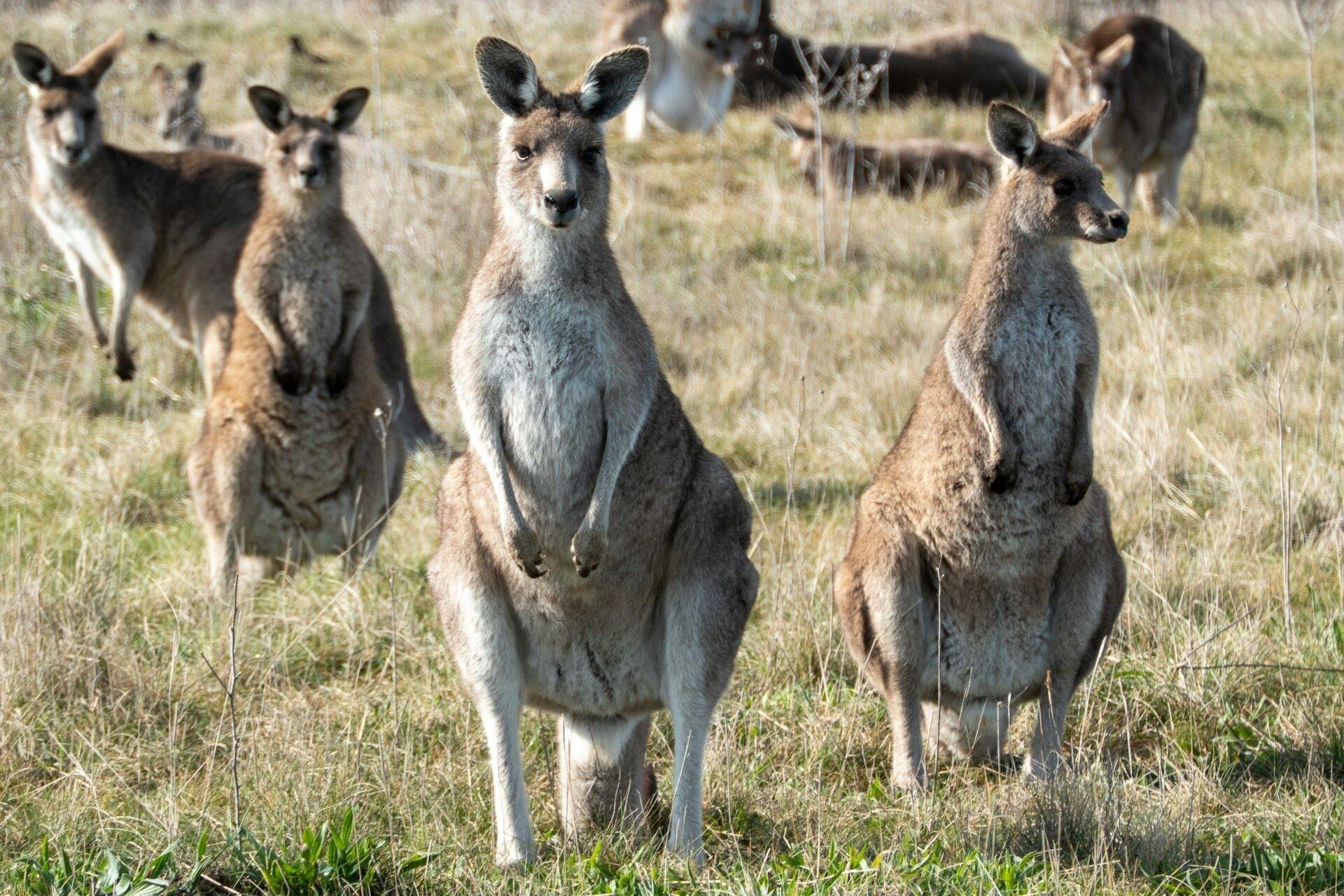

It's hard to name an animal more synonymous with Australia =than the kangaroo. Even its silhouette evokes the country. Its image now shapes how Australia and Australians present themselves internationally, but how did this marsupial become such a key part of Australian identity?
Key Takeaways
- European imagery associated the kangaroo with Australia in the eighteenth century. However, Aboriginal peoples had known the animal for thousands of years.
- Kangaroos appeared in colonial art, advertising and patriotic imagery long before Australian Federation in 1901.
- The kangaroo and emu have appeared together on Australia's Commonwealth Coat of Arms since 1908.
- The kangaroo is one of Australia's most recognisable national icons, but it isn't listed separately among the country's six officially chosen national symbols.


Why Is the Kangaroo a Symbol of Australia?
The kangaroo is native to Australia. Its movement is instantly recognisable. Its close association with Australia's landscape made it an obvious choice for artists and designers. Over time, widespread use gave it cultural significance that extended far beyond its place in Australian wildlife.⁷
An official national symbol is formally recognised through a government process, while a national icon becomes widely associated with a country through its history and culture. The kangaroo is one of Australia's most recognisable national icons, but the Australian Government does not list it separately among the six officially chosen national symbols.⁵ However, it does have an official role alongside the emu on the Commonwealth Coat of Arms.⁶
How Did the Kangaroo First Become Associated with Australia?
Aboriginal peoples valued the kangaroo long before Europeans arrived. Even the English word kangaroo comes from gangurru, a Guugu Yimidhirr word recorded during James Cook's 1770 voyage.⁷ European explorers were fascinated by it, along with much of Australia's wildlife that was unfamiliar to them.

1806
The Bowman Flag
A kangaroo and emu appeared on either side of a shield, demonstrating their use as Australian emblems long before Federation.⁸
1880s
Commercial and Decorative Imagery
Kangaroo designs became popular on souvenirs, decorative objects and commercial products, including bicycles and Billy Tea.⁷
1908
The First Commonwealth Coat of Arms
King Edward VII granted Australia's first Coat of Arms, featuring the kangaroo and emu supporting a central shield.⁶
1912
The Coat of Arms Is Redesigned
King George V granted the current design, retaining both animals and introducing the emblems of Australia's six states.⁶
1913
The First Nationwide Australian Stamps
Australia's first nationwide postage stamps featured a kangaroo inside a map of the country.¹
1944
The Qantas Kangaroo
Qantas introduced a kangaroo emblem inspired by Australia's penny coin, establishing an enduring association with Australian aviation.⁹
1982
The Royal Australian Air Force
The RAAF ensign's roundel gained a leaping red kangaroo, strengthening the animal's connection with Australian defence.⁴
1983
The Boxing Kangaroo
The Boxing Kangaroo flag gained prominence during Australia II's historic America's Cup victory, becoming a familiar sporting emblem.³
1986
The Australian Made Logo
Designer Ken Cato created the green-and-gold kangaroo logo to identify Australian-made and Australian-grown products.²
How Did the Kangaroo Become an Australian Emblem Before Federation?
In the nineteenth century, colonists regularly used native Australian animals to express an identity distinct from Britain. The kangaroo's unusual appearance made it a prime candidate for this role. They appeared in everything from everyday objects to patriotic illustrations.⁷

You'll also see kangaroo and emu designs on brass breastplates presented to Aboriginal people by colonial settlers. In these instances, Europeans used the animals as examples of heraldic and authoritative traditions rather than traditional Aboriginal systems of recognition.⁸ It was clear by this point that the animals had become incredibly familiar parts of colonial visual culture, even before Australia became a federated nation.

Why Is the Kangaroo on the Australian Coat of Arms?
When Australian colonies federated in 1901, the new Commonwealth needed symbols to represent its identity. Native wildlife was an interesting alternative to typical British heraldic traditions. The kangaroo was already being used in colonial imagery and was an established Australian emblem. By including it in the Coat of Arms, the federal Government found a distinctly Australian visual identity.⁶

How Has the Kangaroo Been Used to Represent Australia?
You'll see kangaroos representing Australia beyond the Coat of Arms. Thanks to the animal's unique silhouette, it works well in logos, badges, and other designs where an image must be understood quickly. Organisations that want to communicate Australianness or Australian origins can easily use a kangaroo.
The Commonwealth Coat of Arms

The kangaroo has appeared on Australia's Commonwealth Coat of Arms since 1908. Alongside the emu, it supports the shield representing the Australian states. The two animals are traditionally understood to symbolise a nation moving forward, reflecting their limited ability to move backwards easily.⁶
Australian Currency and Stamps
Kangaroos have appeared on Australian coins and stamps for generations. The first nationwide postage stamps, issued in 1913, featured a kangaroo inside a map of Australia.¹ Today, the familiar one-dollar coin carries Stuart Devlin's design featuring five kangaroos.¹⁰
Royal Australian Air Force

The kangaroo also represents Australia in military aviation. In 1982, the Royal Australian Air Force added a leaping red kangaroo to the roundel on its ensign. This distinctive design gives the Australian military flag a recognisable national character.⁴ Interestingly, this uses the colours of the national flag and neither of the national colours of green and gold.
Qantas and the Flying Kangaroo

Qantas adopted kangaroo imagery in 1944, inspired by the animal on Australia's penny coin. The Flying Kangaroo has since undergone several redesigns while remaining central to the airline's identity. Today, it is recognised internationally as a symbol of Australian aviation.⁹
The Australian Made Logo

The green-and-gold Australian Made logo uses a stylised kangaroo to identify products that meet Australian-origin certification requirements. Introduced in 1986, the design connects the country's distinctive wildlife with local manufacturing and production. It remains a familiar symbol on Australian products.²
Australian Sport

The kangaroo is a familiar symbol of Australian sporting identity, appearing on team uniforms, flags and merchandise. The Boxing Kangaroo became particularly prominent during Australia II's 1983 America's Cup victory. The original flag was later recovered overseas and returned to Fremantle.³
Is the Kangaroo Australia's Official National Animal?
Although the kangaroo is ubiquitous as a symbol of Australia, the Department of the Prime Minister and Cabinet doesn't list a national animal, so it doesn't have official status like the national anthem.⁵ The kangaroo is often described as the national animal; this is a cultural status, not an official one. It's also worth noting that there are several kangaroo species, and plenty of other animals that could be the country's national animal. Which would you pick?
The term kangaroo refers to several related marsupial species, including red, eastern grey and western grey kangaroos. They belong to the broader macropod family, which also includes wallabies and tree kangaroos. The red kangaroo is the world's largest living marsupial. In Australian logos and emblems, kangaroos are generally stylised rather than accurate depictions of a particular species. Their powerful hind legs, long tails and distinctive ears make them recognisable even in simple silhouettes. This allows the kangaroo to represent Australian wildlife without identifying one particular species.⁷
If you'd like to learn more about Australian history, culture, or nature, consider working with a private tutor on Superprof. Tutors are available across Australia for different subjects, skills, levels, and budgets. If you're not sure exactly what you're looking for, don't worry! Most tutors offer a free first session, so you can try a few before choosing the one that's right for you.
References
- Australia Post. “Our History.” Australia Post, https://auspost.com.au/about-us/corporate-information/our-history. Accessed 14 Oct. 2026.
- Australian Made Campaign. “Frequently Asked Questions.” Australian Made, https://australianmade.com.au/why-buy-australian-made/faqs/. Accessed 14 Oct. 2026.
- Australian Olympic Committee. “Original Boxing Kangaroo Flag Calls Freo Home.” Australian Olympic Committee, https://www.olympics.com.au/news/original-boxing-kangaroo-flag-calls-freo-home/. Accessed 14 Oct. 2026.
- Department of the Prime Minister and Cabinet. “Australian Ensigns.” Australian Flags Booklet, https://www.pmc.gov.au/resources/australian-flags-booklet/part-3-other-official-flags-australia/australian-ensigns. Accessed 14 Oct. 2026.
- Department of the Prime Minister and Cabinet. “Australian National Symbols.” Department of the Prime Minister and Cabinet, https://www.pmc.gov.au/honours-and-symbols/australian-national-symbols. Accessed 14 Oct. 2026.
- Department of the Prime Minister and Cabinet. “Commonwealth Coat of Arms.” Department of the Prime Minister and Cabinet, https://www.pmc.gov.au/honours-and-symbols/commonwealth-coat-arms. Accessed 14 Oct. 2026.
- National Museum of Australia. “Kangaroo.” Defining Symbols of Australia, https://www.nma.gov.au/exhibitions/defining-symbols-australia/kangaroo. Accessed 14 Oct. 2026.
- National Museum of Australia. “Manufacture and Designs.” National Museum of Australia, https://www.nma.gov.au/explore/features/aboriginal-breastplates/manufacture-decoration. Accessed 14 Oct. 2026.
- Qantas. “Our Logos.” Qantas, https://www.qantas.com/en-au/about-us/logos. Accessed 14 Oct. 2026.
- Royal Australian Mint. “One Dollar.” Royal Australian Mint, https://www.ramint.gov.au/collect/national-coin-collection/circulating-coins/one-dollar. Accessed 14 Oct. 2026.
Summarise with AI:
Did you like this article? Leave a rating!

 Loading...

