
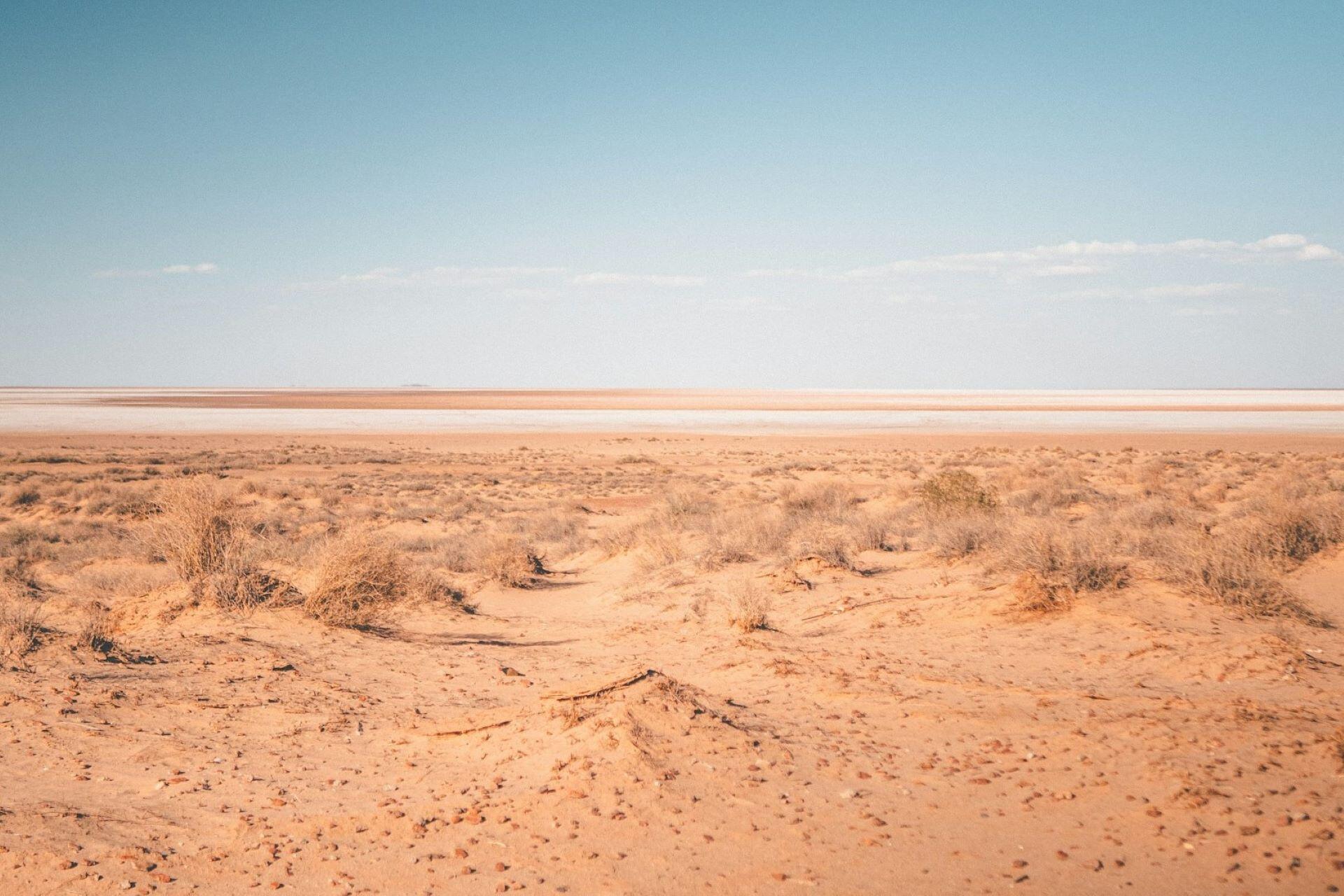

Contrary to common belief, Australia is not entirely desert. While it is the driest inhabited continent, only about 18% of its landmass is classified as desert, with the remainder comprising diverse ecosystems, including forests, grasslands, and coastal regions.
To better understand Australia’s desert landscapes, it helps to look at the country’s 10 officially recognised mainland deserts, including where they are located and their sizes. The table below provides a quick summary before we explore each desert in more detail.
| Desert | Location | States / Territory | Approx. Size | Landscape Type | Key Features |
|---|---|---|---|---|---|
| Great Victoria Desert | Central southern Australia | WA, SA | 348,750 km² | Sandy desert | Sand ridges, salt lakes, red plains |
| Great Sandy Desert | Northwestern Australia | WA, NT | 284,993 km² | Sandy desert | Dune fields, sparse vegetation |
| Tanami Desert | Central northern Australia | NT, WA | 184,500 km² | Sandy and rocky | Sand plains, low relief terrain |
| Simpson Desert | Central eastern Australia | NT, SA, QLD | 176,500 km² | Sandy desert | Parallel dunes, seasonal rivers |
| Gibson Desert | Central western Australia | WA | 156,000 km² | Sandy and stony | Gravel plains, low hills |
| Little Sandy Desert | Northwestern central Australia | WA | 111,000 km² | Sandy desert | Red dunes, spinifex grass |
| Strzelecki Desert | Northeastern South Australia | SA | 80,250 km² | Sandy desert | Sand dunes, salt lakes |
| Sturt Stony Desert | Central Australia | SA, NT | 29,750 km² | Stony desert | Stone-covered plains |
| Tirari Desert | Northeastern South Australia | SA | 15,250 km² | Sandy desert | Dunes, salt lakes, Lake Eyre |
| Pedirka Desert | Central Australia | NT, SA | 1,250 km² | Sandy and clay | Flat terrain, claypans |





Is Australia All Desert?
Australia is often thought of as a desert country. However, this perception can be misleading when considering how deserts are actually defined¹. An interesting fact about Australia is that its landscape is actually very varied. A small part of the country is formally classified as desert, but a lot of it is arid or semi-arid. This is why Australia is the driest inhabited continent on the planet, yet also home to forests, grasslands, and coastal environments.
of the country is considered arid or semi-arid⁴
Australia is often described as a desert country, but this can be misleading. While around 18% of the land is classified as desert, a much larger portion is considered arid or semi-arid, meaning it receives low rainfall but still supports ecosystems. This distinction explains how Australia can be both extremely dry and environmentally diverse.
What Are the Main Deserts in Australia?
Australia's deserts are mostly in the central and western parts of the country or continent (Australia can be thought of as both). They form a broad belt of arid land. Among Australia's recognised deserts, there are the Great Victoria, Great Sandy, Simpson, and Gibson deserts. These are defined by low rainfall and sparse vegetation, which is why they're still grouped together despite differences in landscape and location².
recognised deserts in Australia.
Australia’s 10 Deserts
In terms of size, landscape, and location, there's a lot of variation across Australia's 10 recognised deserts, offering an interesting comparison to Australia's densely populated coastal areas. They cover a large portion of the country's interior, but they aren't contiguous. Instead, they form a patchwork of sandy, stony, and salt-covered regions across multiple states and territories³. Here's a quick overview of each so you can see how they differ.⁵
Australia’s deserts are defined primarily by low rainfall rather than just sand or heat. Some are dominated by dunes, while others consist of rocky plains or salt lakes. Despite their differences, all ten deserts are grouped together because they share similar arid conditions and environmental challenges.
Great Victoria Desert
Great Sandy Desert
Tanami Desert
Simpson Desert
Gibson Desert
Little Sandy Desert
Strzelecki Desert
Sturt Stony Desert
Tirari Desert
Pedirka Desert
Unique Features of the Great Australian Desert
The Great Australian Desert is actually a collection of interconnected regions across the massive country. They all share similar environmental conditions in the country's interior. Low rainfall, high evaporation, and long-term geological processes define this broader area⁷. This makes for a range of distinct but related environments⁵.
Diverse Landscapes
Large dune systems dominate areas like the Simpson Desert, with long, parallel ridges of red sand shaped by wind over thousands of years. These dunes can stretch for hundreds of kilometres and define much of central Australia's terrain.
Ephemeral salt lakes, including Lake Eyre, fill only during rare rainfall events. For most of the year, they remain dry, forming bright, reflective salt crusts across vast flat areas.
Areas such as Uluru and Kata Tjuta highlight the desert's geological diversity. These formations rise sharply from otherwise flat terrain and are composed of ancient rock shaped over millions of years⁶.
Regions like the Sturt Stony Desert are covered in small stones rather than sand. These surfaces reduce erosion and reflect the long-term weathering of rock in arid environments.
Many desert waterways only flow after rainfall. These intermittent rivers and creeks play an important role in shaping the landscape and supporting temporary ecosystems.
Flora and Fauna
Spinifex is one of the most widespread desert plants in Australia. Its tough, spiky structure reduces water loss and helps stabilise sand dunes in harsh conditions.
These trees are adapted to survive long dry periods, with deep root systems that access underground water. They are commonly found in sandy regions of central Australia.
As apex predators, dingoes play an important role in maintaining ecological balance. They are highly adaptable and can survive in some of the harshest desert environments.
Australia's deserts are home to a wide range of reptiles, including lizards and snakes. These species are well-suited to hot climates and often avoid extreme temperatures by being active at night.
Species such as emus and red kangaroos are commonly found in desert regions. Many animals are nomadic, moving between areas in response to rainfall and available water across connected desert ecosystems⁸.
Human Interaction
Aboriginal peoples have lived in Australia's desert regions for tens of thousands of years. Their knowledge of water sources, seasonal patterns, and land management is central to understanding the environment.
Locations such as Uluru hold deep cultural and spiritual meaning. These sites are protected and remain important for both heritage and identity.
Desert regions contain valuable natural resources, including minerals and opals. Mining activities have shaped parts of the landscape and contributed to local economies.
The Australian Outback attracts visitors seeking remote landscapes and unique experiences. Popular routes and tracks allow access to otherwise isolated regions.
Efforts to protect fragile ecosystems include national parks and reserves. Managing water use, wildlife, and human impact is essential in these arid environments.
Key Takeaways
- Australia is not entirely desert, with only a portion of its land formally classified as desert and much more considered arid or semi-arid
- The country has 10 recognised deserts, spread mainly across the central and western regions
- These deserts vary widely, including sandy dunes, stony plains, and salt lake systems
- The Great Victoria Desert is the largest, covering a significant part of southern inland Australia
- Australia’s deserts form a broader arid system rather than one continuous landscape
- Despite harsh conditions, desert regions support adapted plant and animal life
- Indigenous communities have lived in and managed these environments for thousands of years
- Human activity in desert areas includes conservation, tourism, and resource extraction
References
- Australian Broadcasting Corporation. “Are Australia’s Deserts Really Deserts?” ABC News, https://www.abc.net.au/news/2023-01-17/are-australias-deserts-really-deserts-outback-northern-territory/101794956. Accessed 23 Apr. 2026.
- Australian Broadcasting Corporation. “Deserts and Semi-Arid Landscapes.” ABC Education, https://www.abc.net.au/education/landscapes-and-landforms-deserts-and-semi-arid-landscapes/102317152. Accessed 23 Apr. 2026.
- Australian Geographic. “Australia’s 10 Deserts.” Australian Geographic, https://www.australiangeographic.com.au/science-environment/2016/04/australias-10-deserts/. Accessed 23 Apr. 2026.
- Australian Government, Department of Climate Change, Energy, the Environment and Water. “Rangelands.” DCCEEW, https://www.dcceew.gov.au/environment/land/rangelands. Accessed 23 Apr. 2026.
- Australian Government, Geoscience Australia. “Deserts.” Geoscience Australia, https://www.ga.gov.au/scientific-topics/national-location-information/landforms/deserts. Accessed 23 Apr. 2026.
- Australian Government, Geoscience Australia. “Landforms.” Geoscience Australia, https://www.ga.gov.au/scientific-topics/national-location-information/landforms. Accessed 23 Apr. 2026.
- Australian Government, Geoscience Australia. “Landforms and Their History.” Geoscience Australia, https://www.ga.gov.au/scientific-topics/national-location-information/landforms/australian-landforms-and-their-history. Accessed 23 Apr. 2026.
- One Earth. “Greater Australian Interior Desert Shrublands.” One Earth, https://www.oneearth.org/bioregions/greater-australian-interior-desert-shrublands-au7/. Accessed 23 Apr. 2026.
Summarise with AI:
Did you like this article? Leave a rating!

 Loading...
