
Electromagnetic waves are likely the type of waves you are most familiar with. They encompass a broad spectrum, including radio waves, microwaves, infrared, and visible light, among others, each with unique properties and applications. These waves are oscillations of electric and magnetic fields that propagate through space, carrying energy. This article examines the electromagnetic spectrum and applications for electromagnetic waves.
The Electromagnetic Spectrum Explained
- The electromagnetic spectrum comprises everything from low-frequency radio waves to high-frequency gamma waves.
- Light has both wave-like and particle-like properties; the narrow band of visible light sits on the spectrum between infrared and ultraviolet light.
- Unlike electromagnetic waves, which can travel through a vacuum, mechanical waves rely on particle displacement to travel.
- Electromagnetic waves have many everyday applications, from cooking in a microwave to receiving medical treatment.


What Are Electromagnetic Waves?
Electromagnetic waves are a type of radiation. These waves form when a magnetic field joins with an electrical field1. When these two forces move together, they create waves that can travel through the air and solid objects.
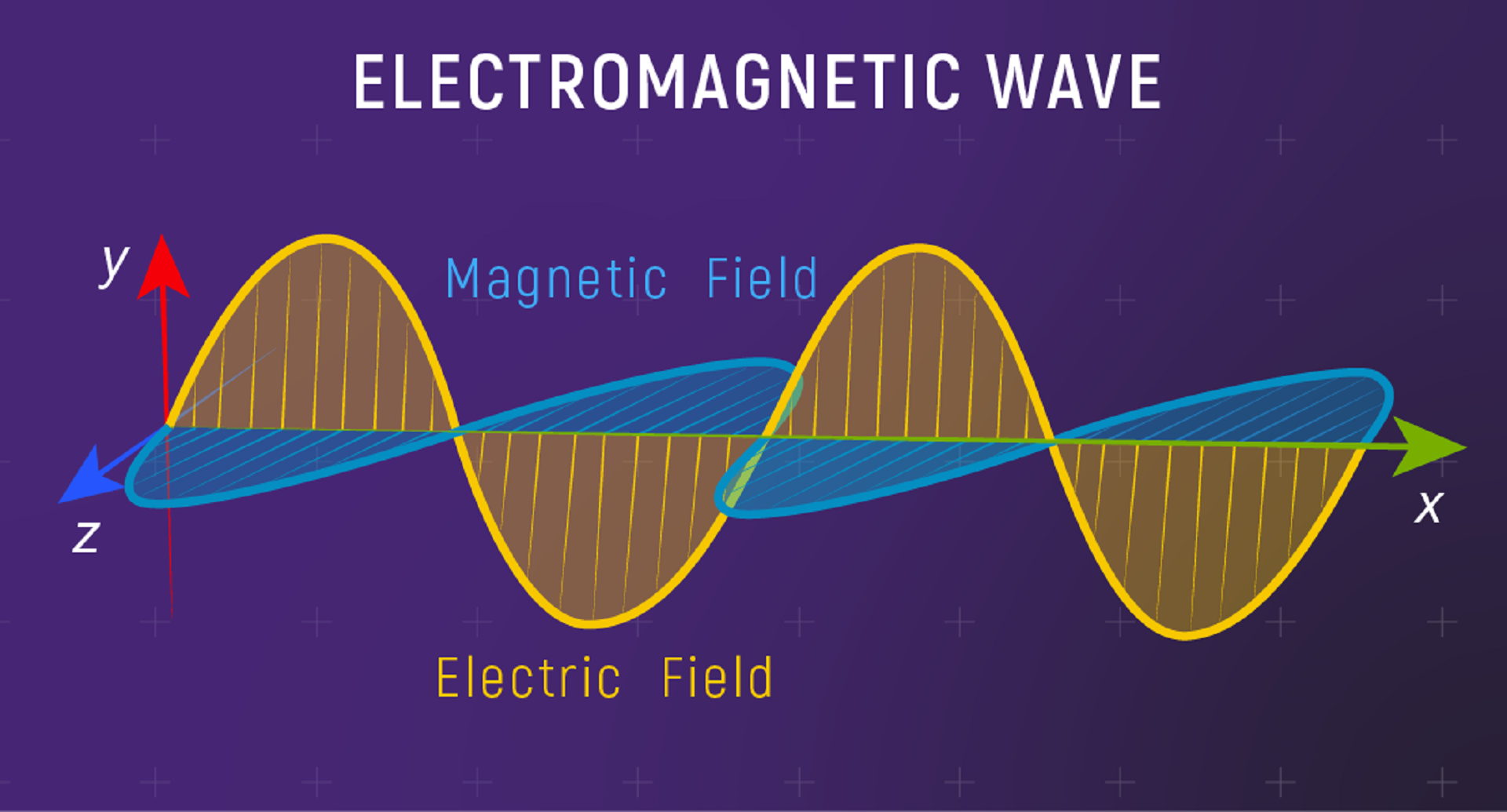
Like all the types of waves we study in physics classes, electromagnetic waves travel in a specific direction (x in the diagram). These two components, electrical and magnetic, run perpendicular to each other, as well as to the direction of the wave. This diagram illustrates that concept2.
Electromagnetic Wave Properties
Beyond these waves' transverse nature - the fact that they oscillate perpendicular to the direction of wave travel - they feature several more noteworthy characteristics.
Note that wavelength and frequency are inversely proportional: in a vacuum, all frequencies travel at the same speed regardless of any variance in energy.
Electromagnetic Waves vs Mechanical Waves
The key difference between these two types of waves is a medium: mechanical waves must have a medium to travel through. That medium may be gas, liquid or solid. Mechanical waves rely on the vibration of media's particles to propagate (to move).
By contrast, electromagnetic waves don't need a medium, though they can travel through solids. Their wave-particle property allows electromagnetic waves to propagate in a vacuum. Besides this fundamental distinction, these waves exhibit other differences.
Electromagnetic waves
- transverse waves only
- speed is constant in a vacuum
- propagate via oscillating magnetic-electric fields
Mechanical waves
- transverse, longitudinal, and surface waves
- speed varies by medium
- propagate via particle vibration
If you're a music lover, you might be most familiar with sound waves, which are mechanical. Other types of mechanical waves include ocean waves and seismic waves - the kind that predict earthquakes. Microwaves, X-rays, and light are examples of electromagnetic waves.
The Speed of Electromagnetic Waves
Earlier, you read that electromagnetic waves travel at the speed of light in a vacuum, calculated at approximately 3 × 10⁸ m/s. However, these waves may also travel through solids. What's their speed, then?
The waves' speed decreases in denser media because they interact with the media's particles.
You might wonder what the point is of knowing how fast electromagnetic waves propagate. In fact, it has several implications.
In all, these aspects allow the scientific community to distinguish the whole electromagnetic spectrum using a single speed.
The Electromagnetic Spectrum Explained
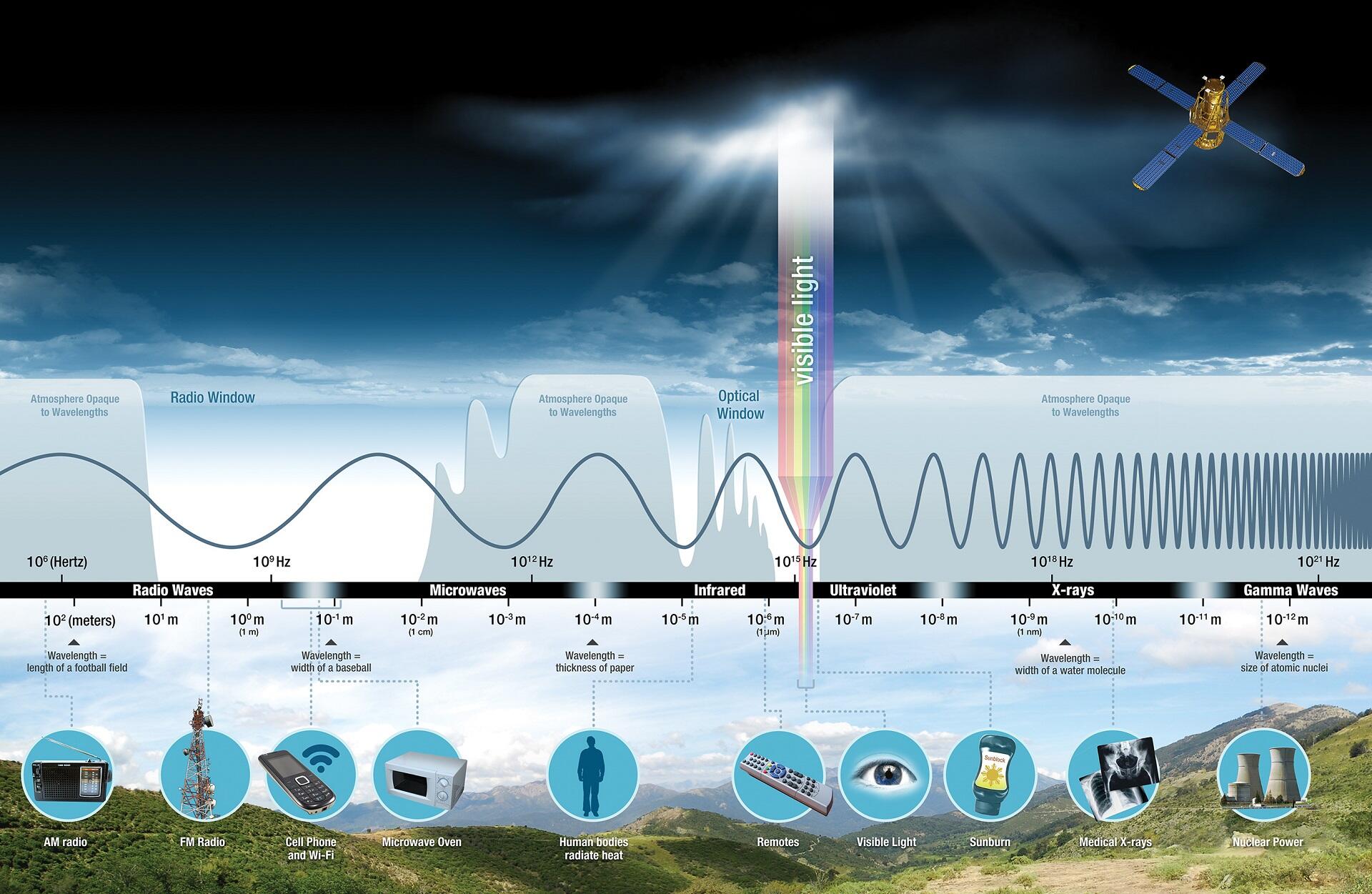
This spectrum comprises the full range of electromagnetic radiation. We needn't consider the longitudinal vs transverse properties, as you already know all electromagnetic waves are transverse waves3.
As shown in the graphic above, we categorise these waves by wavelength as well as frequency. Radio waves, at the far left of the spectrum, have the largest wavelength and the slowest frequency. That's where we begin detailing these waves' aspects.
Light as an Electromagnetic Wave
Above, you read about wave-particle duality: the electromagnetic waves' property that allows these waves to travel in a vacuum as well as through solids. Light also exhibits that duality, which allows it to both travel in a vacuum (as particles) and to create reflection and refraction phenomena (as waves).
For all of light's capabilities, the spectrum of visible light is relatively narrow. On the electromagnetic spectrum, visible light falls about at the midpoint, roughly between 400 and 700 nanometres (nm). It's flanked on one side by ultraviolet light (UV) and by infrared (IR) on the other4.
In our band of visible light, violet light claims the shortest wavelength, around 380–450 nm. Red light, by contrast, sits at the longest of our vision range's wavelengths (~625–750 nm). Violet light refracts more, making it ideal for industrial uses such as substance analysis and identification.
The race is currently on to build machines that can etch silicone wafers using extreme ultraviolet light at a wavelength of seven nm.
As artificial intelligence (AI) technologies advance, the demand for ever more powerful and capable chips continues to grow. All over the world, labs are using light as an electromagnetic wave to etch ever faster chips.
Radio Waves, Microwaves, X-Rays: Everyday Uses of Electromagnetic Waves
I do not think that the radio waves I have discovered will have any practical application.
Heinrich Hertz
This German physicist proved Jame Clerk Maxwell's electromagnetism theory, which he established through a set of differential equations. Today, we call them Maxwell's equations. By sheer happenstance, one of Hertz' experiments paved the way to proving Maxwell's work.
For three years, Hertz was totally consumed by his work in electromagnetism. Still, he concluded his discoveries would serve no purpose at all. Considering the world we live in, one filled with electromagnetic devices, one wonders how he could have been so despondent.

Let's say you've just wrapped up your day; it's time for a bit of relaxation. You pick up your television remote, using its infrared waves to first turn on your telly and then select something to watch. The telly itself is a marvel of electromagnetic wave utilisation; viewing is only possible thanks to radio waves emitting ultra-high frequencies (UHF).
Well, those were the tellies of old. Today's units rely on microwaves, transmitted via WiFi, for wireless transmissions. Speaking of microwaves, how about something to eat? You can pop a frozen into your microwave oven; it operates on the same principle as your WiFi router. Or maybe just some popcorn?
Do you like to scroll while you stream? Your handheld computer operates on roughly the same wavelength as your microwave and WiFi router do. Of course, you'll do all that viewing thanks to the narrow band of visible light the human eye can detect.
But don't stay up too late! You'll be at your doctor's surgery tomorrow; you have to have another X-ray on that wrist that keeps paining you. Medical X-rays' wavelength is only about as wide as a water molecule but they can still cause a lot of harm if you're not careful to shield yourself from those rays.
Of course, they're nowhere near as harmful as gamma rays could be. We use them to treat certain cancers, but they also power medical imaging devices like PET scans. Did you know they're also used to irradiate food - to kill bacteria, and in high-powered telescopes?
Ah, if only Heinrich Hertz could visit the world we live in! He would see that all the wave properties he so meticulously recorded have found many uses. Indeed, they are indispensible to modern life.
Further Reading on Electromagnetic Waves
- National Oceanic and Atmospheric Administration. “Electromagnetic Waves.” Www.noaa.gov, 10 Apr. 2023, www.noaa.gov/jetstream/satellites/electromagnetic-waves. Accessed 17 Apr. 2026.
- NASA. “Anatomy of an Electromagnetic Wave - NASA Science.” Science.nasa.gov, NASA, 10 Aug. 2016, science.nasa.gov/ems/02_anatomy/. Accessed 17 Apr. 2026.
- Encyclopedia Britannica. “Electromagnetic Spectrum.” Encyclopædia Britannica, 11 Mar. 2019, www.britannica.com/science/electromagnetic-spectrum. Accessed 17 Apr. 2026.
- CRISP. “Principles of Remote Sensing - Centre for Remote Imaging, Sensing and Processing, CRISP.” Crisp.nus.edu.sg, crisp.nus.edu.sg/~research/tutorial/em.htm. Accessed 17 Apr. 2026.
Summarise with AI:
Did you like this article? Leave a rating!

 Loading...