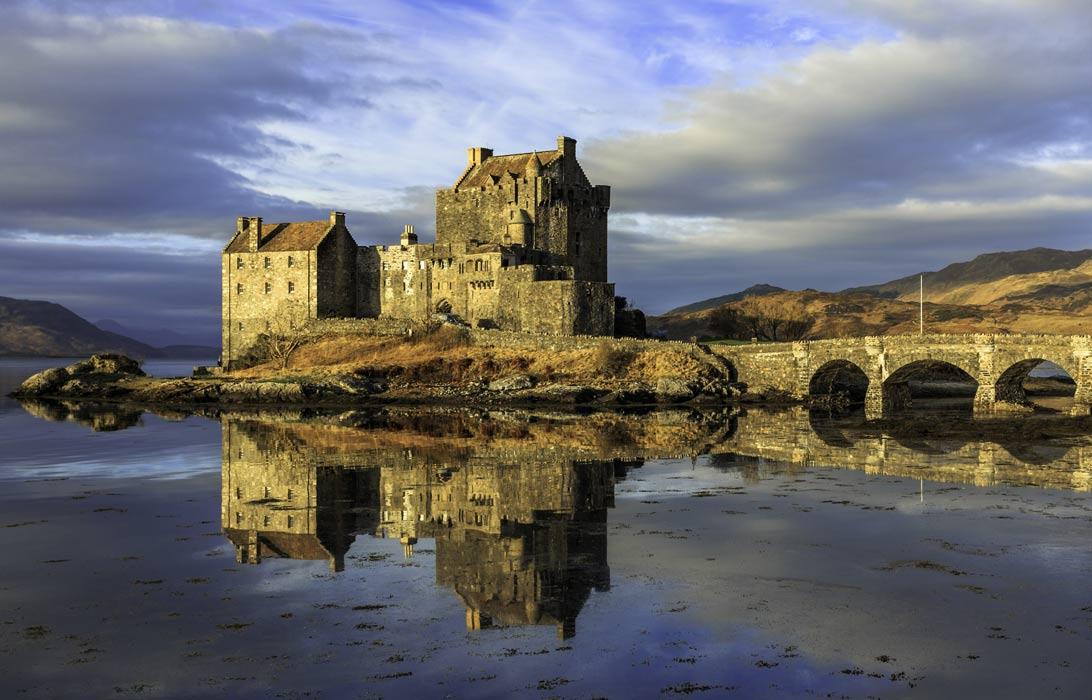

The image of Eilean Donan, the castle in the Scottish Highlands, in the photograph above, is a perfect example of reflection. Reflection occurs when a wave bounces off a surface. By contrast, refraction happens when a wave changes direction upon entering a different medium, due to a change in the wave's speed. This article studies reflection, refraction and diffraction, explains the physics behind these phenomena, and provides real-life examples for each.
Reflection and Refraction of Waves
- Reflection (of sound or light) is when waves hit a surface and bounce back.
- Refaction occurs when waves pass from one medium of a certain density to one of a different density.
- Diffraction entails waves spreading out as they pass through an aperture, creating light and dark patterns due to interference.
- Each is governed by a law: the Law of Reflection, Snell's Law, and Bragg's Law, respectively.


Fundamentals of Wave Behaviour
Physics students pondering the reflection-refraction-diffraction difference should step back for a minute. Each of these physical phenomena should be studied on its own before being seen as a part of a whole. This chart presents them and their effects in a nutshell, before we study each one in-depth.
| 🌊Phenomenon | ➿Main action | 💨Main cause | 🔎Example |
|---|---|---|---|
| Reflection | bounces back | wave hits a surface | your mirror image |
| Refraction | bends through | wave encounters a new medium | short, fat legs in the swimming pool |
| Diffraction | spreads out | wave passes an edge or opening | light through a keyhole |
Not all waves are alike. They have different wavelengths and frequencies, which affects the ways we perceive them. Their amplitude - their 'loudness' - may be downright unpleasant, if not painful.
Wavelength is a wave property that describes the distance between two consecutive points of a wave's phase. Wavelengths and frequencies are inversely proportional; the longer the wavelength, the lower the frequency. Frequency describes the number of cycles per second of a wave.
If you've already studied the properties of waves, you know that amplitude is also a property that affects waves. It describes the amount of energy carried by a wave; its effects are proportional. The greater the amplitude, the more intense the effects of the wave.
Wave Behaviour Physics
Waves don't just have properties. The ways they travel are also important. Waves may be longitudinal or transverse, depending on the direction of particle vibration relative to the energy transfer of the wave.
Light can travel in a vacuum due to its particle-like properties.
Waves must travel through gas, liquid or a solid (a medium).
The medium's particles move the wave along.
The movement of a medium's particles is what defines waves as either longitudinal or transverse. Each type of wave has distinct characteristics.
Longitudinal waves
- characterised by areas of high- and low-density (compression and rarefication)
- vibration direction is parallel to wave travel
- cannot be polarised
- require a medium to propagate
- examples: sound waves, seismic P-waves
Transverse waves
- characterised by alternating crests and troughs
- vibration is perpendicular to wave travel
- can be polarised
- can be mechanical or electromagnetic*
- examples: radio waves, rippling water
* Mechanical waves require a solid or liquid medium. Electromagnetic waves may travel in a vacuum. This is a brief explainer of longitudinal or transverse waves, just enough to clarify how waves affect reflection and refraction.
Media and the Reflection or Refraction of Waves
From the comparison above, we see that waves do not all behave in the same way. Depending on the medium, they may travel faster (through solids) or slower, as they travel through gases. They may travel longitudinally or transverse-wise. All of these factors may cause a reflection of the wave, or a refraction1.
Reflection happens when a portion of a wave bounces back into the medium at the point of interface. The angle of reflection equals the angle of incidence, that is: both angles are measured to the respective light rays from the normal line. That is the Law of Reflection.
When a light ray hits a surface, the angle of reflection is always equal to the angle of incidence.
Equation: ∠i = ∠r
This law applies to smooth surfaces only! It's called specular reflection, as opposed to diffuse reflection, which happens when light hits a rough surface.
Unlike reflection phenomena, refraction depends on changes in a wave's speed. Recall that waves travel the fastest through solids, a bit slower through liquids, and very slow through gases. That's due to the number of particles available to help push the wave along: many in solids, far fewer in gases.
The change in speed alters the direction of propagation (of waves).
Formula: n1sinθ1=n2sinθ2
The environment we live in compels us to see everything through a gas: the atmosphere. So, when we look at something in water, we are effectively changing the medium our sight line is travelling through. That 'wave' then travels a bit faster, making things seem bigger and closer than they actually are2.
You can try this experiment for yourself. Fill a clear glass halfway with water, and drop a pencil in it. You'll note a small refraction when looking at the pencil through the glass, but a much larger refraction of the part of the pencil that's in water. More than one Superprof physics tutor conducts this experiment to help their pupils understand this phenomenon.
Wave Reflection Physics Facts and Examples
To start, we must define the terms used to explain this phenomenon, starting with what are waves.
Now, to diagram this phenomenon. Draw a line at ninety degrees (a right angle) from the reflective surface; call that line the normal. The angles of incidence and reflection are measured between the incident wave and the normal. So, if light enters at forty-five degrees, it will reflect at forty-five degrees too.
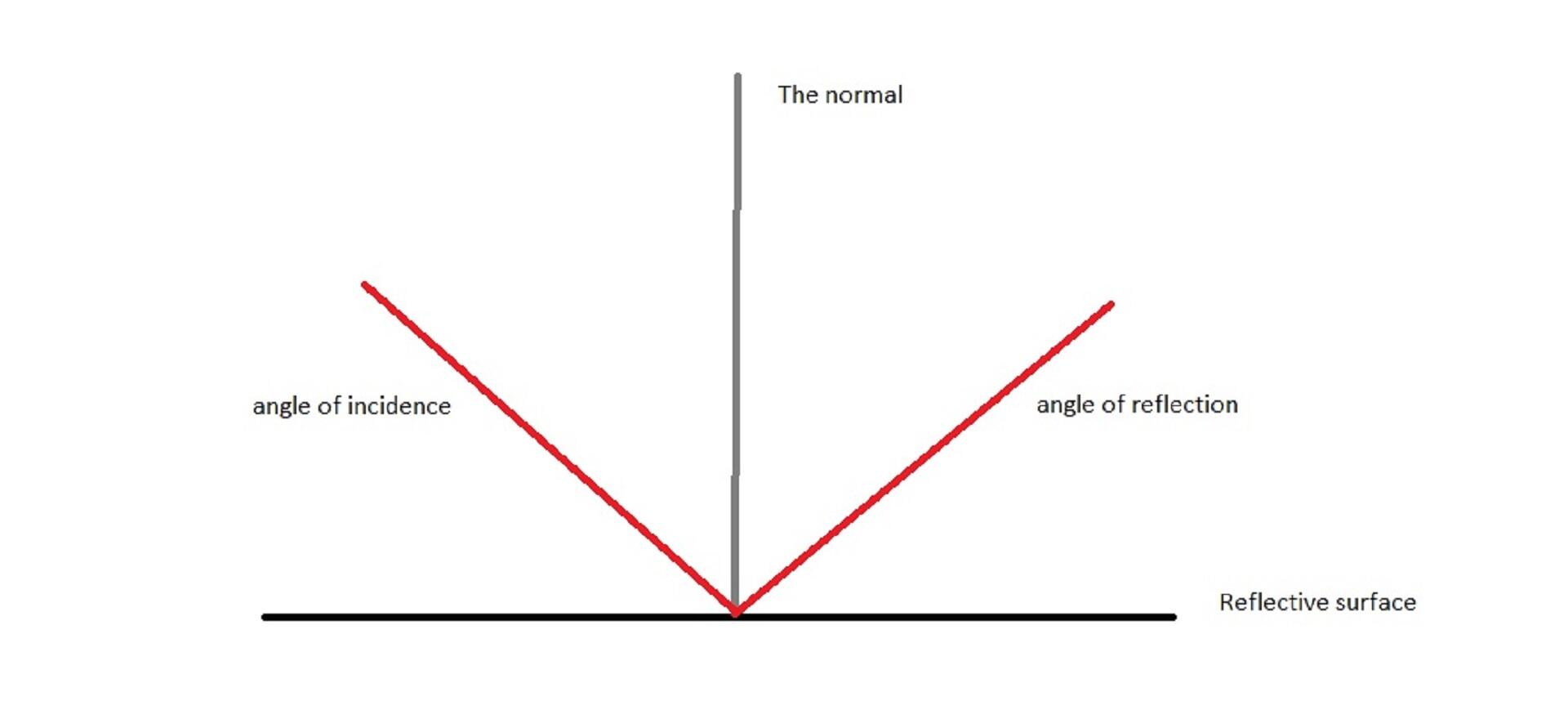
This law applies to light waves, sound waves and seismic waves; all types of waves. The energy travels in straight lines from the wave’s source and disturbs the medium through which it travels.
Examples of Wave Reflection
When a wave reaches the point where two media meet, a portion of that wave will be cast back into the original medium. This is what we call reflection3.

This picture details where two media meet: the water's surface. It is a smooth, unrippled surface, making it ideal for optical reflection.
Light waves reflect on the water's surface, bouncing the image of the trees and bench back into the atmosphere; into our visual field.
Echoes are an excellent example of sound waves bouncing back upon striking another medium. A sound (wave) emits, and travels until it encounters another medium. A portion of that sound wave will travel back to the listener.
Practical Uses of Wave Reflection
Bats use echolocation to fly around objects and hunt prey; that is one application of reflection in the everyday world. Of course, bats aren't the only species to use sound waves, whales, birds and even some humans rely on this technique to navigate their world.
On a grander scale, radar and sonar use wave reflection to detect objects in their scope of survey. Sonar applies to sound waves in water, while radar describes radio signals travelling through the air. These technologies not only detect objects, but they also measure distances.
For people living in tsunami or earthquake-prone areas, the ability to detect seismic waves is a matter of life and death. Geologists study reflections of seismic waves to build a picture of Earth's interior structure, which allows them to predict life-threatening events.
Wave Refraction Explained
In 1973, Pink Floyd released arguably its most famous album, Dark Side of the Moon, whose cover depicted a prism refracting a light beam, a bit like this picture. You'll note that the light wave bends as it enters the prism.
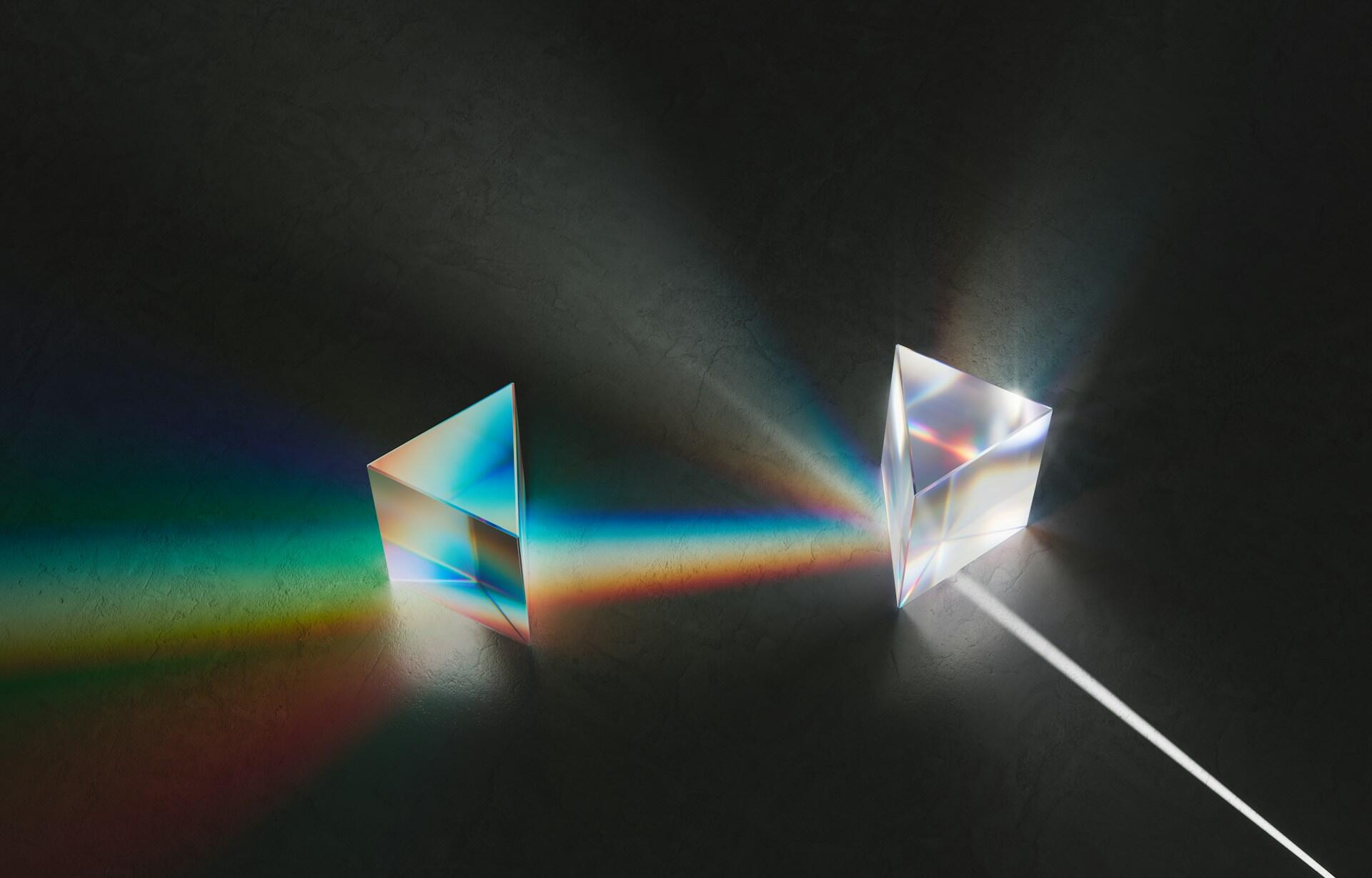
This phenomenon results from different parts of the light wave entering the prism at different time, which makes the wave pivot and change direction. Several factors dictate these results.
If you live in New South Wales, you can find a Physics tutor Sydney on Superprof to help you understand principles of refraction. When they do, they may show you pictures of light refracting prisms (or Pink Floyd's album cover), and they may give you a few real-world examples of refraction to study.
Examples of Wave Refraction
Most physics textbooks rely on sound or light waves to describe wave phenomena. But did you know that electromagnetic waves also refract? But to save us from getting too technical, we rely on ocean waves to illustrate wave refraction.
As the wave enters shallower water from the depths, on its way to the shore, the part of the wave already in the shallow water slows down. This action forces the wave to bend, aligning itself parallel to the coastline.
This example illustrates the 'opposite effect' described above, when moving into a less dense medium results in a bend away from the normal.

If you live in an area that sees temperature drops, you may have experienced sound waves being refracted. Temperature gradients allow sounds to travel farther, particularly at night, when cooler air bends sound waves towards the ground.
Vision correction: near- and farsighted people use refractive lenses to correct vision.
Medicine: endoscopes rely on internal reflection and refraction to manipulate light paths.
Seismologists use earthquake waves' refraction to map the Earth's internal structure.
Coastal engineers rely on wave refraction diagrams to calculate wave energy.
Diffraction of Waves
Waves may encounter obstacles that do not change their energy. When that happens, the waves bend around the obstacle or, if that blockage offers an opening, it spreads through. Before explaining diffraction, we must examine its guiding principle.
Every point on a wavefront acts as a source of secondary spherical wavelets that interfere to form a new wavefront.
This principle allows us to perceive a wave front not as a unified body but as many points of origin for waves. That, in turn, posits that a wave from an aperture isn't a single wave, but an infinite number of wavelets.
These wavelets may interfere with one another, yielding a pattern. This is the physics of diffraction, in which two characteristics determine resulting patterns.
Scale dependency
If the aperture is smaller than or similar to the wavelength, the wave will spread significantly.
Interference
The superposed wavelets' interference creates the diffraction pattern.
Examples of Wave Diffraction
Have you ever seen the cone-shaped beam from a flashlight? That is an example of diffraction, where the light is first restricted by its casing, and then spreads out. Unfortunately, we don't get a clear view of the diffraction pattern, like we can with ocean breakwaters.

These breakwaters show us how wavelets interfere with one another to cause a diffraction pattern. As the water emerges from the opening, it spreads through the open water.
Each superposed wavelet engages in constructive and destructive interference, yielding this diffracted pattern.
As your Physics tutor Melbourne would explain, X-rays are also diffractive. Not the type that examines our bones, necessarily, but the kind that examines the atomic structures of crystalline solids. X-ray diffraction has applications in the pharmaceutical and materials science enterprises, as well as manufacturing, geology, and mining industries.
Further Reading on Reflection and Refraction of Waves
- Mattson, Thomas. “Reflection, Refraction, Diffraction, and Wave Interference | EBSCO.” EBSCO Information Services, Inc. | Www.ebsco.com, 2022, www.ebsco.com/research-starters/physics/reflection-refraction-diffraction-and-wave-interference. Accessed 15 Apr. 2026.
- Nettles, Coralie. “Reflection, Refraction & Diffraction | Overview & Examples.” Study.com, 2023, study.com/learn/lesson/types-light-waves-refraction-dispersion-diffraction.html. Accessed 15 Apr. 2026.
- Zhabinskaya, Dina. “10.2: Reflection.” Physics LibreTexts, 7 Nov. 2022, phys.libretexts.org/Courses/University_of_California_Davis/UCD:_Physics_7C_-_General_Physics/10:_Optics/10.2:_Reflection. Accessed 15 Apr. 2026.
- OpenStax. “4: Diffraction.” Physics LibreTexts, Nov. 2016, phys.libretexts.org/Bookshelves/University_Physics/University_Physics_(OpenStax)/University_Physics_III_-_Optics_and_Modern_Physics_(OpenStax)/04:_Diffraction. Accessed 15 Apr. 2026.
Summarise with AI:
Did you like this article? Leave a rating!

 Loading...