
Sound waves are mechanical vibrations that spread as longitudinal waves through air, water, and solids (types of media). These waves cause particles to vibrate back and forth along the wave’s direction of travel. This travel creates alternating high pressure (compression) and low-pressure (rarefication) patterns that carry energy away from their source. That's waves in a nutshell; this guide explores the wave phenomenon, the properties of sound waves, and their many applications.
How Sound Travels Through the Air
- A device or phenomenon creates sound - mechanical vibrations.
- Those vibrations travel away from their source, disrupting the medium they travel through.
- This travel creates a pattern of compressions and rarefications that further push the sound along its path.
- The transporting medium's particles are not transported along the wave's path.


What Are Sound Waves?
We hear and communicate thanks to sound waves; and even use them to diagnose medical conditions. Sounds you hear may be produced miles away (a plane in flight) or in your immediate area, perhaps like the footsteps of your neighbour in the flat upstairs.
As we and other noise-making phenomena generate sound, the whole world vibrates endlessly from these disturbances. But what is sound, beyond what we hear? What are sound waves, from the physics perspective?
With the basic nature of waves established1, we can begin exploring the properties of sound waves.
The Properties of Sound Waves
Several key characteristics define the properties of acoustic waves and their behaviour as they transmit through a medium. These properties define the physical aspects of sound waves. They also influence how waves interact with their surroundings.
Wavelength
We define wavelength as the distance between two consecutive points a in phase on a wave. Wavelengths are inversely proportional to the property of frequency, and directly related to the speed of sound. If you live in Victoria, you can find a Physics tutor Melbourne on Superprof.
Pitch and Frequency of Sound Waves
This property refers to the number of cycles (oscillations) that take place each second in a sound wave. Sound waves' frequency has a direct impact on the sound's pitch: high-frequency sounds have a high pitch; low-frequency sounds have a lower pitch. We measure frequency in Hertz (Hz).
| 👂Sound | 🔁Frequency |
|---|---|
| The lowest C on a piano Highest piano note | 32 Hz ~ 4,096 Hz |
| A bass guitar | 40-60 Hz |
| A cat purring | 50 Hz |
| An average human voice | 250 Hz |
| Jet engines | 4,000 Hz |
| Insects chirping | up to 5,000 Hz |
| A whistle | 6,000 Hz or more |
| A dolphin's song | up to 18,500 Hz |
Amplitude
This property relates to the loudness of the sound; a large amplitude makes for a louder sound. Amplitude represents the maximum displacement of a medium's particles from their static position as the wave passes them. This short clip shows how this phenomenon works.
Speed
This property describes how fast a sound wave travels through a medium. We can calculate speed with the formula 'speed = wavelength x frequency'. Unlike electromagnetic waves which travel at the speed of light, this rate depends on the type of medium the wave travels through.
Gas medium
Very slow rate of speed.
Liquid medium
Faster than through gas.
Solid medium
Fastest rate of speed.
Those media's properties, such as density, elasticity, and temperature, are what determine waves' behaviour, as the clip above demonstrates.
Intensity
This property relates to the sound wave's ability to carry power per unit area. We measure intensity in watts per square metre (W/m2). It describes the energy of a sound wave; it relates to the distance from a sound's source, as well as its amplitude.
Intensity dictates how loud we perceive a sound to be.
Phase
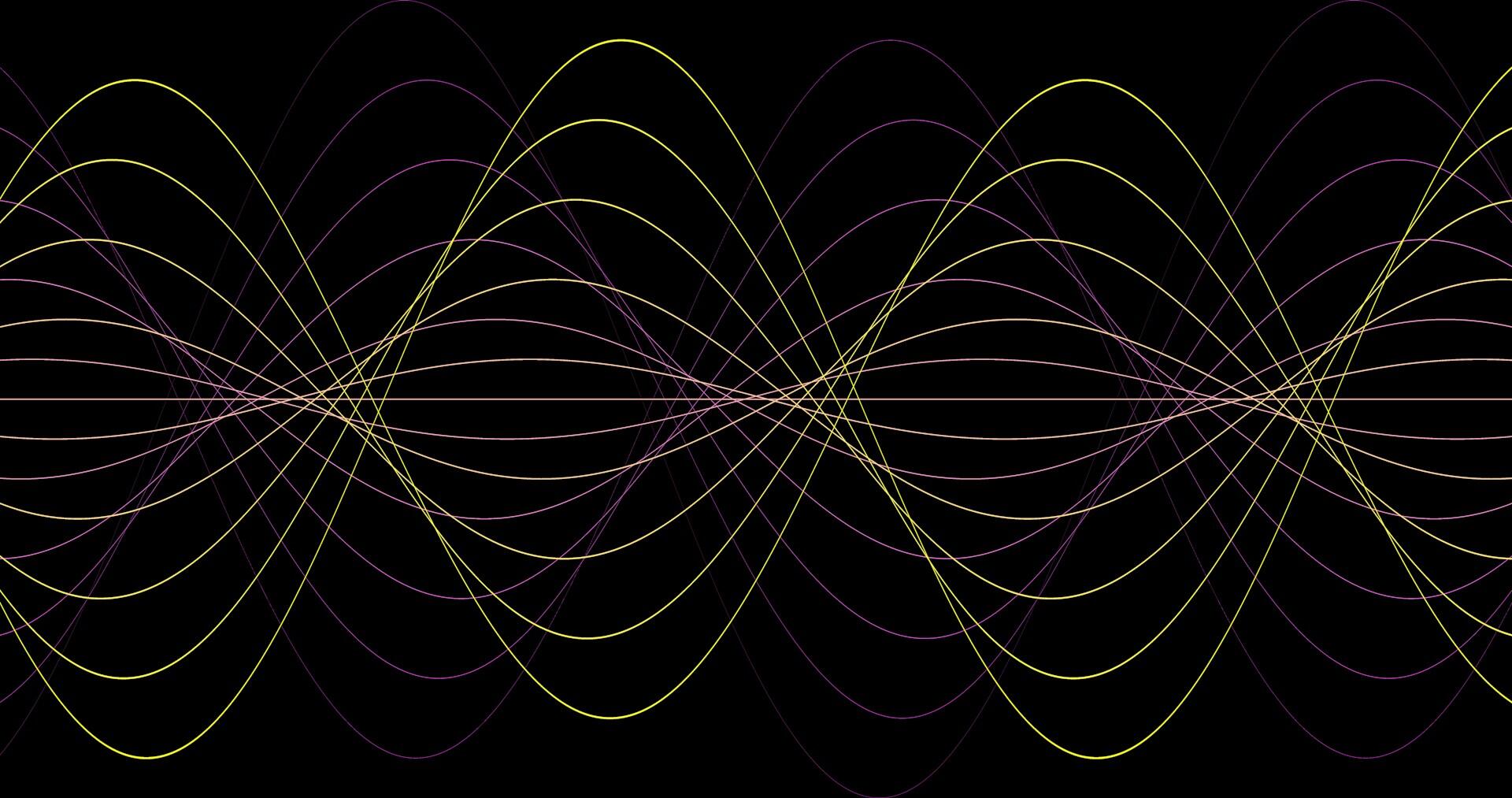
As sound waves cycle, they trace an up-down pattern such as the one in the picture below. In such a cycle, the phase describes a particular position of a point in time. When multiple waves interact, such as in the picture, phase differences can cause interference. This interference affects the sound's intensity and amplitude.
The properties of waves impact how instruments (and humans) perceive sounds. Though each may not be actively felt by the casual listener, every one of them plays a role in sound transmission. For example, we can't sense how fast sound travels through a medium. However, as noted above, speed is a vital measurement of sound travel from a physical perspective.
How Sound Travels Through Air
When a sound source vibrates, it makes everything else around it vibrate too – as the sound energy propagates outwards from the source in waves of rarefactions and compressions.
Rarefaction = low pressure
describes an area where particles are the farthest apart.
Compression = high pressure
describes an area where particles are close together.
A sound wave is a type of mechanical wave, meaning that it has to have a medium through which to pass.
As noted above, sound cannot travel through a vacuum; it needs the vibration of atoms to transfer its energy. Given this, it's easy to understand that sound travels at a different pace depending on the medium through which it is travelling.
Sound travels through air at a rate of 330 metres per second.
This is known as the speed of sound.
However, air being a gas – and given that gas is a state in which the atoms are least densely arranged – it is the medium at which sound travels the slowest.
Waves of sound travel much more quickly through solids than both liquids and gases. This is because the molecules in solids are generally much closer together than in air. Therefore, energy is more easily transferred from one molecule to the next.
How do these physics facts impact transversal and longitudinal waves? As noted in this article's first segment, sound travels through solids via both types of waves. To grasp these concepts, study what 'transversal' and 'longitudinal' mean in our companion article.
Conditions that Affect Sound Travelling Through Air
Have you ever endured such a humid day that it felt like you were moving through sludge? Humidity has the opposite effect on sound waves. It allows them to travel faster because water vapor molecules reduce the overall density of the air.
Besides humidity, temperature has the greatest effect on sound wave travel. Heat excites air molecules, making them more ready to carry (propagate) sound waves.
Sound travels roughly 35% faster in 100% humidity (compared to dry air).
Each 1°C rise in temperature causes a speed-of-sound increase of roughly 0.6 m/s.
High humidity magnifies temperature's effects2.
When there is a change of medium through which the sound is travelling, such as humidity and temperature, some of the sound will be reflected – what we call an echo. By contrast, if you shout on a cold, snowy night, the sound will barely travel through the air. That's due, in part, to the snowflakes' ability to absorb sound.
However, refraction is the more important phenomenon at play. The air is colder near the ground, forcing the sound waves to bend upwards, away from anyone who might hear them. To learn more about this effect, be sure to read our article on reflection and refraction.

Ultrasound Waves Physics
Ultrasound refers to sound waves with frequencies that the human ear cannot detect. We define ultrasound as any sound above a frequency of 20,000 Hertz. Referencing our chart above, even dolphin songs (up to 18,500 Hertz) do not qualify as ultrasound. What does, then?
A lot of sound classifies as ‘ultra’, considering that we gauge sound by the limits of human hearing3. Dogs (and scientific instruments) can hear a much larger range of sounds than humans. As my Superprof Physics tutor Sydney explained, the distinction between sound and ultrasound is rather arbitrary, particularly as they are both sound.
Infrasound
Any sound fequency below human perception (<20 Hz).
Audible sound
Any sound within the 20 - 20,000 Hz (20 kHz) range.
Ultrasound
Any sound frequency above human perception (>20 kHz).
Ultrasound machines generate short blasts of longitudinal waves. The resulting ultrasound images come from theose sound waves reflecting off tissue boundaries4. The device that emitted the waves (the transducer) captures those reflections by converting the returning sound waves into low-voltage electrical signals.
Though we're most familiar with ultrasound in medical settings, this technology has uses across industries, as well as manufacturing and maintenance. For instance, ultrasonic testing is used to detect internal flaws in bridges. The sound waves help identify cracks, faulty or weak welds, and corrosion in steel bridges. In concrete bridges, ultrasound examines embedded steel bars (rebar) for delamination, voids, and thickness.

Ultrasound Uses in Medicine
The beauty of the ultrasound scan is something that only parents can appreciate.
David Nicholls, author
The most familiar use of ultrasound is for creating images of babies in the womb. However, ultrasound also works on bone, cartilage, and internal organs such as the thyroid or liver, to help diagnose diseases. This technology is made possible by the process of reflection.
Ultrasound works because there are lots of different sorts of material in your body: fat, muscle, and bone, upon which sound waves bounce off of. By using a tool that can both emit and detect sound waves, the process of ultrasound builds images by receiving reflections (echoes) from the interfaces between the different layers of material.
So, at the interface between fat and muscle, some of the emitted sound waves are reflected and detected. All of this can then be compiled onto a computer and an image can be created from the detection. You can search for physics tutor on Superprof to help explain these concepts.
Further Reading on on Sound Waves Physics
- Svantek Academy. “Sound Wave.” SVANTEK - Sound and Vibration, 2025, svantek.com/academy/sound-wave/. Accessed 13 Apr. 2026.
- Paré, Annabelle . “Acoustic Measurements: The Effects of Weather on Sound Propagation.” Bba, 2023, www.bbaconsultants.com/publications/acoustic-measurements-the-effects-of-weather-on-sound-propagation. Accessed 14 Apr. 2026.
- Woodford, Chris . “How Does Ultrasound Work? | Uses of Ultrasound.” Explain That Stuff, 6 Aug. 2023, www.explainthatstuff.com/ultrasound.html. Accessed 14 Apr. 2026.
- Au, Arthur, and Michael Zwank. “Ultrasound Physics and Technical Facts for the Beginner.” Www.acep.org, 16 July 2020, www.acep.org/sonoguide/basic/ultrasound-physics-and-technical-facts-for-the-beginner. Accessed 14 Apr. 2026.
Summarise with AI:
Did you like this article? Leave a rating!

 Loading...