

In our article on the properties of waves, we briefly touched on longitudinal and transverse waves. Transverse waves oscillate perpendicular to the direction of wave propagation, while longitudinal waves oscillate parallel to it. This fundamental difference affects how each wave type behaves and where it occurs. This chart reveals further differences between the two types of waves.
| 📐Aspect | 🔊Transverse waves | 🔉Longitudinal waves |
|---|---|---|
| Wave structure | crests and troughs | compressions and rarefications |
| Particle motion | perpendicular to wave direction | parallel to wave direction |
| Medium | waves travel in solids and on liquid surfaces. Electromagnetic waves can travel through a vacuum. | waves must travel through a solid, liquid, or gas. Cannot travel through a vacuum. |
| Density and pressure | both usually remain constant. | density and pressure vary within the wave. |
| Polarisation | can be polarised | cannot be polarised |
| Speed | may travel at the speed of light through a vacuum. If propagating through a medium, its speed depends on the medium. | propagation speed depends on the medium it travel through. Slow for gases, faster for liquids, and fastest for solids. |


What are Transverse Waves?
If there were such a thing as a ‘classic’ wave, it would be the transverse wave. These are the familiar sorts of waves that we study in diagrams. We do this because the transverse waves are the easiest waves to visualise. They demonstrate their polarization, which we can see extending into space.
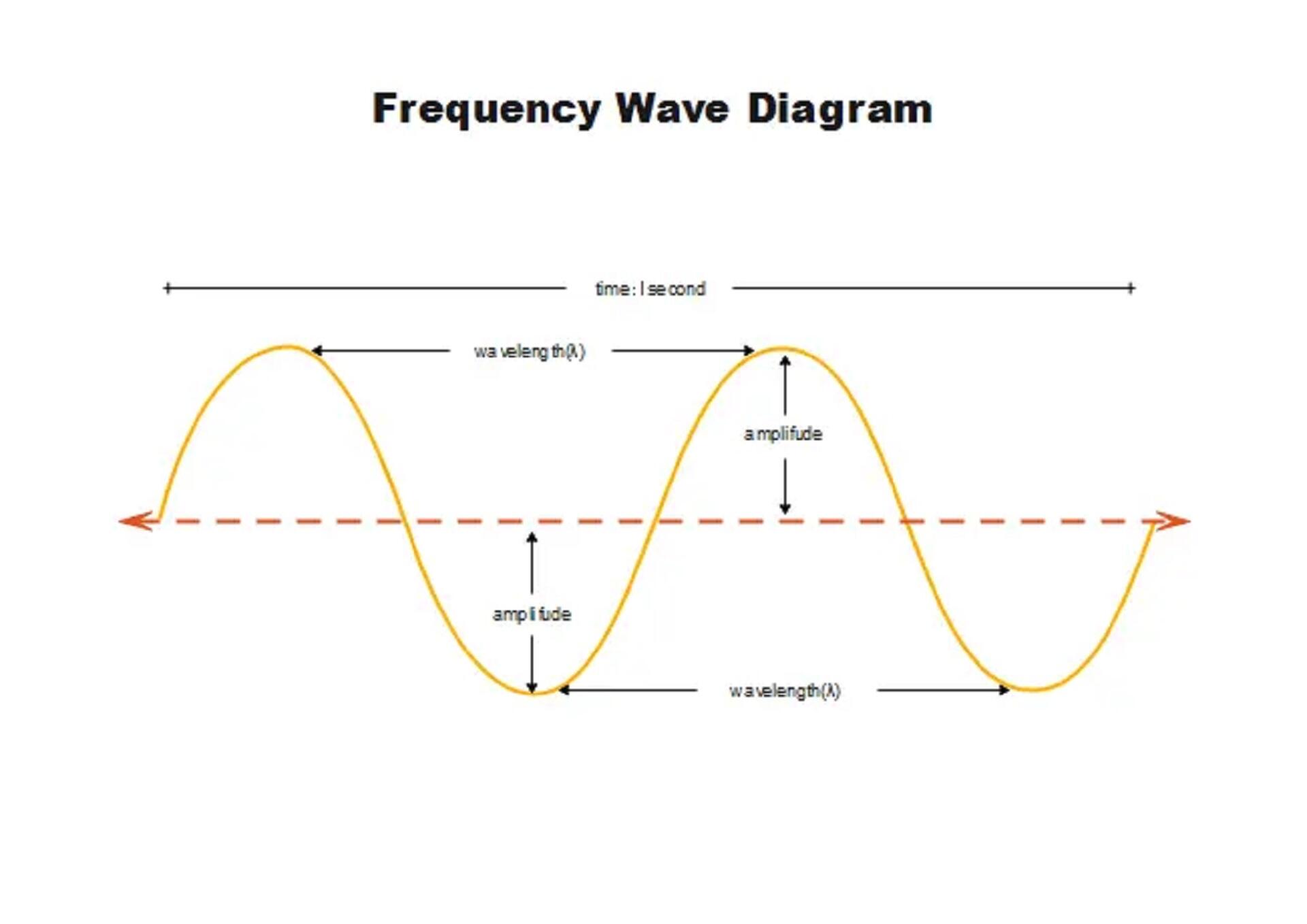
This diagram represents a standard transverse wave, complete with peaks and troughs. The red dashed line indicates the direction of the wave's travel. The height from that line to the peaks' crest is the wave's amplitude.
The distance between two crests represents the wavelength, and their closeness signals its frequency.
Have you ever seen a fitness enthusiast working gym battle ropes? As they work the ropes, the energy their actions generates creates visible waves, which travel from their hand down the length of the rope. This is the principle of transverse waves, which radiate outwards from their source.
Their displacement of the particles they propagate through is at right angles to the direction of energy transmission.
Properties of Transverse Waves
As noted in the introduction's table, transverse waves may travel through solids and across liquid surfaces1. Electromagnetic waves do not need a medium to propagate; they travel in a vacuum at the speed of light. Beyond this crucial characteristic, transverse waves exhibit several others.
Transverse Waves Examples
We talked about battle ropes at the gym, which give a nice visual of transverse wave action. The vibration from a plucked guitar string works in the same way as battle ropes, except that the frequency of the wave is much higher. You might ask your teacher about that, and these wave examples, during your Superprof online Physics course; a fun way to start your next lesson.
- water ripples
- seismic S-waves (secondary waves)
- X-rays
- visible light
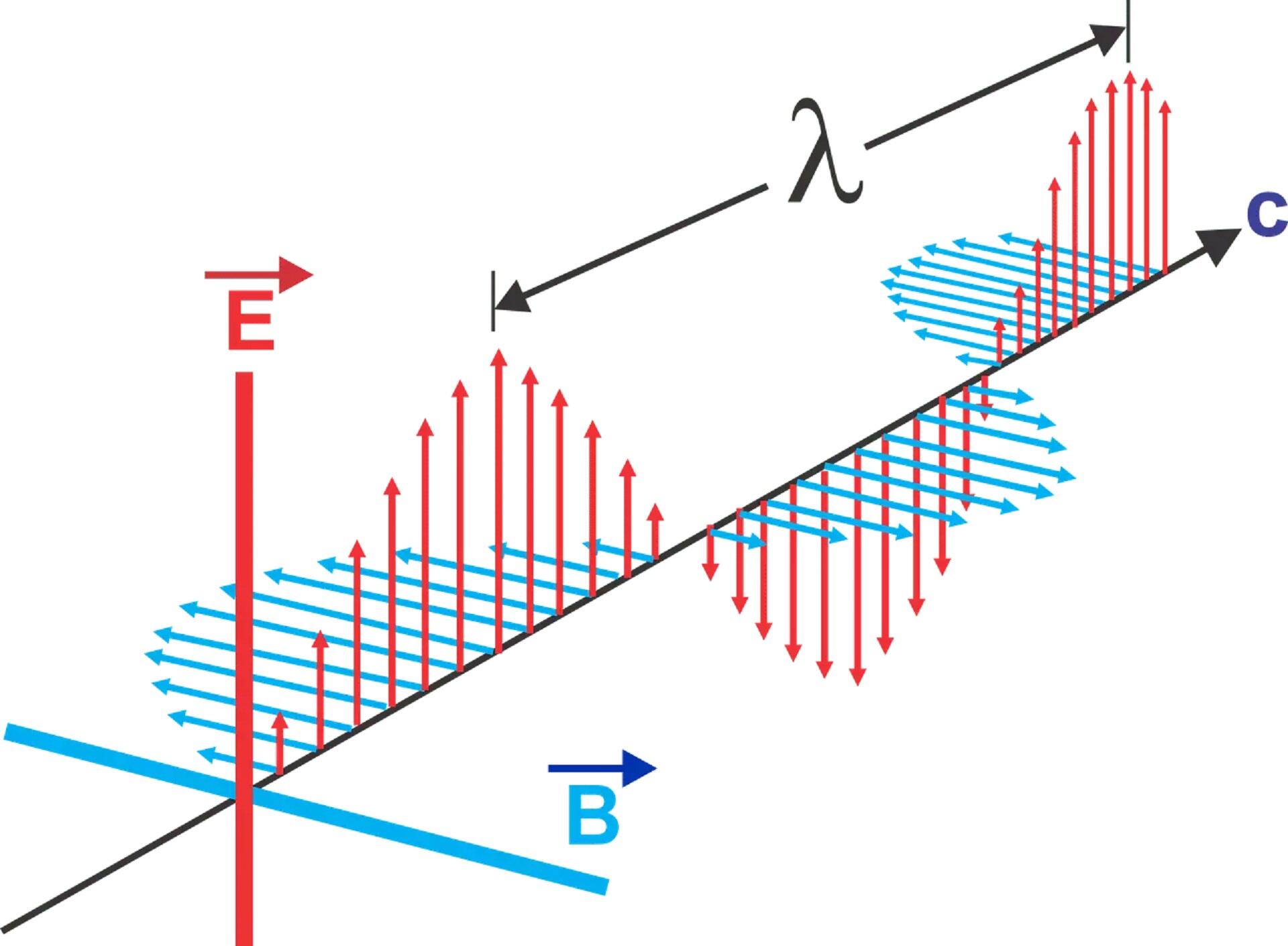
Electromagnetic waves such as infrared, ultraviolet, and radio waves are also transverse. In their disturbance of the magnetic field, they polarize alternately – meaning when the electric wave is peaking, the magnetic aspect is in a trough.
A Note on Electromagnetic Waves
Mechanical waves need a material medium to travel through, otherwise they could not propagate. They transfer energy through material, whether solid, liquid, or gas. However, electromagnetic waves travel through a space with no material medium. In a vacuum, in other words.
This makes the notion of the disturbance or displacement a bit hard to grasp. How can there be displacement if there is nothing to displace?
In the mid-1800s, James Clerk Maxwell theorised that electromagnetic waves are disturbances that propagate in the magnetic field. Around 30 years later, German physician Heinrich Hertz 'accidentally' conducted experiments that proved Maxwell's theories.
Hertz never believed his discoveries would amount to much of anything. Today, we honour him by measuring electromagnetic frequency in Hertz (Hz).
What are Longitudinal Waves?
In a transverse wave, the displacement leads to a polarization of the medium. In a longitudinal wave, particle displacement runs parallel to the direction of wave travel2.
This longitudinal wave diagram shows areas of compression and rarefaction (spreading out) as wave travels. That action is what allows the wave to propagate.
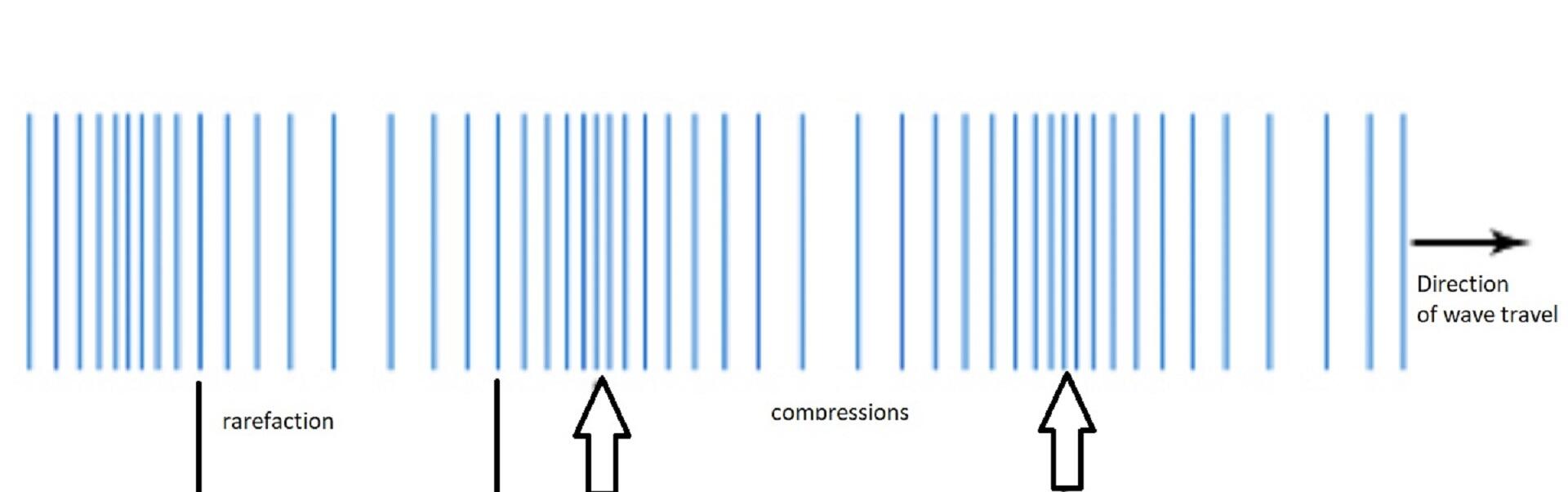
Compressions and rarefactions are the longitudinal equivalent to the transverse waves' peaks and troughs. Compressions are the areas in the medium in which the particles are closer together. Here the pressure is very high, which means that the medium can push itself apart again.
Rarefaction represents areas of low pressure, where the particles of the medium are further apart. If you were to measure the amplitude or frequency and wavelength of a longitudinal wave, you would take the measurement from the points of highest compression. You might be interested in Physics tutoring to fully master these concepts.
Properties of Longitudinal Waves
These mechanical waves displace particles in parallel to the direction of propagation, which creates the regions of high- and low-density and pressure mentioned above. This type of wave has several key characteristics.
If you live in Victoria, you might find a Physics tutor Melbourne on Superprof to help you understand these properties and how they apply to energy transfer.
Longitudinal Waves Examples
You might have already figured out why this article features a child's toy, a slinky, as its leading image. These funny, loose springs demonstrate the principles of longitudinal waves as they compress and stretch out (rarefy), depending on the energy you apply. Slinkies are non-serious examples of these waves; now, we cite several, more important ones.
- sounds waves
- seismic P-waves (primary waves)
- ultrasonic waves
- sonic booms
Main Differences Between Transverse and Longitudinal Waves
If you’ve read our companion article that helps you explore waves in-depth, you already know some of these differences. Here, we summarise the differences3 you've read about so far.
Transverse waves
- perpendicular particle motion
- waves of crests and troughs
- may travel in solids and on liquid surfaces
- generally constant pressure/density
- can be polarised
- may travel in a vacuum
Longitudinal waves
- parallel particle motion
- waves of compressions and rarefications
- must have a medium: gas, liquid, or solid
- fluctuates as the wave passes
- cannot be polarised
- cannot travel in a vacuum
Of these, the first three are the most crucial for both types of waves. Indeed, direction is the defining characteristic of these waves. How waves propagate determines their efficiency. Waves that travel in a vacuum propagate at the speed of light. Waves that must travel through a medium depend on that medium's properties to determine their velocity.
Mechanical waves are another name for longitudinal waves.
The comparisons above spell out their differences.
What About Surface Waves?
Surface waves are mechanical waves that propagate on the interface between two media. Ocean waves are surface waves but seismic waves are a more fitting example.
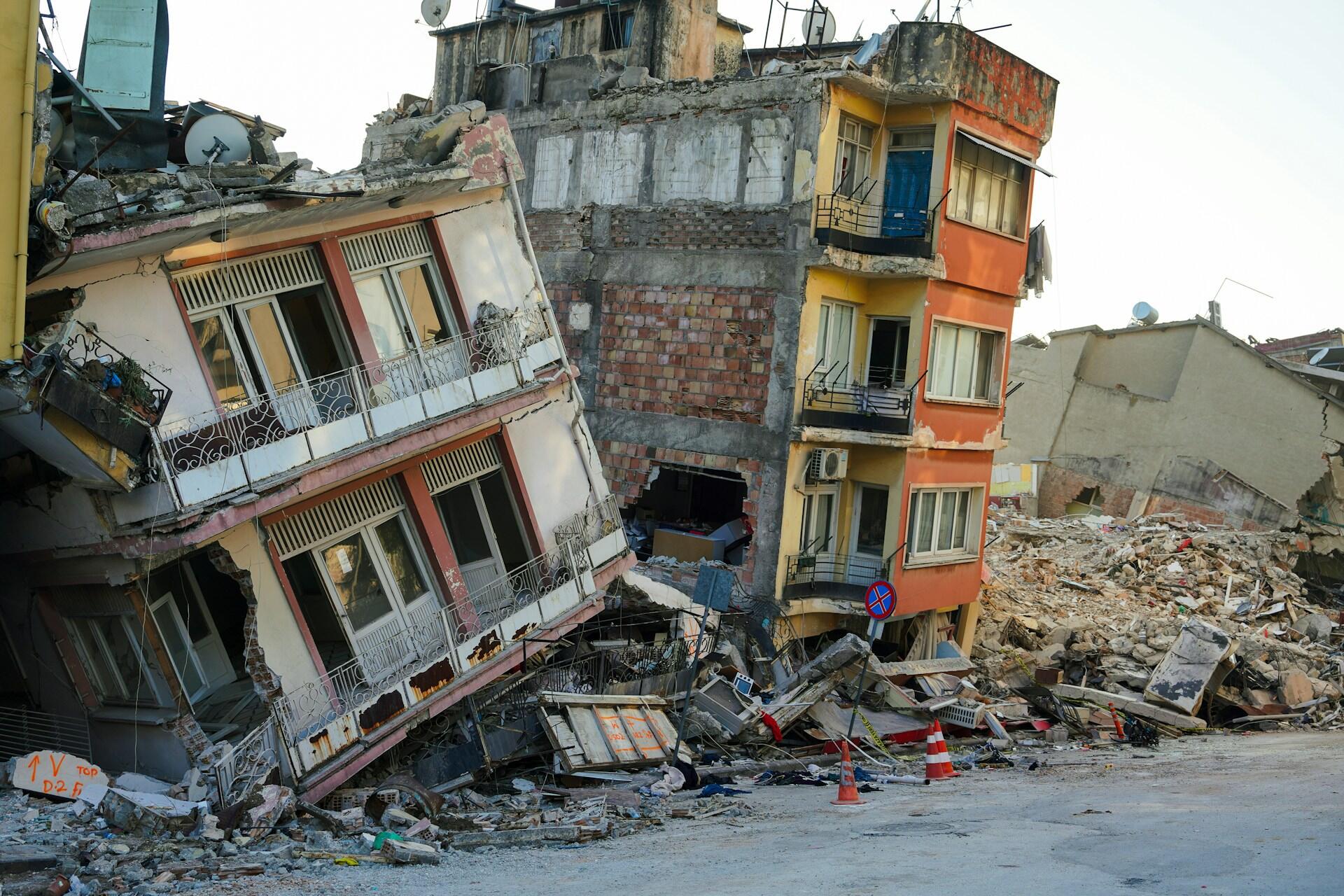
Earthquakes happen when P-waves and S-waves become trapped at the Earth's surface.
Surface waves travel along a surface, hence their name. Such can be the Earth's crust, or the ocean's surface. These waves' larger amplitudes and longer wavelength make them the most destructive during seismic events.
These types of waves are of most concern to geologists, seismologists, and oceanographers. These studies provide crucial data which might otherwise be difficult to image. Because surface waves show dispersion, geologists can construct 3D models of the Earth's crust and upper mantle structure. This, in turn, helps predict future seismic events.
Surface waves are a combination of longitudinal waves and transverse waves.
Sound Waves' Longitudinal Properties
In space, no one can hear you scream.
Tagline from the movie Alien
That line has a dramatic effect but it is not exactly true. Space is not the vacuum everyone seems to think it is; it's filled with plasma and particles that permit sound propagation. Only it does so at frequencies humans cannot hear.

If you know anything about sound and sound waves, you know they are longitudinal. As sound originates, it travels through the air in repeated compressions and rarefications.
Of course, air is not the only medium sound may travel through; in fact, it is the slowest medium through which sound waves travel.
As gases have fewer particles to help propagate the sound waves, they travel much slower than through a liquid.
That's why echoes, a type of reflection and refraction of sound, sounds fainter than the original sound. However, solids are sound waves' most effective propagators because their particles are densely packed together.
You might try this experiment: lay your head on a table and knock its underside. First, do so directly beneath your ear, and then spread your knocks further out to notice any weakening of the sound. This clip explains how soundwaves travel, along with all longitudinal and transverse waves.
Further Study on Transverse vs. Longitudinal Waves
- “Transverse Waves - Examples, Speed & Reflection of a Transverse Waves.” BYJUS, byjus.com/physics/transverse-waves/. Accessed 18 Apr. 2026.
- “Properties of Longitudinal Waves – HSC Physics.” Science Ready, scienceready.com.au/pages/properties-of-longitudinal-waves. Accessed 18 Apr. 2026.
- MacArthur, Jamie . “4.7.1: Transverse and Longitudinal Waves.” Chemistry LibreTexts, 14 Mar. 2024, chem.libretexts.org/Courses/Madera_Community_College/Concepts_of_Physical_Science/04:_Fluid_Mechanics_and_Waves/4.07:_Properties_of_Waves/4.7.01:_Transverse_and_Longitudinal_Waves. Accessed 18 Apr. 2026.
Summarise with AI:
Did you like this article? Leave a rating!

 Loading...