Without waves there would be nothing: no heat, no light, no sound, not even any movement. Waves in physics are disturbances that transfer energy through space or a medium. These energy-delivering waves propagate without displacing any particles in the medium itself. Here, we explore the energy that powers our everyday life and, indeed, earth systems themselves.
What to Know About Wave Energy Transfer Physics
- Waves are energy-transferring disturbances that do not transfer particles from the media they travel through.
- Physics recognises two types of waves: mechanical and electromagnetic.
- Electromagnetic waves may travel in a vacuum but mechanical waves require a medium to propagate.
- Radio waves and microwaves are examples of electromagnetic waves; water waves and seismic waves are mechanical.


What Is a Wave in Physics?
As noted above, waves are disturbances in a medium that transfer energy. For the most part, we can see evidence of this energy transfer, ocean waves and the devastation earthquakes cause, for example. But we cannot see the energy itself.
Waves displace mass as they propagate. The way they displace this mass determines whether they are a transverse or longitudinal wave. Transverse waves displace mass at an angle perpendicular to the direction of the energy’s movement. Longitudinal wave displacement is parallel to energy movement1.
Characteristics of Waves in Physics
Regardless of the movement of the medium’s displacement, both types of waves in physicsexhibit the same properties.
Wavelength and Frequency
Wavelength and frequency are two important ways to measure waves. These two properties have an inverse relationship: the longer the wavelength, the lower its frequency, and vice versa2.
Wavelength
- measures the distance over which the wave repeats
- it's the distance between two consecutive points (crest to crest or trough to trough)
- wavelength determines how waves act in their environment
- wavelength is measured in metres
Frequency
- measures how often the wave repeats within a certain range
- it's the number of wave oscillations per second
- frequency determines the energy level of the wave
- frequency is measured in Hertz (Hz)
Sound waves and light waves are go-to examples to illustrate frequency in waves. Humans can hear in the range of 20 - 20,000 Hz, a fairly limited spectrum that, at its upper reaches, causes hearing loss. Likewise, our eyes can only perceive a narrow band of light, leaving us blind to infrared and ultraviolet rays.
Infrared and ultraviolet wavelengths can harm human eyes and skin.
However, therapeutic infrared and infrared household devices, such as remote controls for the telly, are generally safe for use.
Amplitude and Wave Speed
Amplitude and wave speed are equally crucial for testing and working with waves. These two properties determine the strength, impact, and velocity of waves.
Amplitude
- indicates the magnitude of displacement
- on a transverse wave, it's the distance between the peak or trough of a wave and the rest position.
- amplitude determines the intensity or strength of the wave
- amplitude is generally measured in metres
Wave Speed
- indicates how fast the wave travels
- wave speed depends on the medium the wave travels through (slow for gases, fast for solids; speed of light in a vacuum).
- wave speed determines how fast a wave propagates through a medium
- measured in metres per second (m/s)
Types of Waves in Physics
This chapter's title is a bit confusing; didn't we already mention longitudinal and transverse waves? In fact, many physics tutors must clear up this question for their new students. 'Longitudinal' and 'transverse' are labels for wave types, but 'types' extends to further concepts of waves in physics.
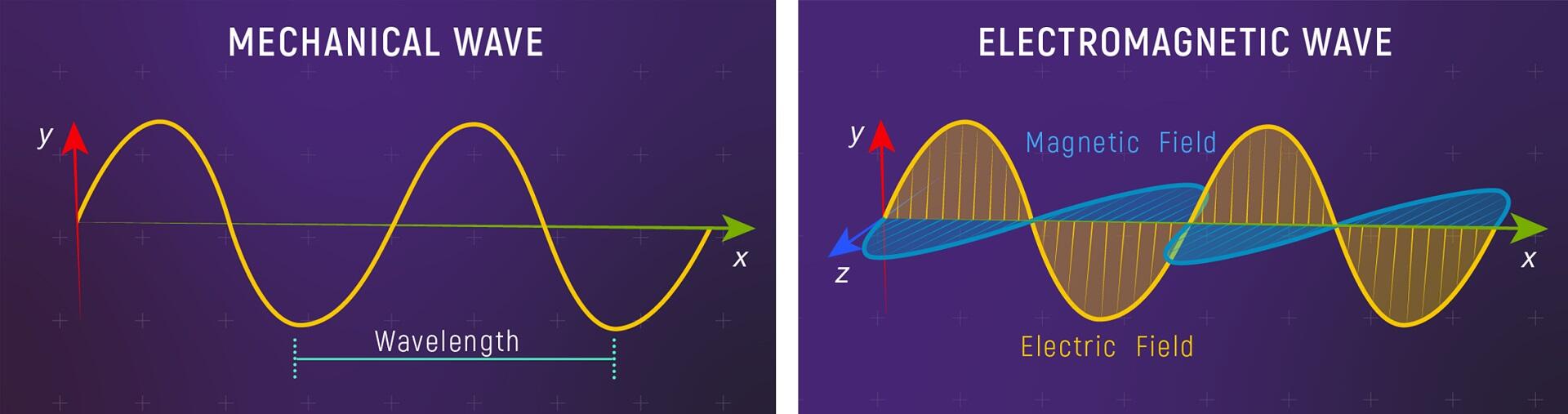
In this chapter, we discuss mechanical and electromagnetic waves. Though they all have wavelengths, frequencies, amplitude, and speed, their defining characteristic is whether they need a medium to propagate3.
Mechanical Waves
These waves need a medium to travel. That medium may be gas, liquid, or solid. The waves' energy displaces the particles in those media but, crucially, does not transport particles along the energy flow.
Waves transfer energy, not mass.
The speed of a wave's propagation depends on the type of medium it transits through. The denser the medium, the more particles are available to be displaced, which makes the wave travel faster. Thus, you might logically intuit this breakdown.
Gas medium
loose particle structure means slower transport.
Liquid medium
Denser particle structure means faster transport.
Solid medium
The densest particle structure means the fastest transport.
Imagine that you lay your ear on a train track. You would be able to hear a train coming from a great distance because the sound energy is being transferred through the solid medium - the track. You're not hearing the actual train itself, only its sound energy. This clip demonstrates how media impacts wave speed (and how helpful listening to train tracks can be).
Sound waves are one example of mechanical waves. Others include water waves - from ripples in a pond to the waves we surf. Earthquake-causing seismic waves, both the primary waves (P-waves) and the aftershocks (S-waves), are also mechanical.
Electromagnetic Waves
It's easy - but untrue - that waves needing a medium through which to travel is a rule of thumb. You can correctly say that mechanical waves must have a medium but electromagnetic waves do not require one. This type of wave can travel in a vacuum.
Electromagnetic waves are self-propagating. They may travel through a vacuum because the medium that they are disturbing or displacing is not matter. They disturb the electromagnetic field which they themselves create.
Electromagnetic wave may also travel through solids and on the surface of liquids.
Radio waves may pass through wood and glass because of their low frequencies.
Light reflecting off of water is an example of electromagnetic wave travel on a liquid's surface. However, we can cite far more examples of these waves travelling through a vacuum at the speed of light, including light itself.
- radio waves
- microwaves
- gamma rays
- X-rays
- visible light
- infrared and ultraviolet light
Mechanical vs Electromagnetic Waves
You mustn't think that the only difference between these two types of waves is the need for or absence of a medium. In fact, these two types of waves have more differences than similarities nasa ref.
1. Both types of wave represent the movement of energy.
2. Neither one transports matter.
3. Both are oscillations where each point of the wave can act as an independent source of propagating waves.
That's it for the similarities; now, to talk about how their differences, beyond the fundamental 'requires a medium' one.
Mechanical waves
- they propagate through the vibration of particles in their medium
- they can be transverse, longitudinal or surface waves
- the medium determines mechanical waves' speed
Electromagnetic waves
- electric and magnetic fields oscillate and regenerate each other
- electromagnetic waves are only ever transverse
- electromagnetic waves travel at the speed of light in a vacuum
Wave Energy Transfer Physics: Behaviours and Phenomena
As they oscillate and displace particles while propagating, waves exhibit characteristic behaviours and treat the world to curious phenomena4. If you live in Brisbane, you might find a VCE Physics tutor on Superprof to explain these behavioiurs. But we'll bet that reflection is one that you are likely familiar with.

As you know, light travels, well, at the speed of light. When it hits a boundary, such as the surface of a body of water, a portion of that wave bounces back, creating a reflection, like this flower on the still water's surface.
Echoes are an example of a portion of a sound wave bouncing back when it hits a surface. These sound reflections occur when a sound wave hits a smooth, hard surface to return to the listener. Bats are famous sound generators that navigate and hunt by echolocation. Medical ultrasound devices work on the same principle.
By contrast, refraction entails bending a wave as it passes from one medium to another. As with reflections, light and sound waves give us great examples of this phenomenon.
Light refraction
- the bending of light waves is due to changes in medium
- the wave's speed changes as it enters a new medium
- the direction of the bend depends on the new medium's density
- denser media causes light to slow down; less dense media speeds the wave up
Sound refraction
- the bending of sound waves is due to changes in medium or atmosphere
- layers of water or air with different pressures, temperatures or densities cause refraction
- cooler night temperatures bend sound downwards
- warmer day temperatures bend sound upwards
In denser media, light bends towards the normal; the imaginary line perpendicular to the surface. In less dense media, the light wave bends away from the normal.
Alongside reflection and refraction, diffraction is a phenomenon that involves both bending and spreading waves. It describes waves travelling around obstacles or through small openings (apertures) without losing any of their energy. A keyhole or slit in a material are examples of aperture, but the spacing between molecules at the atomic level also qualifies.
Diffraction happens with all types of waves: light, sound, water, and matter. This clip treats us to several experiments that demonstrate reflection, refraction, and diffraction.
What Is Wave Interference?
Interference is a wave phenomenon where two or more waves travel through the same medium, creating a new wave form. This phenomenon produces two main types of interference, each of which accords to the phase relationship between the waves.
Constructive interference
- waves' peaks and troughs align (they are in phase)
- waves boost each other
- results in higher amplitude
Destructive interference
- waves' peaks align with troughs (they are out of phase)
- waves cancel each other out
- results in low or no amplitude
Interference happens with all types of waves. If you have noise-cancelling headphones, you're treating yourself to a bit of destructive interference to silence outside noise. Soap bubbles cause constructive light interference because the light reflects off both the inner and outer surfaces of the very thin soap film. This dual reflection is in phase, which boosts the rainbow appearance we see in bubbles.
One mustn't install their WiFi router in their kitchen.
Microwave ovens and other kitchen appliances operate on the same frequency as routers.
This causes destructive interference, cancelling out the WiFi waves.
We classify ultrasound and sound waves as longitudinal (mechanical), light waves are typically transverse. Where light waves may be seen by the human eye, at least in our narrow band of visible light, we cannot see soundwaves. That is, unless we image them on a computer screen or other measuring device.
Wave Definition Physics: Further Reading on the Physics of Waves
- The Physics Classroom. “Categories of Waves.” Physicsclassroom.com, 2019, www.physicsclassroom.com/class/waves/Lesson-1/Categories-of-Waves. Accessed 21 Apr. 2026.
- BBC. “Types of Waves - Properties of Waves - AQA - GCSE Physics (Single Science) Revision - AQA.” BBC Bitesize, 2025, www.bbc.co.uk/bitesize/guides/zgf97p3/revision/1. Accessed 21 Apr. 2026.
- Hustak, Leah . “Electromagnetic Wave (Light Wave) vs. Mechanical Wave - NASA Science.” NASA Science, NASA, 2 July 2021, science.nasa.gov/asset/webb/electromagnetic-wave-light-wave-vs-mechanical-wave/. Accessed 21 Apr. 2026.
- Britannica. “Waves.” Encyclopædia Britannica, 22 Dec. 2016, www.britannica.com/science/wave-physics. Accessed 21 Apr. 2026.
Summarise with AI:
Did you like this article? Leave a rating!

 Loading...