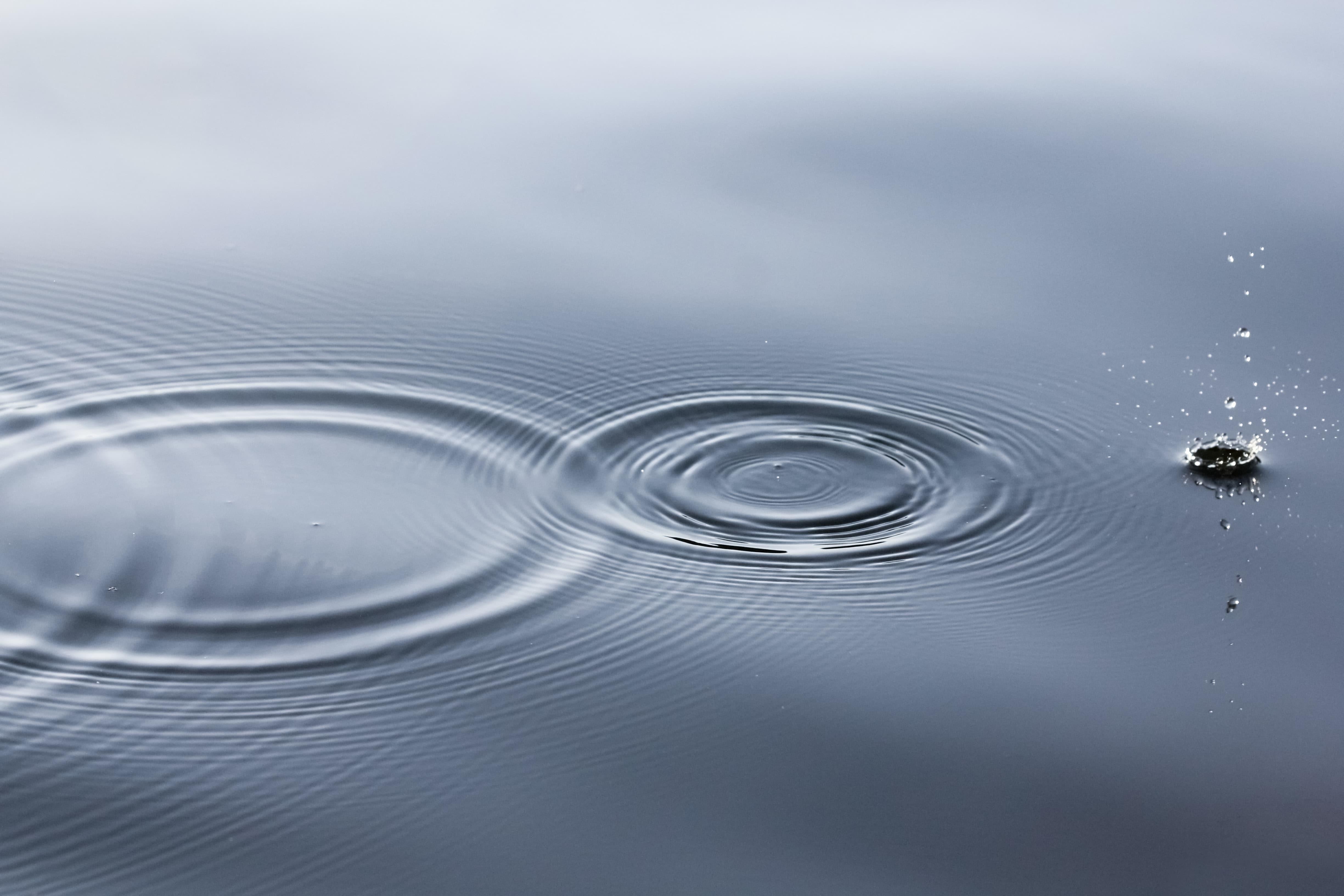

Waves are everywhere; these disturbances transfer energy through space or a medium without transporting any matter. Properties of waves include wavelength, frequency, amplitude, and speed. As this article lays out, each property plays a crucial role in defining waves’ behaviour and characteristics. This chart previews critical relationships between wave properties; keep it in mind as we dive into our topic.
| 🔄Related properties | ✨Effect | ➗Formula |
|---|---|---|
| Wavelength and frequency | Higher frequency = shorter wavelengths Longer wavelengths = lower frequencies. | v w =fλ wave velocity = frequency x wavelength |
| Period and frequency | The time for one complete cycle is reciprocal to frequency. | T=1/f or f=1/T time = 1 cycle / frequency frequency = 1 cycle / time |
| Angular frequency | In oscillating and rotating waves, angular frequency relates to regular frequency. | ω=2πf angular frequency = 2 x pi x frequency |
| Independent amplitude | Amplitude (X) measures wave displacement and energy. It does not affect wave propagation or speed. | No representative equation |


What Defines a Wave?
When you drop a stone into a pool of water, those ripples are waves. When we go to the beach, those big crashing piles of water – waves – are just a larger version of this usually invisible physical phenomenon. When the wind rushes through trees or over fields, bending the grass and leaves under its force, you are seeing waves there too.
Your online Physics course likely won't be so poetic in describing waves. In fact, in physics classes, waves are classified in two different ways.
Mechanical Waves and Electromagnetic Waves
Before we go on to tackle the shapes and movements of different waves, it is important to recognise two types of waves.
Mechanical Waves
- require a gaseous, liquid, or solid medium to propagate.
- may be longitudinal, transverse, or surface
- velocity depends on the type of the medium
- examples: sound waves, seismic waves, and water waves
Electromagnetic Waves
- may travel in a vacuum, across solids and liquid surfaces.
- strictly transverse
- travels at the speed of light in a vacuum
- examples: radio waves, microwaves, gamma rays, and visible light
These differences come down to one factor1: mechanical waves need the vibration of particles to propagate. The speed of wave propagation depends on the particles in various media. Gases, whose particles are few, propagate waves more slowly than solid media, whose particles are densely packed.
Electromagnetic waves may travel in a vacuum at the speed of light.
They may also propagate across solids and liquid surfaces.
This is possible because of their wave-particle duality.
You’ve probably heard of the famous scientific problem that states that light is both a wave and a particle. In fact, light has properties and behaves both like a particle and like a wave. Light is one example of the wave-particle duality electromagnetic waves exhibit.
Transverse and Longitudinal Waves
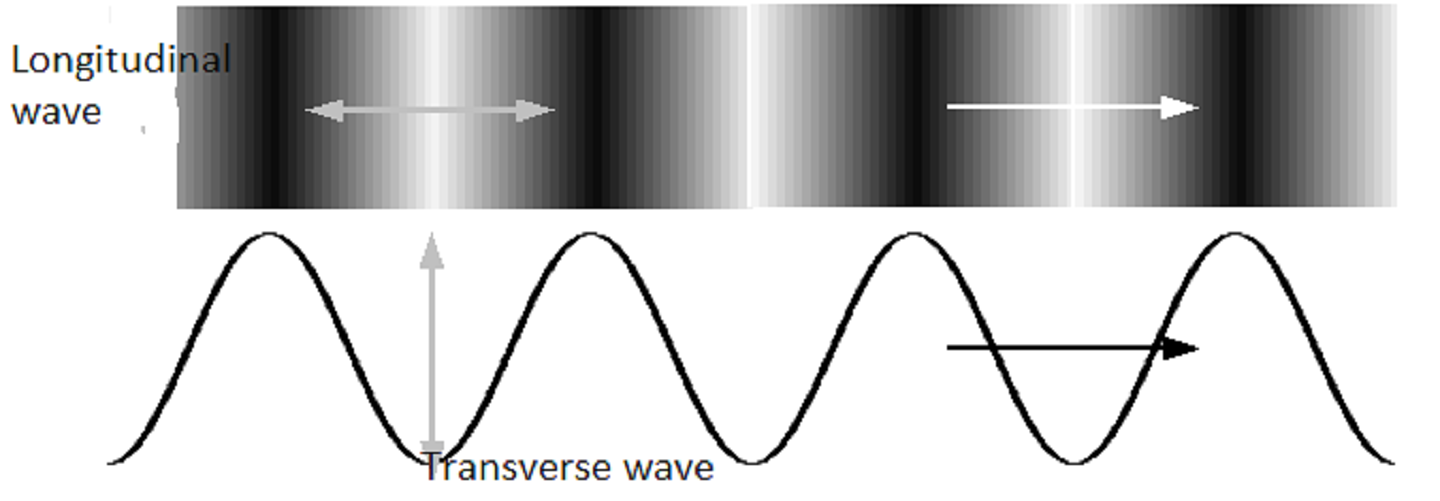
You might have learnt in your Physics tutoring sessions that we describe waves as longitudinal if they have particles that move parallel to the movement of energy in the wave. Rather than the crests and troughs that we see in the classic wave diagram, longitudinal waves do not have this up-down motion.
In scientific terms, we express this phenomenon differently. These waves do not demonstrate polarization, meaning that they do not have peaks and troughs. Instead, the graph above shows us (dark) compressions and (lighter) rarefactions, representing areas of dense and less dense particles. Their oscillation is in the direction of the energy’s travel.
By contrast, the transverse wave is the type of wave that we see in our familiar wave diagram. Here, the movement of particles is at right angles – perpendicular – to the movement of energy, as displayed in the image above.
Transverse waves demonstrate the wave polarization that a longitudinal wave lack: they have that clear movement between peak and trough. We label this polarisation measure 'amplitude', which describes the distance between the peaks and the centre of the wave. Now, to summarise these differences in a side-by-side comparison.
Longitudinal waves
- particles move parallel to energy travel
- characterised by compressions and rarefications
- examples: sonic booms, seismic P-waves, a slinky
Transverse waves
- particles move perpendicular to energy travel
- characterised by crests and troughs
- examples: microwaves, infrared rays, communications technology
Finally, whether transverse and longitudinal waves, one important distinction: waves exhibit the principle of energy transfer2. The particles through which the waves pass briefly move, but the net movement of material is zero. The particles return to their original position after the wave has passed on.
Waves do not expend their energy on making particles move.
The waves transfer energy, not matter.

Key Properties of Waves
Waves have many properties, as we've seen so far, but they depend on the type of wave currently under examination. For instance, the properties of reflection and refraction waves remain constant, despite their opposite effects.
However, some wave properties remain key no matter what type of wave3. Those are the key properties of waves we study now.
Wavelength
Wavelengths represent the distance betweeen two consecutive points of a wave's phase. They have an inverse relationship with frequency; the longer the wavelength, the lower the frequency, and vice versa.
Frequency
Frequency is a vital characteristic that quantifies how quickly a wave repeats. It's directly proportional to energy in electromagnetic waves; higher frequencies produce higher energy. We may then conclude that ultraviolet light is more energetic than infrared light , as it sits further right on the electromagnetic spectrum.
Amplitude
Because amplitude represents the measurement of displacement, we call the amplitude the maximum disturbance of a particular point in the medium. This is the distance between the rest position and the highest peak or trough.
Wave Speed
We might also consider wave speed as the number of times a wave oscillates in a second. Wave speed is off particular importance with regard to media. As mentioned above, waves travel faster through solids than through gases or liquids.
The Inverse Relationship Between Wavelength and Frequency
Should you read an introduction to waves, this will be among the first bits of information it presents. Of all the key properties of waves, the relationship between these two is the most impactful. It affects everything from tuning a guitar or other musical instrument to to building a communication network.
Guitar strings produce transverse waves, and each string’s fundamental wavelength is twice its vibration length. Each string’s frequency is inversely proportional to its wavelength, and directly related to the wave speed. When you press your finger on a guitar fret, you are shortening its wavelength, thereby increasing its frequency.
Of course, you don’t need to know the physics of waves to tune a guitar; you only need a good ear. However, as a physics student, it’s good to understand how the physics of waves affect everyday activities, including making music.
Properties of Waves: More Practical Applications
If you’re not a guitar player, you’ve no need to fret. You can still appreciate wave properties as they apply to other everyday phenomena.
Sound Waves
We are literally swimming in sound waves but we can only hear a narrow band of them. Human hearing can capture sounds in the 20 Hz to 20,000 Hz frequency range. By contrast, dogs can detect sounds up to 60,000 Hz. That’s why they respond to ultrasonic dog whistles that our ears cannot detect.
Communication devices accommodate our limited hearing range, but they communicate between themselves at much lower frequencies. Radio wavelengths tend to be very long. At the other end of the wavelength spectrum we find medical devices such as X-rays and ultrasounds. Their wavelengths are very short, giving them much higher frequencies.
Light Waves
As with sound, our world is awash in light, but we can only see a very narrow spectrum of it (around 380 - 750 nanometres). Infrared light, the kind that turns on our tellies and changes the channels, lies just beyond our lower vision wavelength. The ultraviolet light that makes our skin burn sits just beyond our vision’s upper end.
Fibre optic communication happens close to the infrared wavelength, operating at wavelengths of 850 – 1550 nanometres. These systems typically transmit data as light pulses.

Water Waves
We Aussies love to surf, but we don’t usually give much thought to the physics of our sport as we glide to shore atop our waves. Those waves have energy that we tap into; that energy comes from the longer wavelengths in the ocean, due to the water’s dispersion. As the waves roll into shore, their wavelengths shorten, causing their height to increase until they crest. At that point, we jump on and delight in our ride.
But water waves aren’t just great for surfing. Hydropower plants use water waves to generate electricity. Oceanographers study wave patterns to determine the water’s energy transport capabilities and prevent coastal erosion. They also predict hurricanes and tsunamis by modelling how the waves interact with the seafloor and atmosphere.
Learn More About Wave Frequency Definition Physics
- Prabhat, S . “Difference between Mechanical and Electromagnetic Waves.” Difference Between, 19 Mar. 2011, www.differencebetween.net/science/difference-between-mechanical-and-electromagnetic-waves/. Accessed 19 Apr. 2026.
- RevisionDojo. “What Makes Waves a Powerful Model for Describing Energy Transfer?” RevisionDojo, 7 Dec. 2025, www.revisiondojo.com/blog/what-makes-waves-a-powerful-model-for-describing-energy-transfer. Accessed 19 Apr. 2026.
- Khan academy. “Wave Properties (Article) | Waves.” Khan Academy, www.khanacademy.org/science/ms-physics/x1baed5db7c1bb50b:waves/x1baed5db7c1bb50b:wave-properties/a/wave-properties. Accessed 19 Apr. 2026.
Summarise with AI:
Did you like this article? Leave a rating!

 Loading...