


Of all the great empires in history, the Roman Empire is arguably the most impactful1. Today's citizenship and government systems come straight from the Romans, as do many religious beliefs, language, and educational methods. As such, we must study key events in the Roman Empire timeline, and how they still shape our lives today.
| 📅 Year | 🌟 Event | 📝 Notes |
|---|---|---|
| 753 BCE | Romulus founds the city of Rome. | This started the Regal Period, initiating a series of kings taking power. |
| 509 BCE | The Roman monarchy ends. | The king gets expelled. The Roman Republic is founded. |
| 27 BCE | Augustus proclaims himself Emperor. | This is the start of the Roman Empire. |
| 117 CE | The empire reaches its peak. | Emperor Trajan ruled Rome's greatest territorial expanse. |
| 235–284 CE | The Third-century Crisis. | A period of military anarchy, economic depression, and political disturbance that nearly collapsed the empire. |
| 284-305 CE | Reforms under Diocletian | The empire breaks into 4 regions. Civil service expands. Military is reorganised. Taxation becomes standardised. |
| 285-286 CE | The empire splits. | The Western portion retains the Roman Empire name. The Eastern portion becomes the Byzantine Empire. |
| 306-337 CE | Reforms under Constantine | Reunited the empire; ruled as sole emperor. Relocated the empire's capital to Constantinople. Expanded civil service. Military enhancements. Initiated a gold currency to assure economic stability. Christianity gains state favour and becomes legal. |
| 476 CE | The Western Roman Empire collapses. | Emperor Romulus Augustulus is deposed, ending the imperial line. |
| 1453 CE | The Byzantine Empire collapses. | The Ottomans capture Constantinople, the empire's seat of power. |


The Roman Empire Timeline: From Monarchy to Republic to Empire
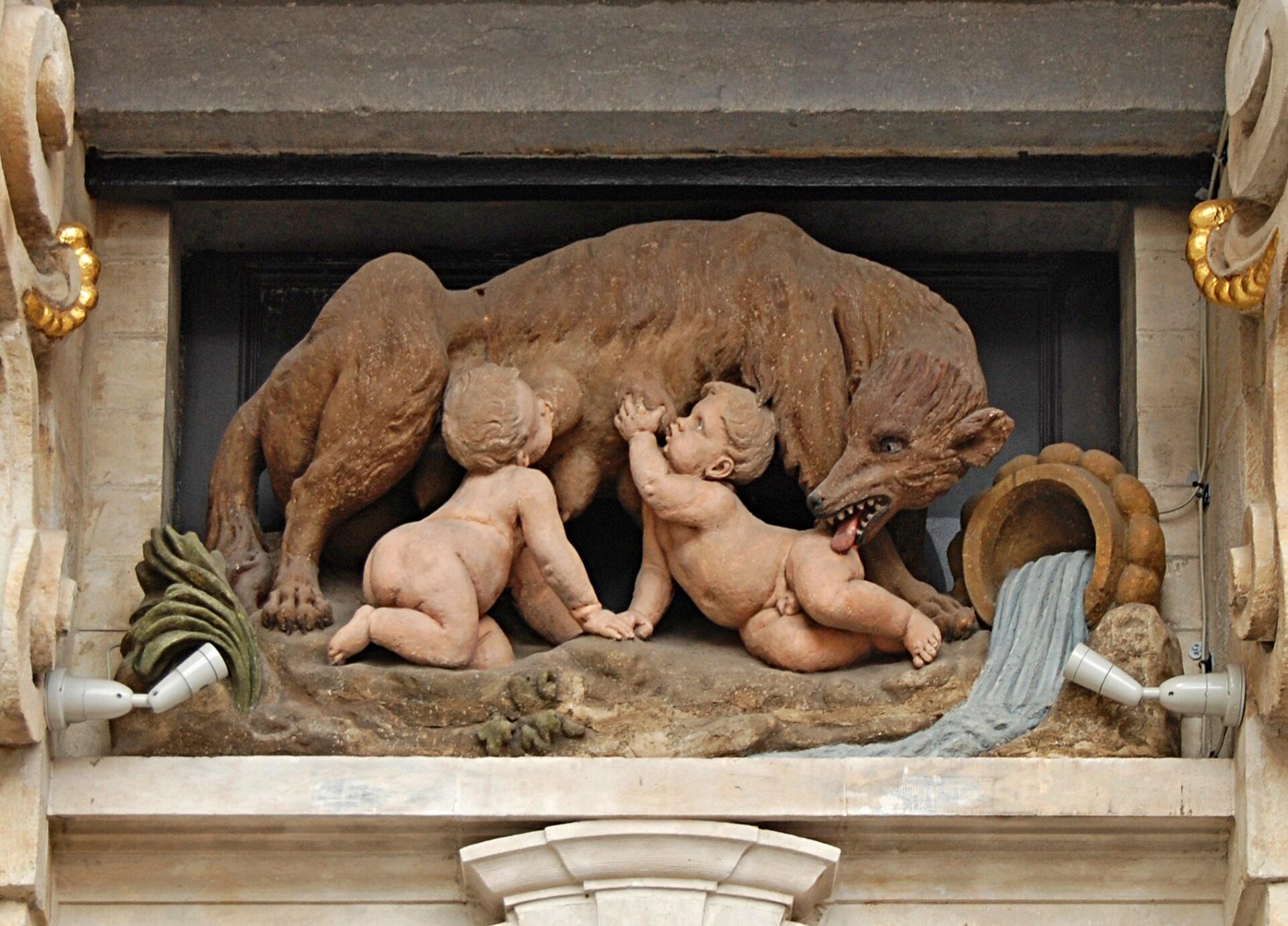
Our society is built on the concept of one high leader, followed by various layers of administrators, and social stratification. This, too, comes from the Romans. This system started in 753 BCE (before the current era), when Romulus founded the city of Rome and proclaimed himself its king.
The story tells of twin brothers, born of Rhea Silva and the god Mars.
Remus is murdered; Romulus gave the city he founded his name.
The founding of this city marks the beginning of monarchical Rome; by surviving accounts, it was not a peaceful time. Women were routinely kidnapped from neighbouring lands, provoking near-constant war. Romulus reigned for 37 years; under him, the military was a primary focus.
Subsequent kings expanded Roman power in various ways: militarily, economically, and by territorial gains. The last of these kings, Tarquinius Superbus, was especially tyrannical, which compelled his overthrow in 509 BCE. At that point, Rome switched from autocratic rule to a republican system of distributed power among oligarchic consuls2.
Roman Empire History: From Republic to Empire
As so often happens in distributed power systems, disagreements, jealousy, and lust for power destabilise operations. That was the state of the Roman Republic as the new millennium approached. Julius Caesar, astute at seizing political control, had been named dictator for life. However, he came to a brutal end in 44 BCE. Out of this morass, one candidate emerged.
He was ruthless in eliminating rivals.
He faked humility and piety while gathering allies behind the scenes.
He was nominated First Citizen - princep in 27 BCE.
Octavian's new title, Augustus, effectively made him Rome's first emperor. He was careful to shield his operations behind republican governance structures. Over time, he minimised the Senate's power, replacing it with imperial authority. Here, we see the beginnings of Pax Romana.
Augustus and the Beginning of Empire
Rome's first emperor had an interest in building an empire quietly. Violence and revolt were never far away; to accomplish any of his aims, he had to make small changes to government over time. His First Citizen title gave him the leeway to take control of the military and the city's wealth.
1. He resigned his consulship (Rome's highest elected office) in 23 BCE.
2. He retained his tribunican power for life, which granted him imperial authority..
By keeping the appearance of a working government while exerting absolute authority behind the scenes, Augustus engineered a Principate system that served Roman emperors for three centuries. This system provoked the Third-Century Crisis.
Roman Empire Map: Expansion, Pax Romana, and Peak Empire
Before becoming emperor, Augustus had built a loyal following across the military ranks. Once he ascended, he did everything possible to fund and outfit forces in distant outposts and nearby, as did every emperor after him. It was this attention to the military that prepared the legions for conquests and takeovers.
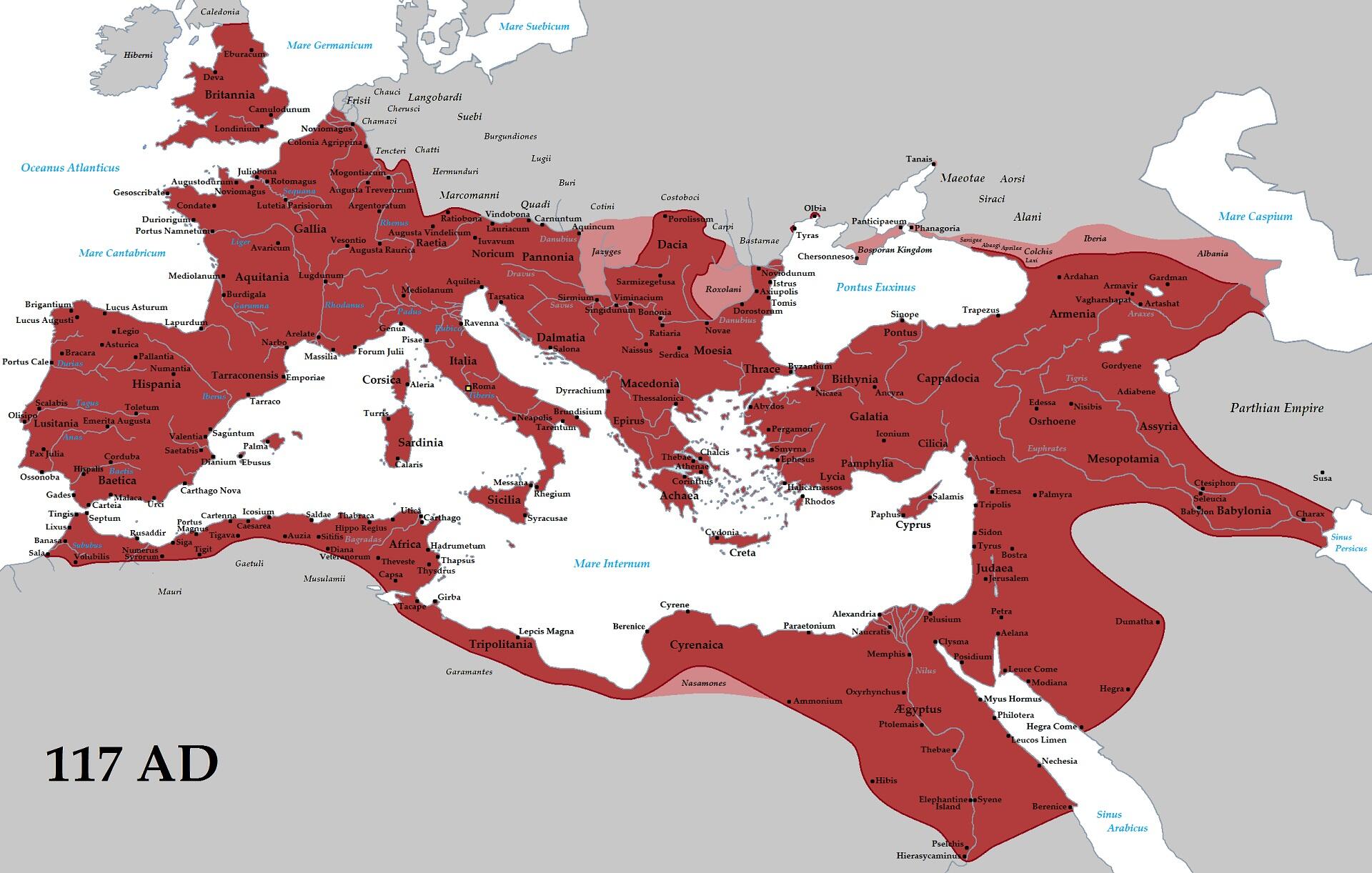
They advanced and grew their holdings3, as the forces of the Mongolian Empire would, centuries later. Roman troops had already secured the entire Italian peninsula under Caesar. Winning Carthage (Tunisia) gave them Spain and large parcels in Northern Africa.
Heading east from there, Romans secured parts of Greece, Macedonia, Syria, and Egypt. But it was under Trajan’s rule (98 – 117) that the empire saw its greatest expansion.
By Emperor Trajan’s death in 117 CE, Rome had reached peak empire, and Pax Romana was the order of the day.
It controlled around five million kilometres2, stretching from Mesopotamia to Britain.
It claimed between 60 and 70 million people, around 20% of the global population.
Rome was home to over a million people, a city size unmatched until 19th-century Europe.
How the Romans Governed Their Vast Empire
In many ways, the British Empire mirrored Roman governing structures. The Romans used a system of stratified government with imperial authority dominating every aspect4.
The Third Century Crisis in Roman History
You might have learnt in your history courses that this crisis lasted just over 50 years, and it nearly broke the Empire. The assassination of Emperor Severus Alexander in 235 CE triggered it, causing society, the government, and the economy to go into free-fall.
The emperor’s throne saw more than 20 leaders claim it, only to fall in a matter of years – or months. The military executed coups and outright assassinations, practising a type of anarchy. The empire’s external enemies made much of the opportunities this chaos provided.
The empire broke into three parts: Gallic (west) Palmyrine (east) and Central.
Enemies invaded Roman territories on several fronts.
The empire had already been struggling under currency debasement, which led to hyperinflation. Disturbances around the empire made it difficult to collect tax revenues, worsening the economic trouble. Finally, trade suffered due to disruptions throughout the empire. The crisis ended when Diocletian took the throne in 284 CE.
Diocletian, The Tetrarchy, and Constantine
If ever an empire needed a visionary leader, the Roman Empire was it. Where The Russian Empire succession scheme kept power within the Romanov bloodline, Roman succession came down to 'the last man standing'.
Diocletian rose to power by military acclaim, after slaying his rival and defeating his troops. He had several plans for righting the empire5, implementing a series of reforms as soon as he took the throne.
The Tetrarchy - dividing the empire into four parts - tailored governance and military activity to their specific regions. Each part would receive funding and resources as needed, rather than blanketing the entire empire with equal capital.
Constantine's Reforms
Reversing the Tetrarchy was Constantine's first act upon taking power. He wanted the empire unified, and entirely under his control. However, he kept the separation of the military and civil administrations, and preserved the administrative divisions Diocletian created.
Constantine repealed Diocletian's failed initiative and issued a stable gold currency.
Religious reform is perhaps the act that Constantine is most renowned for. He legalised Christianity through the Edict of Milan in 313 CE, and convened the Council of Nicea to standardise religious doctrine. His next biggest act was to move the seat of Roman power to Constantinople, renaming the city (Byzantium) after himself. Centuries later, imperial Ottoman warriors would reclaim the city and make it their seat of power.
The Eastern and Western Roman Empires
In 330 CE, Constantine moved the seat of the empire for economic and strategic regions. Constantinople was centrally located and provided ready access to regions of greater wealth. It was easier to defend than the overly-exposed, politically unstable Rome, too. Finally, escaping the Roman Senate gave the empire a fresh political start.
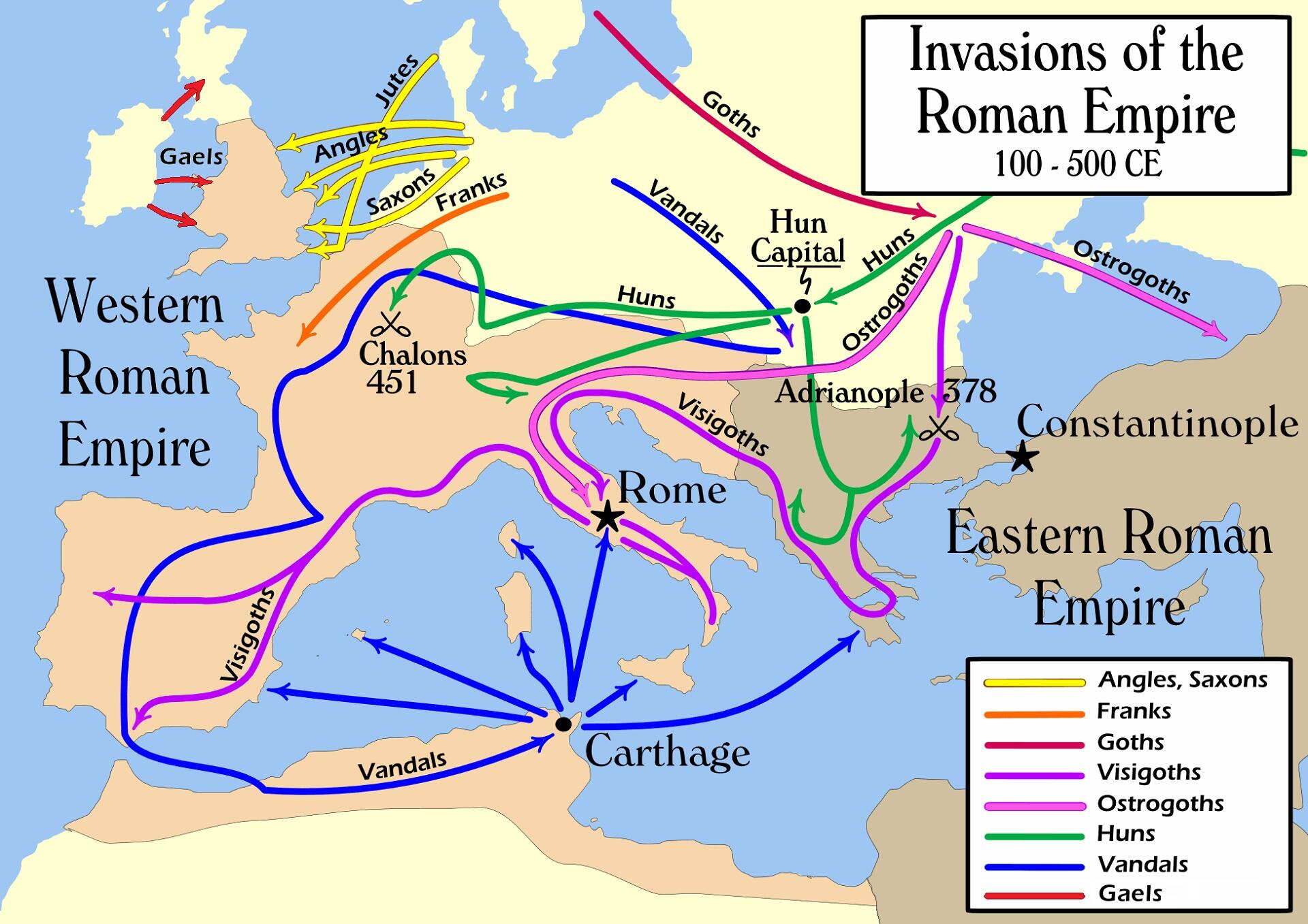
From 395 CE on, the empires diverged in their governments, economics, and cultural norms.
That doesn’t mean that the political machine in Rome stopped. However, the city’s administrative functions declined as more officials relocated to where the power actually lived. The empire’s split was made official in 395 CE, upon Emperor Theodosius I’s death. He had assigned his son, Arcadeus, oversight of the eastern portion of the empire, and Honorius, his other son, the western part.
Why Did The Western Empire Fall?
The eastern Empire enjoyed substantial wealth, controlled more territory, and embraced diversity. By contrast, the western Empire suffered from declining revenues, external attacks, infighting, and greater instability. Those are general reasons why one thrived while the other withered. This chart compares the two empires, point for point7.
| 🧩 Aspect | 👉 Western Roman Empire | 👈 Eastern Roman Empire |
|---|---|---|
| Economy | Greater access to trade routes gave this empire a diversified, expanded economy. | Traditional trade routes weakened under weak protections and its greater distances. |
| Government | The government's control over the church kept administrative power in government's hands. | Political power was fragmented. Emperors exerted little power; they were often outdone by the senate and military leaders. |
| Military | Adopted military tactics from regional leaders. Delegated a measure of independent authority to the highest-ranking officers. | Maintained rigid hierarchy and practices; followed the top-down leadership model. |
| Culture | Embraced aspects of Greek and other cultures. Developed modern, cosmopolitan cities in the Hellenistic model. | The culture grew more rural and fragmented as Roman leadership fractured. |
| Language | Adopted Greek as its dominant language. | Insisted on Latin, which eventually devolved into and classical and vulgar Latin. Only the latter survived and evolved. |
| Religion | Embraced Eastern Orthodox Christianity. The church remained decentralised; the state maintained all power. | Power solidified in the Roman Catholic church, with the Pope becoming a central authority often more powerful than the emperor. |
In the end, the difference comes down to adaptation and modernisation versus clinging to tradition. Just as Chinese systems evolved at the end of the Qing Dynasty, the western Roman Empire embraced novelty and change. The eastern empire essentially tried to stop time and keep things as they were, even as the world was moving on.
What Survived of the Roman Empire After 456 CE?
The eastern Roman Empire, later called the Byzantine Empire, survived and thrived until 1453, thanks to its strong economy, harmonious society, and defensive advantages. The western empire limped along for a few more years. After Emperor Romulus Augustulus was deposed in 476, one year into his rule, the empire effectively ended.
Roman territories such as Britain and Gaul took control over their lands and governments. However, Roman law, language and religion remained, evolved, and exist today, adapted to suit our times. These aspects helped found medieval Europe, where the Church took on administrative and advisory roles that the Roman government had held.
Curious about Roman Empire history? Take history courses online with Superprof!
References
- Norwich University. “7 Major Emperors During the Rise of the Roman Empire | Norwich University - Online.” Online.Norwich.Edu, 2026, https://online.norwich.edu/online/about/resource-library/7-major-emperors-during-rise-roman-empire. Accessed 27 Aug. 2026.
- webadmin. “Was Ancient Rome a Monarchy?” Ancient Societies, 21 Jan. 2025, https://ancientsocieties.net/blog/history/ancient-rome-monarchy/. Accessed 27 Aug. 2026.
- Ricketts, Colin. “The Growth of the Roman Empire Explained.” History Hit, 9 Aug. 2018, https://www.historyhit.com/the-growth-of-the-roman-empire-explained/. Accessed 27 Aug. 2026.
- Staff, Roman Empire. “How the Roman Government Worked - Roman Empire.” The Roman Empire, 4 Mar. 2025, https://roman-empire.net/rankings/how-the-roman-government-worked. Accessed 27 Aug. 2026.
- Fiveable. “Reforms of Diocletian and Constantine.” Fiveable, 2025, https://fiveable.me/ancient-mediterranean/unit-16/reforms-diocletian-constantine/study-guide/w8kVm7BBJjBWT0eB. Accessed 28 Aug. 2026.
- Dimitrios Aristopoulos. “Why the Roman Empire Split Into East and West and What Made Them Different.” GreekReporter.Com, 5 July 2026, https://greekreporter.com/2026/07/05/eastern-western-roman-empire-split/. Accessed 28 Aug. 2026.
- Ricketts, Colin. “Divorce and Decline: The Division of East and West Roman Empires.” History Hit, History Hit, 30 July 2018, https://www.historyhit.com/divorce-and-decline-the-division-of-east-and-west-roman-empires/. Accessed 28 Aug. 2026.
Summarise with AI:
Did you like this article? Leave a rating!


 Loading...
