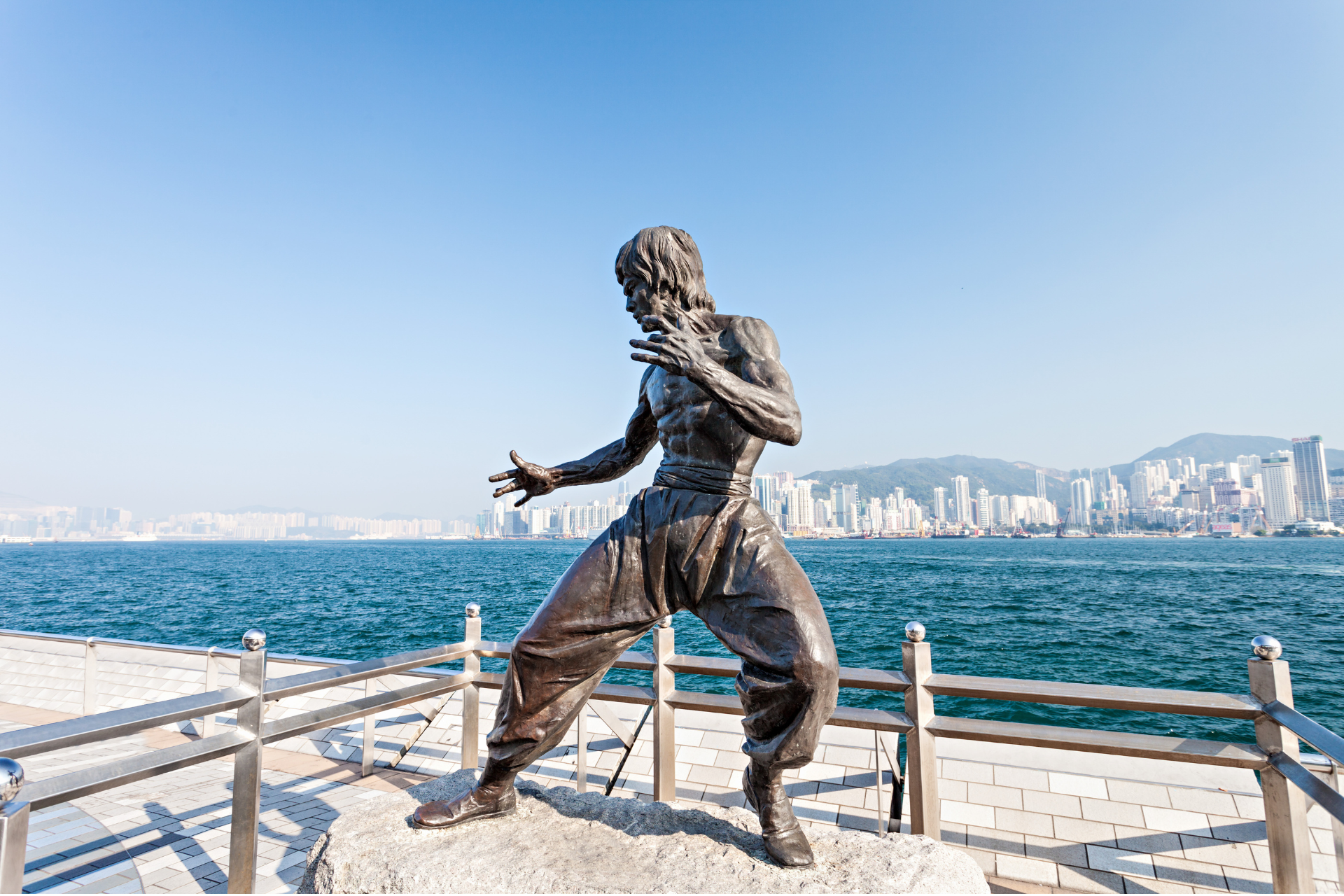

In Hong Kong (香港 - Xiāng gǎng), visitors stroll the Avenue of the Stars, where they can find the statue of Bruce Lee pictured above. He paved the way into global superstardom for other Chinese martial artists thanks to his extraordinary fighting skills. Like many kung fu artists before and after him, he was an athlete, stunt performer, and cultural ambassador. This guide to Chinese kung fu actors showcases the best of Chinese cinema featuring those skills.
| Actor | Born–died | Training background | Signature style | Landmark film |
|---|---|---|---|---|
| Bruce Lee | 1940–1973 | Wing Chun | Fast, direct striking | Enter the Dragon (1973) |
| Jackie Chan | 1954– | Peking Opera training | Acrobatics & physical comedy | Police Story (1985) |
| Jet Li | 1963– | Wushu | Speed, precision & weapons | Once Upon a Time in China (1991) |
| Donnie Yen | 1963– | Tai chi & wushu | Wing Chun & modern fight choreography | Ip Man (2008) |
| Michelle Yeoh | 1962– | Ballet & dance | Fluid, graceful action | Crouching Tiger, Hidden Dragon (2000) |
| Sammo Hung | 1952– | Peking Opera training | Powerful kung fu & comedy | Eastern Condors (1987) |
| Cheng Pei-pei | 1946–2024 | Ballet & dance | Graceful wuxia swordplay | Come Drink with Me (1966) |


Bruce Lee (李小龙 - Lǐ Xiǎolóng)
November 27, 1940, in San Francisco, California.
July 20, 1973, in Hong Kong, aged 32.
Wing Chun; boxing; and, most famously, Jeet Kune Do (the martial arts approach he developed himself)
Fist of Fury (1972), The Way of the Dragon (1972), Enter the Dragon (1973), and Game of Death (1978, released posthumously).
Special Jury Award at the 1972 Golden Horse Awards for Fist of Fury; inducted into Black Belt magazine's Hall of Fame in 1972; numerous posthumous honours recognising his influence on martial arts and cinema.
Bruce Lee got an early start in film work. His father, the Cantonese opera singer Lee Hoi-chuen, signed him up as a child actor in Hong Kong, where he landed several small roles. By the time he was 18, he had 20 film credits to his name1.
“I’m not in this world to live up to your expectations and you’re not in this world to live up to mine.”
Bruce Lee
By age seven, he was practising Tai Chi with his father. Unfortunately, the calm home life he enjoyed dissipated when he was a teenager. He came to rely on his teachers as role models. Brother Edward Muss, the coach of his school boxing team, had a profound influence on his future career.
Bruce Lee founded Jeet Kune Do, a martial art that blends philosophy and physicality.
Bruce Lee met Ip Man when he was 13, the master who would shape his life. Returning to the US as an adult, Bruce Lee made a name for himself competing in various martial arts contests. He then opened a kung fu training centre in Los Angeles, teaching Chuck Norris and Sharon Tate, among many others.
Jackie Chan (成龙 - Chéng Lóng)
April 7, 1954, in Hong Kong.
Trained from childhood at the China Drama Academy, where he studied Peking Opera-style martial arts, acrobatics and performance, later trained in hapkido.
Drunken Master (1978), Police Story (1985), Rumble in the Bronx (1995), Rush Hour (1998), Shanghai Noon (2000).
Honorary Academy Award in 2016 in recognition of his extraordinary career and contributions to cinema, along with numerous other international film and lifetime-achievement honours.
Like Bruce Lee, Jackie Chan started his film career as a child actor. Born in Hong Kong, he was one of his school's 'Little Fortunes', a group of seven students who trained in Beijing Opera. There, he met Yuen Biao and Sammo Hung; they remain collaborators to this day.
I never wanted to be the next Bruce Lee. I just wanted to be the first Jackie Chan.
Jackie Chan, on the comparisons between himself and Bruce Lee.
Jackie never missed an opportunity to learn new martial arts styles. He trained in hapkido, a Korean style of fighting, and in various Chinese martial arts, as well as boxing, judo, taekwondo, and Jeet Kune Do.
Jackie Chan was an extra and a stunt double in Bruce Lee's Fist of Fury.
He then took a minor role in Enter the Dragon.
Bruce Lee beat Jackie's characters in both films.
Film directors craved a new action hero, so they tried to squeeze Jackie into Bruce-like roles with little success. Jackie's breakout role came in 1978, with Snake in the Eagle's Shadow, for which the director gave him full control over his work. Drawing inspiration from Buster Keaton and Harold Lloyd, Jackie injected his stunts with physical comedy, which became his signature style.
Jet Li (李连杰 - Lǐ Liánjié)
April 26, 1963, in Beijing, China.
Wushu. Li began training as a child and became a national-level champion with the Beijing Wushu Team before turning to acting.
Shaolin Temple (1982), Once Upon a Time in China (1991), Fist of Legend (1994), Hero (2002), and Fearless (2006).
Hong Kong Film Award for Best Actor for The Warlords in 2008, in addition to the numerous martial arts championships he won before becoming a film star.
Unlike our first two Chinese martial arts actors, Jet Li did not start his career as a child actor. When he was eight years old, his parents enrolled him in a summer program at the Beijing Sport University. The legendary wushu coach Wu Bin spotted the young athlete's potential and took him under his wing2.
It was a martial arts partnership made in kung fu heaven. Under his coach's tutelage, Jet Li became China's national champion four years running, from 1975 to 1979. Unfortunately, he had to withdraw from competition due to a knee injury. By that time, his fame as a fighter was enough to earn him film opportunities.
Donnie Yen (甄子丹 - Zhēn Zǐdān)
July 27, 1963, in Guangzhou, China.
Began learning tai chi and traditional Chinese martial arts from his mother, martial arts master Bow-sim Mark; later trained with the Beijing Wushu Team. Over his career, also become known for blending different fighting systems in his choreography.
Iron Monkey (1993), SPL: Kill Zone (2005), Ip Man (2008), Rogue One: A Star Wars Story (2016), and John Wick: Chapter 4 (2023).
Multiple Hong Kong Film Awards for Best Action Choreography, including for The Twins Effect (2004), Flash Point (2008), and Kung Fu Jungle (2015).
Rather unusually, this Chinese kung fu actor's introduction to the arts came from his mother, a Wǔdāngquán (武当拳) Grandmaster. He began his training in Tàijíquán (太极拳) under her tutelage, soon branching into other styles of Chinese martial arts. His parents sent him to Beijing when he was 16 to continue training with the Beijing Wushu Team4.
Donnie Yen is best known for his Ip Man portrayals across four films.
Like most Chinese kung fu actors, Donnie Yen trained in several martial arts styles, from traditional Shaolin kung fu to modern mixed martial arts (MMA). In fact, he enhances his screen fights with MMA fighting techniques. But he will forever be revered for his role in reviving interest in Wing Chun style.
Michelle Yeoh (杨紫琼 - Yáng Zǐqióng)
August 6, 1962, in Ipoh, Malaysia.
Originally trained as a ballet dancer, she later learned martial arts and screen fighting for her action roles and became famous for performing many of her own stunts.
Yes, Madam! (1985), Tomorrow Never Dies (1997), Crouching Tiger, Hidden Dragon (2000), Crazy Rich Asians (2018), and Everything Everywhere All at Once (2022).
Academy Award for Best Actress and the Golden Globe for Best Actress in a Musical or Comedy in 2023 for Everything Everywhere All at Once, made her the first Asian woman to win the Best Actress category.
Women have too often been underrepresented in lists of martial arts movie stars. Michelle Yeoh is a spectacular exception—especially considering that her first serious physical training wasn’t in martial arts at all. It was in ballet.
Yeoh trained as a dancer from a young age and studied ballet in London, but a spinal injury ended her hopes of becoming a professional ballerina. She briefly turned to modelling and, in 1983, won the Miss Malaysia beauty pageant. Soon afterward, she appeared in a television commercial alongside Jackie Chan—a connection that helped lead to a contract with Hong Kong studio D&B Films.
Her first film role came in The Owl vs. Bombo (1984). On set, Yeoh noticed something intriguing: the martial arts choreography, much of it created by Sammo Hung's team, wasn't entirely unlike dance. Both demanded timing, balance, flexibility and precise control of the body.
If she could dance, she reasoned, why couldn't she learn to fight on screen?
“Dance and martial arts have a lot in common. They’re both about fluid and powerful movement.”
Michelle Yeoh
She soon proved the point. In Yes, Madam! (1985), Yeoh took on her first major action role, performing elaborate fight scenes and dangerous stunts that helped establish her as one of Hong Kong cinema's most exciting new stars.
Her international breakthrough came with Crouching Tiger, Hidden Dragon (2000). The film became a worldwide phenomenon, and Yeoh's graceful but powerful performance introduced her martial arts skills to a huge global audience.
Hollywood followed, with roles ranging from Bond film Tomorrow Never Dies to Crazy Rich Asians and, eventually, Everything Everywhere All at Once. But Yeoh's roots in Hong Kong action cinema remained an essential part of what made her distinctive: a performer who turned the discipline and elegance of ballet into a completely new kind of screen fighting.
Sammo Hung (洪金宝 - Hóng Jīnbǎo)
January 7, 1952, in Hong Kong.
Trained at the China Drama Academy, the same Peking Opera school later attended by Jackie Chan. His training combined martial arts, acrobatics and dance, later earned a black belt in hapkido.
Winners and Sinners (1983), Wheels on Meals (1984), Eastern Condors (1987), and Ip Man 2 (2010). He also famously appears opposite Bruce Lee in the opening fight of Enter the Dragon (1973).
Hong Kong Film Awards' Lifetime Achievement Award in 2024. He has also won multiple awards for action choreography, including Best Action Choreography for Ip Man 2.
We met Sammo Hung in Jackie Chan's chapter, so we know he has an extensive background in martial arts. Their long-term collaborations, along with Yuen Biao, make for some of the most memorable output of Chinese cinema.
However, where Jackie's career placed him in front of the camera, Sammo worked behind the scenes. At just 14 years old, Sammo was choreographing and performing stunts (see the 1966 Come Drink With Me wǔxiá film).
His next step up came when he hired at Golden Harvest Films, where he choreographed their first two films' action scenes. The studio then sent him to Korea, where he studied hapkido and worked as the martial arts director for several films.
Directing his first feature film, The Iron-Fisted Monk (1977), Sammo emphasised the story's comedic aspects. He gets the credit for making the first, out-and-out kung fu comedy film.
Cheng Pei-pei ( 郑佩佩 - Zhèng Pèipèi)
January 6, 1946, in Shanghai, China.
July 17, 2024, in the San Francisco Bay Area, California, aged 78.
Studied ballet for several years and later learned screen fighting at Shaw Brothers, using her dance background to bring unusual grace and fluidity to her action scenes.
Come Drink with Me (1966), Golden Swallow (1968), Lady Hermit (1971), Crouching Tiger, Hidden Dragon (2000), and Mulan (2020).
Hong Kong Film Award for Best Supporting Actress for Crouching Tiger, Hidden Dragon in 2001; posthumously honoured with a Lifetime Achievement Award at the 2024 Golden Horse Awards.
Like Michelle Yeoh, Cheng Pei-pei studied ballet as a child, and those skills gave her fighting skills grace and credibility. She never intended a career as a martial arts actress, but a Shaw Studios executive saw her dance and thought her moves would be perfect for kung fu action.
She worked hard to master using knives, poles and swords, and she insisted on doing her own stunts, something the studio did not want her to do6. Throughout the 60s, she was Hong Kong studios' go-to swordswoman, but she left at the height of her career.
Her marriage to a businessman led her to American shores, where she taught Chinese dance and, eventually, made the Hollywood scene. She returned to Hong Kong studios after her marriage ended, reinvigorating her career with a starring role in Flirting Scholar (1993). It wasn't until 2000, with her role in Crouching Tiger, Hidden Dragon, that she reprised her kung fu legacy.
How Chinese Action Stars Became Global Icons
Sometimes it's the use of traditional Chinese weapons. Sometimes it's the lightning-fast choreography or death-defying stunts. Whatever the draw, Chinese martial arts stars have left a lasting mark on global cinema.
Beyond the spectacle, their appeal also comes from the discipline, training and creativity behind each performance. Through their films, audiences around the world have discovered new styles of action, as well as elements of Chinese martial arts and culture.
Hong Kong cinema has a long history of films made in both Mandarin and Cantonese. Mandarin productions were particularly dominant in the early 1970s, especially during the height of the Shaw Brothers era, before Cantonese cinema enjoyed a major revival later in the decade.
That means the films mentioned in this article aren't all in the same language. Some were originally made in Mandarin, others in Cantonese or English, and many were dubbed for international audiences. If you'd like to get closer to the language behind the action, our guide to Chinese martial arts vocabulary introduces some of the key terms you'll hear in the world of kung fu. Bruce Lee's Fist of Fury, for example, was originally released in Mandarin, while Hong Kong martial arts cinema more broadly crossed linguistic and cultural boundaries through dubbing and international distribution.
Who is your favourite martial arts movie star? 🎬
Voted for “Someone else”? 👊 Let us know who we missed in the comments below.
References
- Augustyn, Adam. Bruce Lee | American-Born Actor | Britannica. Encyclopædia Britannica, 2019, https://www.britannica.com/biography/Bruce-Lee. Accessed 20 July 2026.
- “1 Coach Wu Bin.” Uswushuacademy.Com, 2026, https://www.uswushuacademy.com/index.php/en-us/about/2-2/36-coach-wu-bin. Accessed 20 July 2026.
- Tao. Xianxia, Wuxia, Cultivation and More – a Small Explanation | My Life, My Tao. 28 Sept. 2019, https://www.mylifemytao.com/xianxia-wuxia-cultivation-and-more-a-small-explanation/. Accessed 20 July 2026.
- Raffi. History of the Beijing Wushu Team. 4 Oct. 2002, http://www.beijingwushuteam.com/BeiJing/BJintro.html. Accessed 20 July 2026.
- Havis, Richard James. “How Michelle Yeoh Went from Ballet Dancer to Martial Arts Star – and the Three 1980S Hong Kong Action Movies That Made Her Name.” South China Morning Post, 29 Aug. 2021, https://www.scmp.com/lifestyle/entertainment/article/3146594/how-michelle-yeoh-went-ballet-dancer-martial-arts-star-and. Accessed 20 July 2026.
- AWMA Blog. “Remembering Wuxia Film Legend Cheng Pei-Pei.” AWMA Blog, 24 July 2024, https://blog.awma.com/remembering-wuxia-film-legend-cheng-pei-pei/. Accessed 20 July 2026.
Summarise with AI:
Did you like this article? Leave a rating!

 Loading...