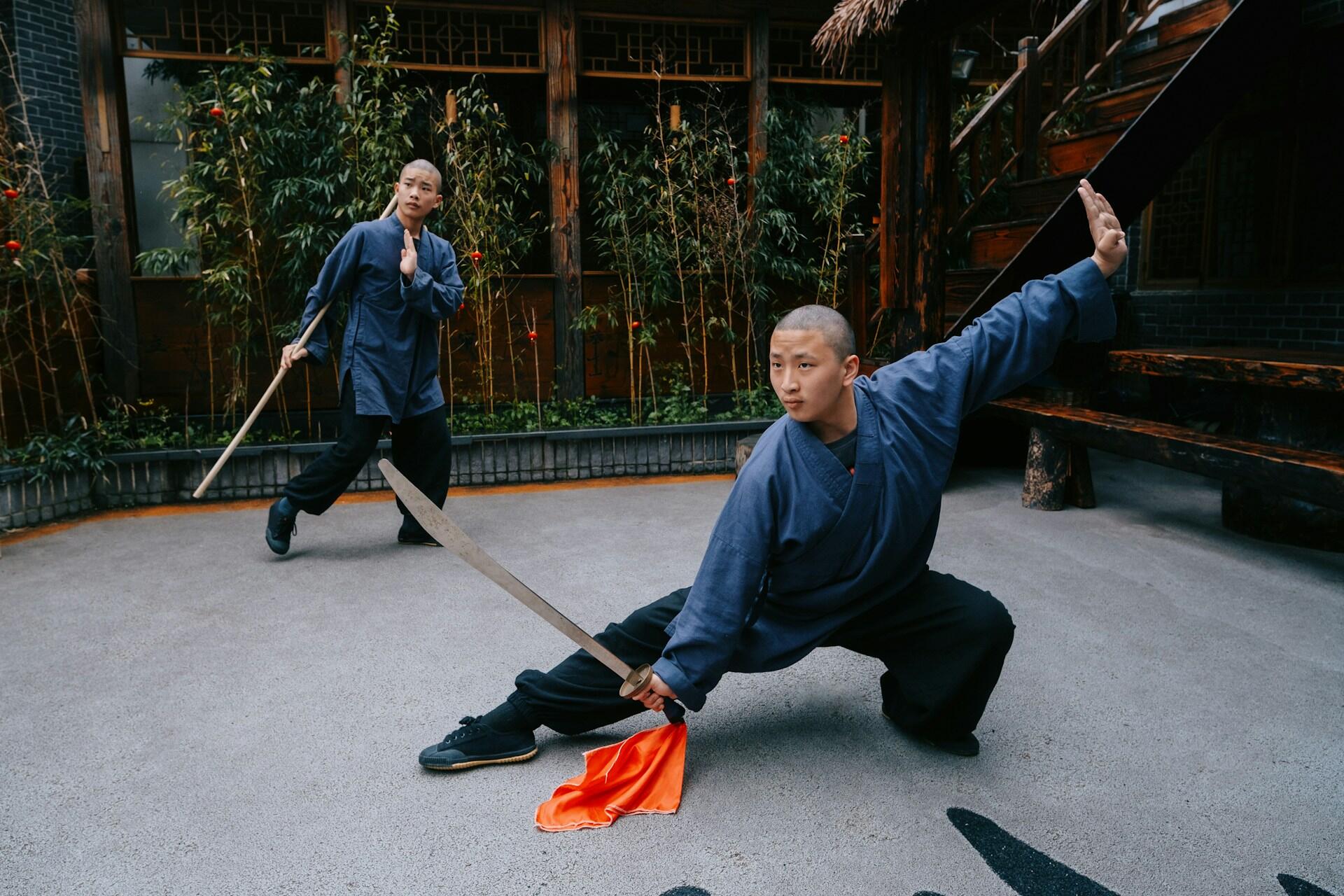

On its own, the art of hand-to-hand combat inspires awe. This mystique grows through cultural exports such as Chinese martial arts films, both the lightning-fast Jackie Chan fare and historical dramas. But kung fu enthusiasts long for the Mandarin words to describe what their favourite martial arts heroes are doing. This kung fu vocabulary list gets you closer to understanding this enigmatic art.
| 🧩 Aspect | 📃 Terms | 📖 Meaning | 🔊 How to pronounce it |
|---|---|---|---|
| Kung fu styles | Shàolín gōngfu - 少林功夫 Tàijíquán - 太极拳 Yǒngchūn - 咏春 | Shaolin style tai chi Wing chun | |
| Basic terms | wǔshù - 武术 gōngfu - 功夫 sǎndǎ - 散打 | martial arts achievement through work mixed martial arts (sanda) | |
| Titles and people | shīfu - 师父 qiánbèi - 前辈 shījiě - 师姐 | teacher, master senior female senior | |
| Training and practice | xùnliàn - 训练 zhāoshì - 招式 liànxí - 练习 | training move, technique practice | |
| Weapons | dāo - 刀 jiàn - 剑 gùn - 棍 | knife, sabre straight sword staff | |
| Philosophical aspects | qi - 气 dào - 道 wǔdé - 武德 | vitality, life force way, path martial virtue |


Chinese Martial Arts Vocabulary: Different Styles of Kung Fu
The people who count such things estimate that people around the world train in more than 170 martial arts styles1. In China, roughly 60 styles - schools - have official recognition as parts of China's intangible cultural heritage. Of those 60 styles, these are the ones with the highest profiles.
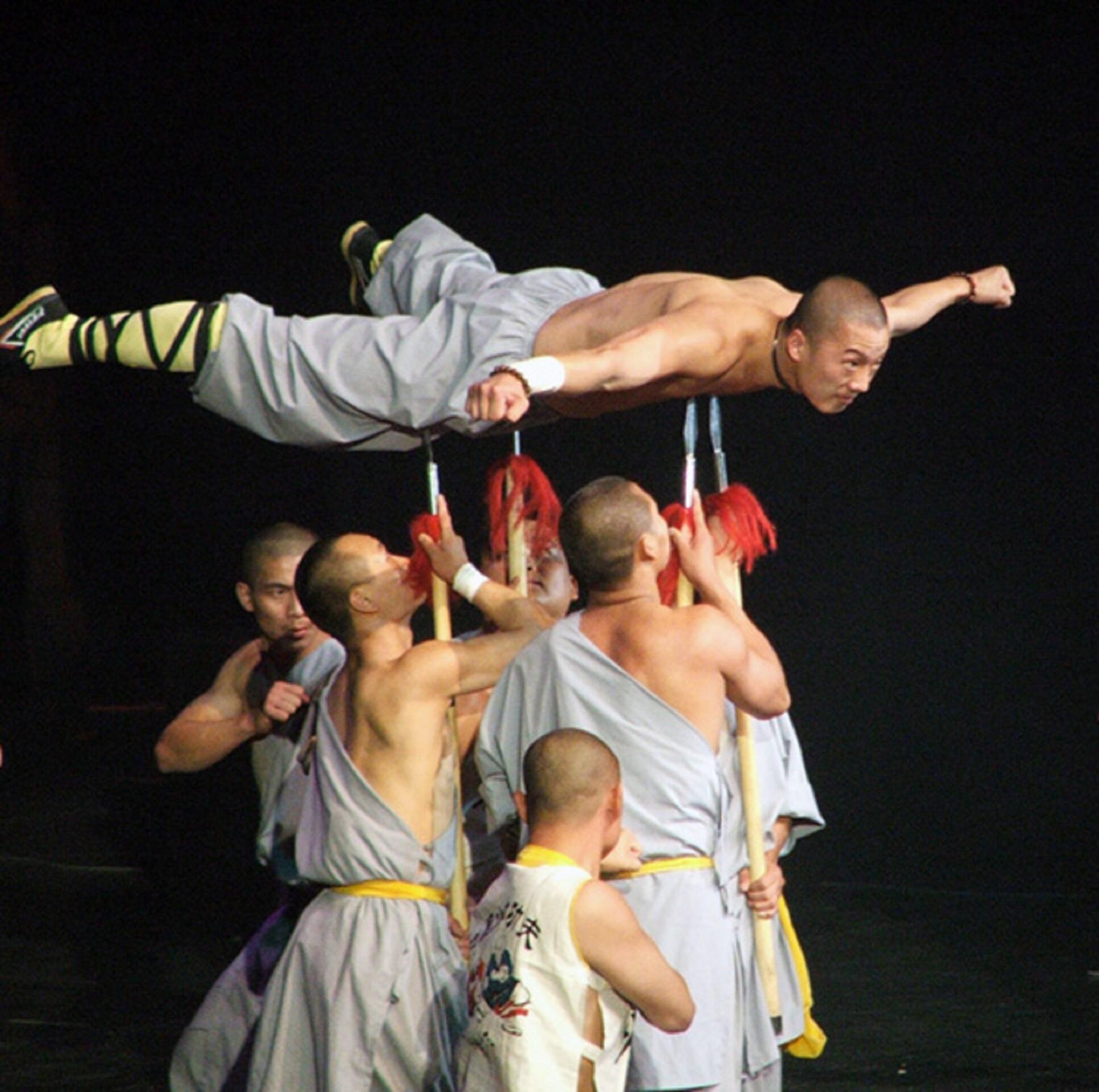
Shaolin kung fu (少林功夫 - shàolín gōngfu) is perhaps the most renowned school. Hong Kong cinema powerhouse Stephen Chow had a lot to do with promoting it, with films titled Shaolin Soccer and Kung Fu Hustle. Other Chinese martial arts actors practised Shaolin in their films, too.
Shaolin focuses on speed and strength. By contrast, Tai chi (太极拳 - tàijíquán) builds the fighters' inner landscape.
These practitioners work on building their qì (气 - vital force), alongside mental and spiritual strength.
Wing chun (yǒngchūn - 咏春) is the style of fighting Ip Man and Bruce Lee practised. As you might know from watching their films, this school is all about technique and less about strength. Wing chun has its roots in Shaolin kung fu.
The Wing chun school is notable for having two women as its founders.
One of them, Ng Mui, learnt shàolín gōngfu while living at a Shaolin temple. She modified the practice to suit women's physique and capabilities, then taught other women how to fight.
Sixty schools are a lot of different ways to practise martial arts, but China boasts hundreds of variations of those schools. It's hard to estimate the exact number due to the secretive nature of combat fighting. It would be a strategic blunder for a fighter to reveal their techniques, wouldn't it?
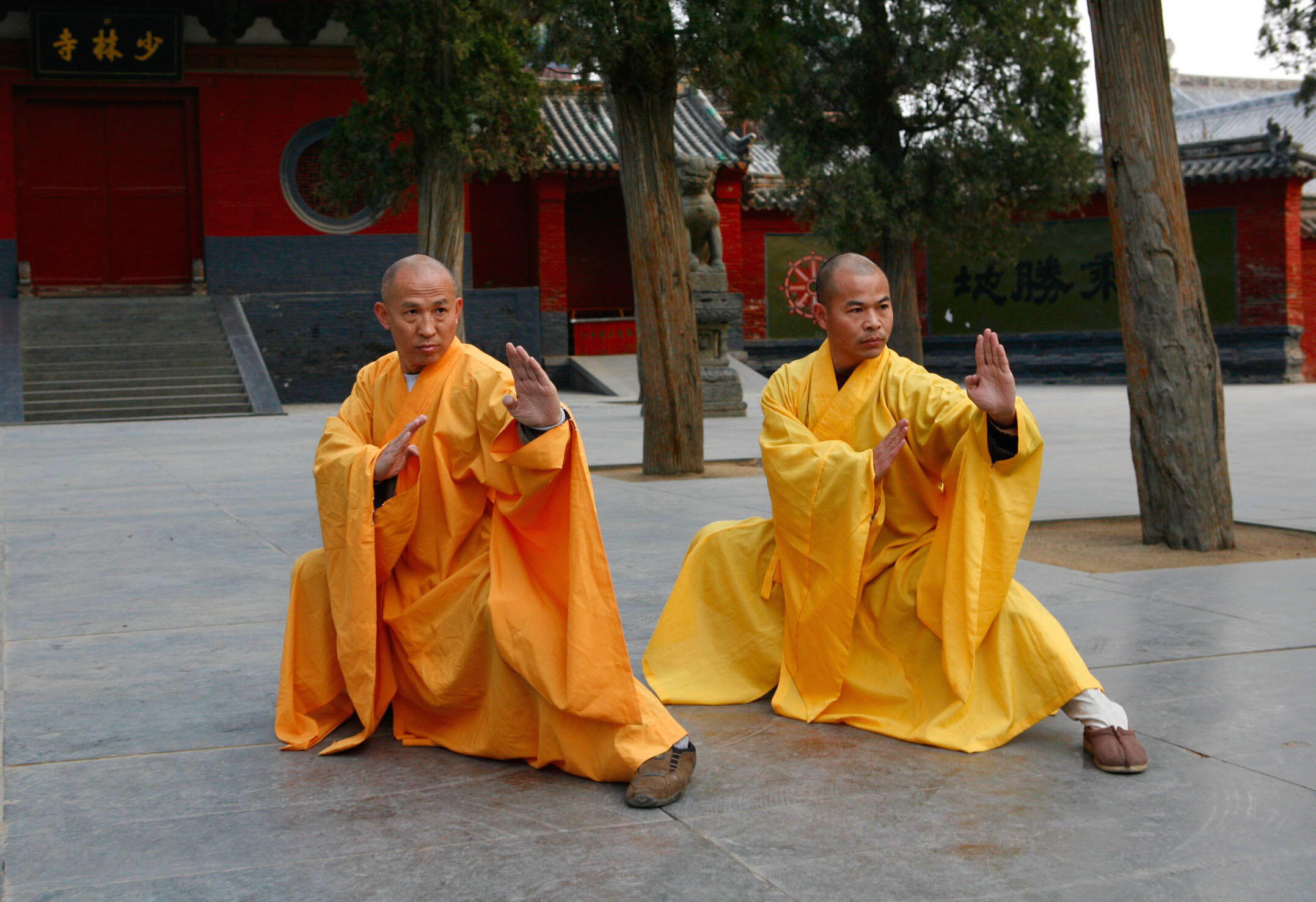
Categorising Chinese Martial Arts
Chinese kung fu styles sort into four general categories that describe their functions, focus, and effects. These are the Mandarin martial arts words to describe them2.
Under this system, Shaolin is a wài jiā school and Tai chi is of the nèijiā category. Another popular style, bāguàzhǎng (八卦掌) is a northern school of fighting, while Wing chun is a southern school.
Essential Kung Fu Terminology
With a few different schools of kung fu and their origins laid out, we can study kung fu vocabulary that describes what those fighters do3.
Obviously, kung fu terminology is far more extensive. But these eight terms are essential for anyone wishing to begin studying Chinese martial arts.
Kung Fu Vocabulary for People and Titles
The Kung Fu Panda films introduced a number of Chinese words related to the discipline, most prominently Shīfu (师父). Did you think that was a rather quirky name when you watched the films? In fact, it is a title, one step below zǔ shī (祖师), the founding master of a discipline.
Across Asian cultures and particularly in learning disciplines, hierarchy is vital to the social structure. This ranking system has its roots in Confucian philosophy, as a way to prioritise social harmony.
No direct link exists between Confucius (孔子 - Kǒngzǐ) and kung fu. However, Chinese martial arts feature many connections to Confucian thought, which you'll explore in this article's last chapter. For now, we only need to know that relationships between hierarchies are important in kung fu. Besides Shīfu, these are the words to describe them.
Back to Kung Fu Panda for a moment. In the film, they called him by his name - Po. His title would have been 'disciple' or 'male junior student'. Can you assign titles to the rest of the cast?
Wushu Terminology for Practice and Training
Some of the words that populate this category already appeared above. This guide to Chinese martial arts necessarily separates these words into categories. That way, you can see how broad and complete Chinese martial arts are.
But that doesn't mean that the categories don't overlap. For instance, tào lù describes the series of movements students execute during training. It is an essential word of kung fu terminology, a fundamental concept that guides training efforts. So, we don't repeat it here; instead, you have new words to learn.
In the clip below, you can hear the referee saying "kāi shǐ" to the fighters. It's a common term used in competitions of all sorts, including academic ones. Can you also recognise the schools represented based on their technique (zhāoshì)?
Mandarin Martial Arts Words for Weapons
Many schools of Chinese martial arts rely on fighters' skills and speed with no weapons needed. However, if you've ever watched a Jackie Chan film, you also know that anything can become a weapon in a skilled martial artist's hands.
The Shaolin discipline permits no weapons. However, monks use long staffs called 扁担 - biǎn dan (shoulder pole) to help carry buckets of rice or water. Those became their main fighting tool.
Between those two extremes, we find a range of weapons that some túdì (disciples) train with. Sometimes, it's because their school/style calls for them. Other times, it's to prepare the fighter for the eventual need for weapons, leaving them to improvise when that time comes. These are the instruments they wield.
Variations include the three-part staff (三节棍 - sānjié gùn), and the monk staff (锡杖 - xízhàng).
One variation is called zhǎng suì jiàn (长穗剑), a long-tasselled sword.
南刀 (nán dāo) - the Southern broadsword, the ox-tail sword (牛尾刀 - niúwěi dāo), and the willow-leaf sabre (柳叶刀 - liǔyè dāo).
There exists a list of 18 basic weapons of Chinese martial arts4. Not every school uses all of them, and some have modified the weapons to better suit their fighting style, as this list shows.
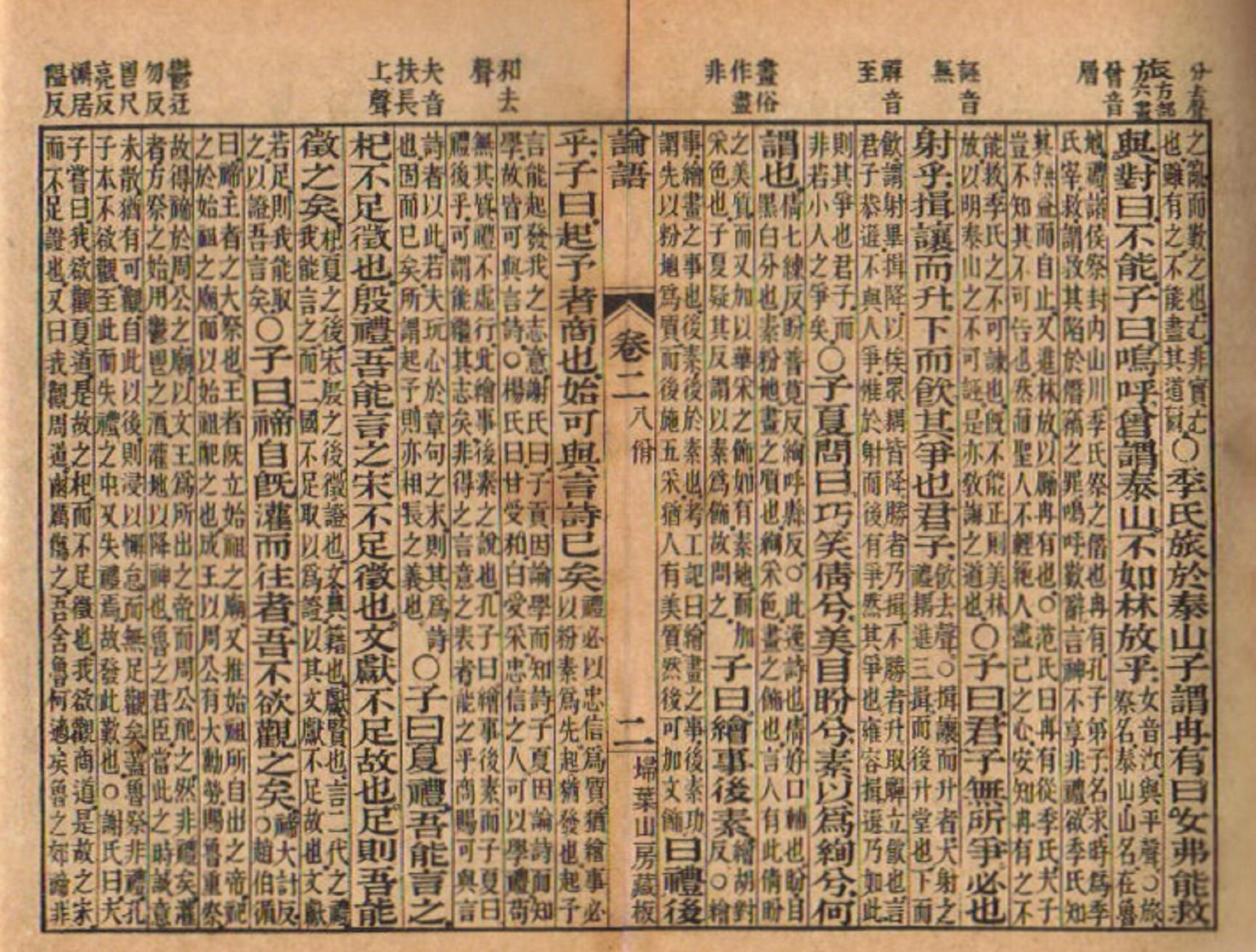
Philosophy and Culture Words in Kung Fu Terminology
Earlier, you read about Confucian thought in relation to Chinese martial arts. Though the two disciplines have no formal ties, the connections are even more profound than if they did.
Confucian ideals impacted Chinese martial arts because they were (and remain) the foundation of Chinese society.
Confucianism is the foundation of philosophy and ethics in China. Concepts include benevolence (仁 - rén), propriety (礼 - lǐ), and trustworthiness (信 - xìn). Not coincidentally, these are qualities every martial arts disciple learns in the course of their training. They're foundational; plenty strong to build greater concepts on.
| Mandarin word | In Pinyin | Meaning |
|---|---|---|
| 气 | qì | vital energy |
| 阴阳 | yīnyáng | yin and yang |
| 道 | dào | way or path |
| 武德 | wǔdé | martial virtue |
| 禅 | chán | Chan/Zen Buddhism |
As usual, Chinese words represent more than one concept. For instance, qì (气) represents 'vital energy', but it can also mean 'air' or 'breath' (气流 - qì liú), another fundamental kung fu concept.
Most notable are the characters representing yin-yang (阴阳). The first incorporates the 'moon' ideogram (月) and the second features the sun (日). In Chinese culture, these are representative of female and male energy, respectively. They indicate completeness, duality, and the balance of forces.
When you study Chinese martial arts, you're not just learning how to defend yourself (or a bunch of cool moves). You're learning an entire philosophy that has shaped and guided the discipline over millennia. Good on you for wanting to learn the proper words to describe your journey!
References
- Jacob. “How Many Martial Arts Are There? Discover 180+ Styles & Their Unique Benefits [2024] 🥋 – Karate MMA.” Karatemma.Org, 29 July 2024, https://www.karatemma.org/how-many-martial-arts-are-there/. Accessed 17 July 2026.
- Meredith, Anne. “The Who, What and Why of Chinese Martial Arts.” CLI, 3 Aug. 2021, https://studycli.org/chinese-culture/chinese-martial-arts/. Accessed 17 July 2026.
- Gracey, Si Gung Kerry. “Kung Fu Terminology Guide | Essential Martial Arts Terms | Shaolin Arts.” Shaolin Arts, 21 Nov. 2024, https://www.shaolinarts.org/kung-fu-terminology-martial-arts-terms-guide/. Accessed 17 July 2026.
- Tai Chi, Wuji . Eighteen Arms of Wushu. https://www.taichiwuji.com/glossary/18-arms-of-wushu/. Accessed 17 July 2026.
Summarise with AI:
Did you like this article? Leave a rating!

 Loading...