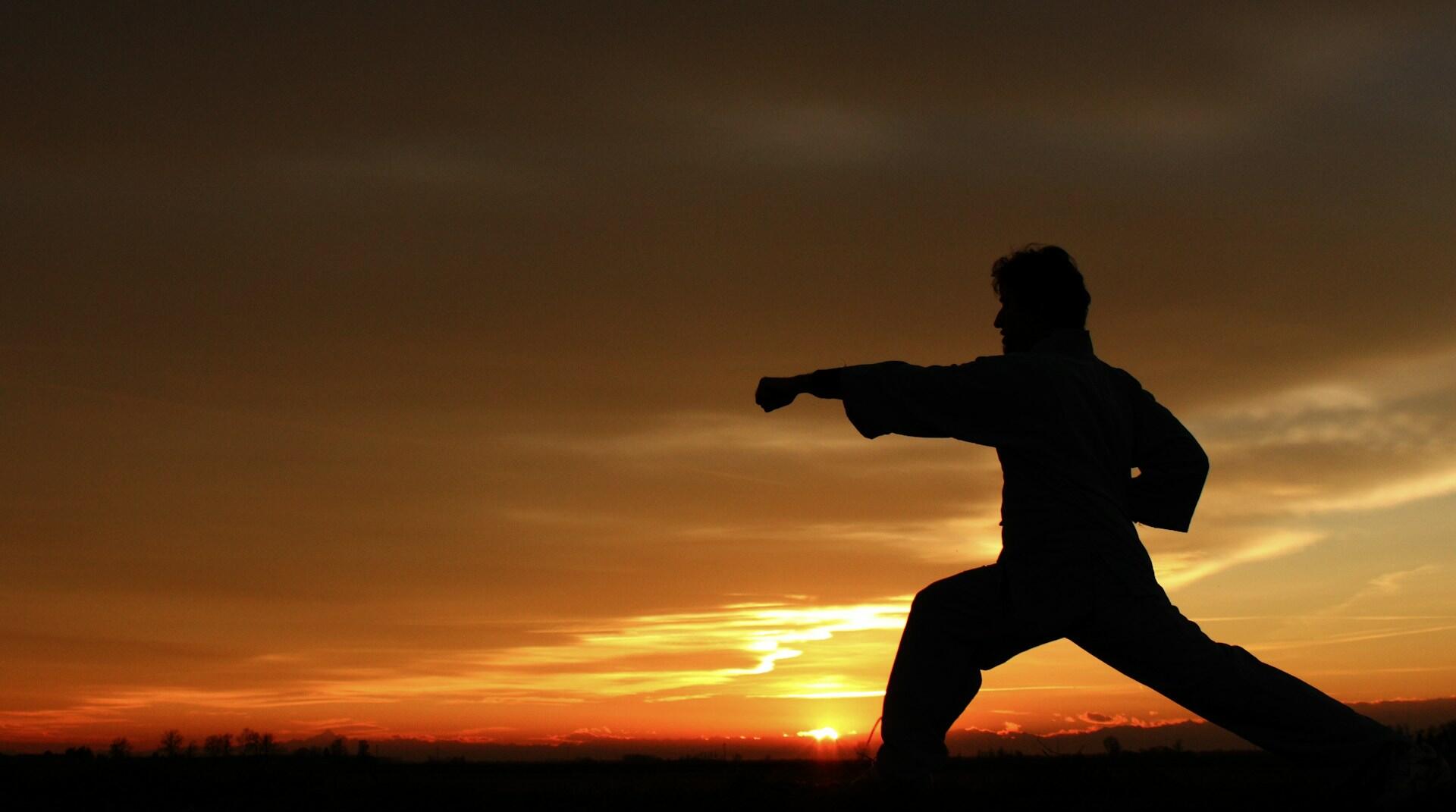

Around the world, many people watch Chinese kung fu movies because the action is amazing. But disciples who train in a Chinese martial art know it's more than a fighting style; it's a way of life. For the rest of us, learning about Chinese martial arts is our path into Chinese history, philosophy, and culture. This article delves into the development, weaponry, and vocabulary that define these martial arts.
Concepts that Define the Types of Chinese Martial Arts
- Kung fu is a discipline that develops the mind and body.
- Wushu is a more stylised type of fighting suitable for competition.
- We can sort Chinese martial arts into four broad categories: inner, outer, northern, and southern.
- Chinese martial arts incorporate a range of weapons, depending on the type of fighting you do.


Chinese Martial Arts History
We are fortunate that China had developed a writing system by around 1250 BCE, giving us written records that help trace the development of Chinese martial culture and martial arts across millennia1.
21st-17th century BCE
Xia Dynasty military leaders organised and trained soldiers in hand-to-hand combat techniques.
17th century - 256 BCE
Shang Dynasty generals organise 'martial dances' to train soldiers and boost morale.
This marks the start of Tai Chi practice.
770-476 BCE
The turbulent Spring and Autumn Period turned martial art from an 'inner' to an 'outer' fighting style.
King Qi Huangong held martial arts contests twice a year to nominate 'heroes'.
Starting 221 BCE
With China's central plain united, a distinctive fighting style emerged, called Hong Fist.
It blended wrestling elements with swordplay and dancing (acrobatics).
960-1279 CE
Song Dynasty military generals encouraged the populations to practise kung fu.
This is the period that Southern style emerged.
~1270s
Shaolin monks develop a unique fighting style.
Han Chinese were barred from practising, they took refuge in temples to master the art.
Starting 1368
The Ming Dynasty saw the mingling of Northern and Southern styles, and formalised Shaolin School boxing.
As late as 1644, during the Qing Dynasty, Han Chinese were still forbidden to practise martial arts in groups and Shaolin temples were closely guarded. However, by that time, people had access to written documents, so they could learn fighting skills from manuals.
The plot of the comedy film Kung Fu Hustle reflects the historical fact that, despite restrictions on practising martial arts in groups, people could still learn fighting techniques from written manuals.
Meanwhile, the government categorised various styles of kung fu under general headers. That's when internal, external, Northern, and Southern classifications emerged.
What Are Chinese Martial Arts?
Collins delivers the barest possible definition of Chinese martial arts. In fact, kung fu isn't just fighting with bare hands and feet, though that might seem the case if you watch Bruce Lee's kung fu movies. But even he occasionally uses ordinary items as weapons.
Kung fu: a Chinese way of fighting in which people use only their bare hands and feet.
Collins Dictionary
A proper definition of kung fu might read: "a disciplined system of physical and mental strength". That is, after all, what the Chinese word for kung fu implies.
The Chinese word gōngfu (功夫) literally means 'mastery through work'.
The Chinese definition of gōngfu is more satisfying, but it still doesn't go far enough2. What kind of work are we talking about mastering? This is where the term wǔshù (武术) comes in. It means 'martial arts' but it literally translates to 'warrior method'.
As we noted above, in the timeline, gōngfu developed as a military training system. So, it's no surprise that this style of martial art invokes warriors. In fact, the English word 'martial' describes things related to military: 'martial law' is law enforced by the military, for example.
Since 1912, the end of the Song Dynasty, China has elevated wǔshù over gōngfu.
Before we explore the differences between the two styles, we need to talk about quán (拳), which means 'fist' or, more loosely, 'boxing style'. Recall from the timeline above that boxing played a heavy role in developing the martial art.
What we call tai chi is 'tàijíquán' (太极拳) in Mandarin, which translates to 'absolute ultimate fist'. Those graceful, flowing moves don't look like they could be 'absolute' anything, let alone a fighting style. They're not - necessarily. They train the fighter's mind to focus and turn inward, allowing him to spot opponents' weakness and use it against them.
Kung Fu or Wushu: What's the Difference?
Carl Douglas' 1974 song was a hit in the UK, Australia and the United States. He drew inspiration from the slew of kung fu films that lit up movie screens at the time. Bruce Lee's, in particular, but other actors' films that revolutionised Chinese action movies, too.
For the record (pardon the pun), Chinese people generally do not feel offended about the Oriental riff or the lyrics' simplicity. They might wish, though, that people understood 'kung fu fighting' better, especially the difference between 'kung fu' and 'wushu'.
Kung fu
- emphasis on self-defence
- allows for improvisation
- focus on spiritual growth
- literal meaning: "mastery through work"
Wushu
- emphasis on competition
- prioritises routine
- focuses on aesthetics
- literal meaning: "martial art".
The best way to visualise this difference is to see it in film. Bruce Lee's Fist of Fury is kung fu at its best. Crouching Tiger, Hidden Dragon is a sterling example of wushu fighting.
The Main Types of Chinese Martial Arts
With so many ways to organise Chinese martial arts, it's rather difficult to label anything 'main'. Above, we learnt the difference between kung fu and wushu; those distinctions could be called 'main'. Going back further, to our timeline, we found martial arts styles organised into these four categories.
Internal vs External
To be a fighter, one must have the mind as well as the body for it. Many Chinese martial arts cultivate both in tandem, but some specialise in either the inner or outer manifestations. These are the training aspects each focuses on3.
Internal (nèi jiā quán - 内家拳)
- breathing: relaxed
- body focus: posture and alignment
- relaxed core and chest
- whole-body training
- intention guides energy
External (wài jiā quán - 外家拳)
- breathing: forced, due to exertion
- body focus: strength and fitness
- tight core, inflated chest
- work specific muscles in sequence
- force and power are reactive
Around the world, people mainly practise three styles of internal martial arts: bā guà zhǎng (八卦掌), tài jí quán (太極拳), and xíng yì quán (形意拳). More dynamic, physically demanding styles are all external.

Northern and Southern
China is a vast country with cultural and traditional differences marking northern and southern regions. The Yangtze River roughly marks the dividing line where even fighting styles differed radically.
The broad, flat plains of central and northern China allowed for long-range battles.
The mountainous, forested southern regions compelled close-quarters fighting.
Therein lies the distinction between Northern and Southern fighting styles. Terrain decided the types of weapons best suited for the job.
Northern Style (北派 běi pài) weapons
- spears
- arrows
- crossbows
- projectiles
Southern Style (南派 nán pài) weapons
- swords
- staffs
- nunchakus
- daggers
Each of these weapons, and the many others Chinese martial fighters used, required specific skills to wield them effectively. So, their training revolved around their weapons selections.
Traditional Chinese Martial Arts Weaponry
For all the fighting styles Chinese martial arts encompasses, its four primary weapons4 have remained the same throughout the centuries. In Mandarin, we call them sì dà bīng qì (四大兵器) - 'four big weapons', with 'big' meant in the sense of 'main'.
Of course, the weaponry of Chinese martial arts is far more extensive than just these four. We can classify this vast catalogue into five main categories: long and short weapons, flexible ones, projectiles and 'twins' - one for each hand. Daggers are a fine example of such.
Chinese Martial Arts Vocabulary
Throughout this article, you've read that Chinese martial arts is about building physical and mental skills. Those might extend to your ability to learn the Mandarin language while feeding your passion for fitness.
In that spirit, we compile all the martial arts terms used throughout this article into a convenient table, along with a few that don't feature.
| 📖 Word or concept | 📜 Written in Mandarin | 📝 Pinyin conversion | 🔊 How to say it |
|---|---|---|---|
| Martial art | 武术 | wǔshù | |
| Kung fu | 功夫 | gōngfu | |
| Boxing | 拳术 | quánshù | |
| Master, teacher | 师父 | shīfù | |
| Weapons | 武器 | wǔqì | |
| Tai chi | 太极拳 | tàijíquán | |
| warrior morality | 武德 | wǔdé | |
| Begin (fighting) | 开始 | kāishǐ | |
| Inner | 内家 | nèi jiā | |
| Outer | 外家 | wài jiā | |
| Four main weapons | 四大兵器 | sì dà bīng qì | |
| Martial arts chivalry (ethics) | 武侠 | wǔ xiá | |
| Practice | 练习 | liànxí | |
| Disciple | 徒弟 | túdì | |
| Match (competition) | 比赛 | bǐsài |
You needn't worry that this vocabulary is limited to martial arts discussions. Many of these terms see everyday usage, like 'hand', 'master', and 'northern'. Depending on how advanced you are in your Mandarin studies, you may even make connections to other concepts that use those words.
References
- Gabby, Li. “History of Chinese Kung Fu, Development of Martial Arts.” 2025. https://www.travelchinaguide.com/intro/martial_arts/kungfu-history.htm. Accessed 22 July 2026
- Michael, Ruth. “Chinese Martial Arts | Film | Research Starters | EBSCO Research.” 2024. https://www.ebsco.com/research-starters/film/chinese-martial-arts. Accessed 22 July 2026
- Prath, Scott. “Understanding the Internal Martial Arts and Differences from External.” 26 Aug. 2022. https://taichibasics.com/understanding-the-internal-martial-arts/. Accessed 22 July 2026
- Wong, Doc-fai. “Four Major Weapons - Plum Blossom International Federation.” 2025. https://plumblossom.net/Articles/Inside_Kung-Fu/Nov2007/index.html. Accessed 22 July 2026
- Christensen, Jan Erik. “Learn 12 Mandarin Martial Arts Terms Today.” LC Chinese School, 28 Jan. 2024, https://lcchineseschool.com/learn-12-mandarin-martial-arts-terms-today/. Accessed 22 July 2026.
Summarise with AI:
Did you like this article? Leave a rating!

 Loading...